Semantic intent mapping is quietly rewriting the rules of keyword research. For two decades, the workflow was simple: find a keyword, check its volume, match the words on your page, and rank. That era is over. Search engines no longer reward the page with the most keyword matches; they reward the page that best understands what the searcher actually means. And the gap between those two things is where most content quietly fails.
The shift is fundamental. As one 2026 analysis put it, keyword matching is a “lexical” approach in a “semantic” world, and a page can rank for a term it doesn’t even contain, provided it satisfies the intent. The job is no longer to optimize for the string of characters someone typed. It’s to optimize for the meaning behind it.
That’s what semantic intent mapping does, and in the age of AI-powered search, it has become the new foundation of keyword research. Here’s how it works.
Why Basic Intent Categories Are No Longer Enough
Most marketers learned the four classic intent buckets: informational, navigational, commercial, and transactional. They’re still useful, but they’re far too blunt for how search works now. Two keywords can share the same category and still demand completely different content.
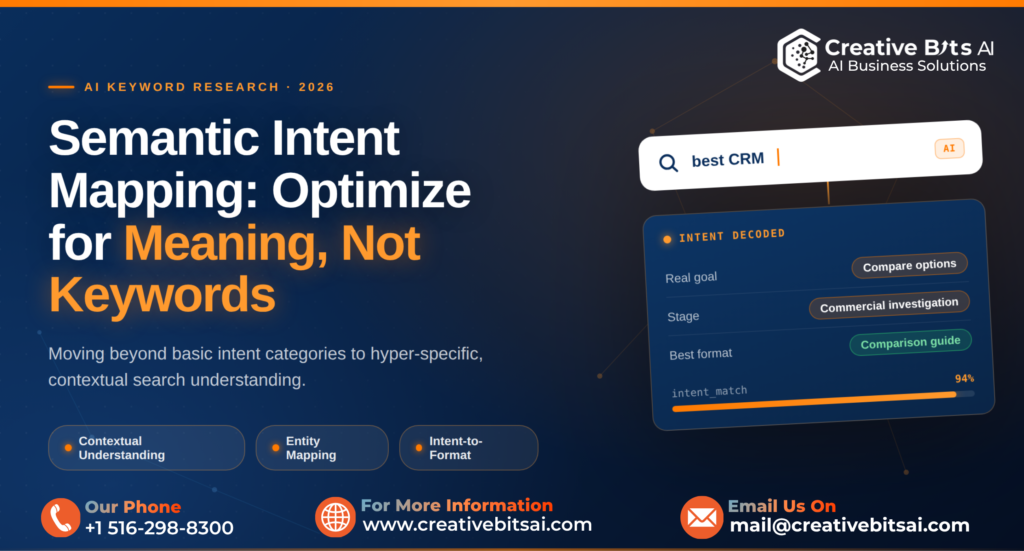
The reason is that modern search engines interpret meaning, not words. Instead of matching exact keywords, Google analyzes context, relationships, and user goals to predict what the searcher actually wants, which is why pages can rank without perfect keyword matches and why keyword-stuffed pages often fail. A single phrase like “best CRM” hides multiple possible intents, research, comparison, or purchase, and labeling it simply “commercial” tells you almost nothing about what to actually build.
Semantic intent mapping goes deeper. It moves from “what category is this query?” to “what specific outcome does this person expect, in this context, right now?” That precision is what separates content that ranks from content that merely exists.
The Three Layers of Semantic Intent Mapping
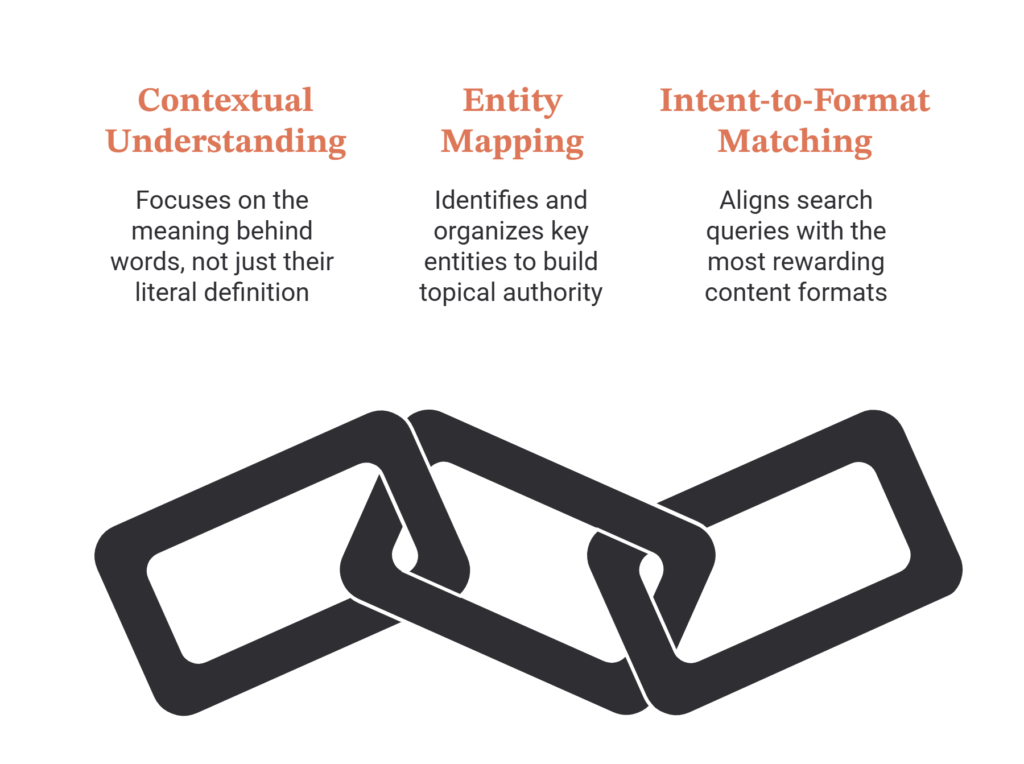
1. Contextual Understanding: Meaning Over Strings
The first layer is reading meaning from context rather than matching words. AI models recognize that two queries with no shared words can carry identical intent. AI understands that “best running shoes” and “top sneakers for jogging” target similar intent, even with no shared words, because it reasons about semantic relationships the way a human would.
This is why the old keyword-density playbook backfires. As search engines now optimize for the “thing,” not the “string,” the practical takeaway is to write naturally and completely about a concept, not to repeat a phrase. Clear, comprehensive writing about the actual topic outperforms keyword-engineered text every time.
2. Entity Mapping: Building Topical Authority
The second layer connects your content to the network of concepts and entities around your topic. Search engines no longer evaluate a page in isolation; they evaluate how its concepts relate to everything else they understand about the subject.
This is where depth wins. AI-driven content scoring tools now weigh topical depth and entity coverage more heavily than raw keyword density. In practice, writing about “SEO tools” means naturally covering the connected entities, keyword research software, rank tracking, and SERP analysis, because their presence signals to the search engine that your content is a genuine authority, not a thin keyword match. This is the same entity-and-authority logic we explored in AI Citations and E-E-A-T.
3. Intent-to-Format Matching: Giving Search What It Rewards
The third layer is the one most teams miss, and it’s where rankings are won or lost. Even perfectly written content fails if its format doesn’t match what the searcher wants. Most content that fails to rank fails on intent mismatch: the keyword is right, the content is well-written, but the page format is wrong for what Google is rewarding on that SERP.
If a query wants a comparison table and you publish a long essay, you lose, regardless of how good the essay is. Semantic intent mapping means checking the live search results for each target query and matching your content type to what’s actually ranking: a guide, a comparison, a product page, a calculator, or a direct answer. Format is no longer cosmetic. It’s an intent signal.
How AI Makes This Practical at Scale
None of this is new in principle; good SEOs always studied intent. What’s new is that AI makes deep intent mapping possible at a scale humans never could. The old way meant manually checking the search results for each keyword, one at a time. Now, an AI model can process 1,000 keywords against their live SERPs and tag every one in about 15 minutes, classifying which need a blog post, which need a service page, which need a comparison, and which to skip entirely.
That speed changes the economics of content strategy. Instead of guessing intent for a handful of keywords, teams can map intent across thousands, then build a content architecture where every page is matched precisely to a real searcher goal. The result is fewer wasted pages and more content that ranks because it was built for meaning from the start.
What This Means for Your Business in 2026
Semantic intent mapping reframes the central question of content strategy. It’s no longer “how many people search this term?” It’s “what does this person actually want, and is my content the right shape to give it to them?”
For mid-market enterprises, this is a decisive advantage. While competitors still chase keyword volume and stuff phrases into thin pages, the businesses that map intent semantically build content that satisfies meaning, earns topical authority, and stays visible across both traditional search and AI-generated answers. That alignment is what compounds into durable rankings.
The Takeaway
Keyword research used to ask, “What words did they type?” Semantic intent mapping asks, “What did they actually mean, and what will truly satisfy them?”
The shift from strings to meaning isn’t optional anymore; it’s how modern search works. Map intent at the level of context, entities, and format, and you stop competing for keywords and start owning the meaning behind them. In a search landscape increasingly run by AI, that understanding is the most durable advantage there is.
Are you ready to build content that ranks for meaning, not just keywords? At Creative Bits AI, we help mid-market enterprises apply semantic intent mapping to their content strategy, turning AI-powered intent analysis into content architectures that win across search and AI-generated answers alike.