AI citations are the new front page of the internet. When someone asks ChatGPT, Perplexity, or Google’s AI Overviews a question, they no longer scroll through ten blue links. They get one synthesized answer, built from a handful of sources that the model decided to trust. The entire game has shifted from “do I rank?” to “am I one of the few sources the AI repeats?“
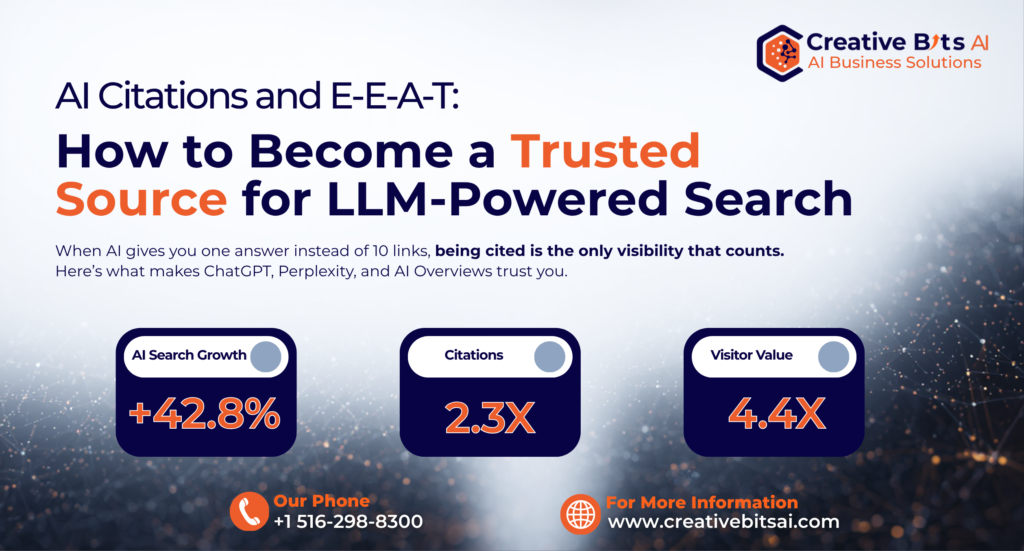
And the stakes are climbing fast. AI search visits grew 42.8% year over year, from 15.6 billion in Q1 2025 to 27.4 billion in Q1 2026, and AI search visitors are 4.4 times as valuable as the average traditional organic visitor. Fewer sources get cited, but each citation reaches a higher-intent audience. That is the new math of visibility.
So how does a model decide whom to trust? The answer comes down to two things working together: E-E-A-T signals and machine-readable structure. Here is how to earn both.
Why AI Citations Don’t Work Like Traditional Rankings
The instinct is to assume that ranking well on Google means getting cited by AI. The data says otherwise. Only 12% of AI-cited URLs appear in Google’s top 10 organic results for the same query, and the pages most frequently cited by LLMs actually have fewer backlinks than less-cited pages. The disconnect is structural, and it is widening.
That is because LLMs do not retrieve sources the way search engines do. They use retrieval pipelines that evaluate content on semantic relevance, information gain, and entity coherence, not the backlink-and-domain-authority logic that has governed SEO for two decades. A page can be invisible on Google and still get cited constantly inside ChatGPT if it is built the way models prefer.
There is also a trust problem that the models are actively trying to solve. Research published in Nature Communications found that between 50% and 90% of LLM-generated citations do not fully support their claims. Because models know they are imperfect citers, they lean hard toward sources that carry verifiable trust signals. That is exactly where E-E-A-T comes in.
The E-E-A-T Half: Authority Signals AI Models Look For
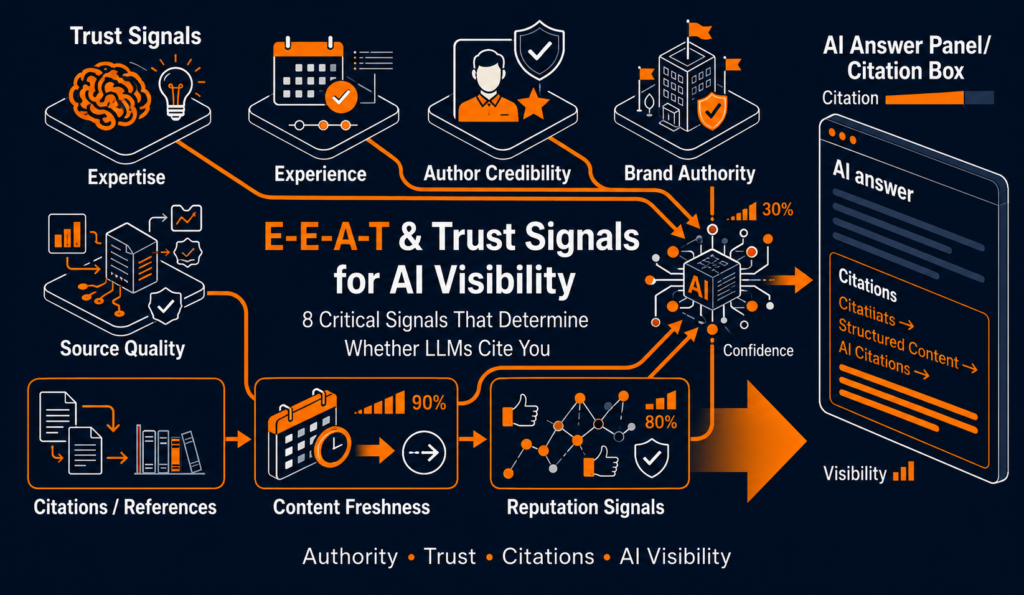
E-E-A-T stands for Experience, Expertise, Authoritativeness, and Trustworthiness. It began as a Google quality concept, but it maps almost perfectly onto what LLMs reward. The E-E-A-T principles Google rewards line up almost perfectly with what LLMs look for when choosing content to cite. Three signals matter most.
Named, credentialed authors. Anonymous content gives a model nothing to corroborate. Large language models reward content tied to verifiable human credentials because named authors, detailed bios, and credible publishers provide the corroboration that models look for before repeating a claim. Put real experts, with real bios, on your content.
Brand authority and multi-platform presence. This is the single strongest predictor in the current research. A 2026 analysis identified brand authority as the strongest single predictor of citation frequency, followed by multi-platform presence across four or more channels. A brand mentioned consistently across many contexts builds a stronger entity, and stronger entities get cited more.
Original information gain. As AI floods the web with generic summaries, the defensive moat becomes content that contains something the model cannot generate itself: original data, first-hand experience, expert judgment. This is the “Experience” in E-E-A-T doing its heaviest lifting, and it is a theme we explored in our companion piece on the AI-Ready Content Audit.
The Structure Half: Making Your Authority Machine-Readable
Here is the trap that catches even credible brands. Even authoritative sources may not be cited if their content format is incompatible with RAG processing. Trust gets you considered. Structure gets you extracted. You need both.
The research on what gets pulled into answers is remarkably specific:
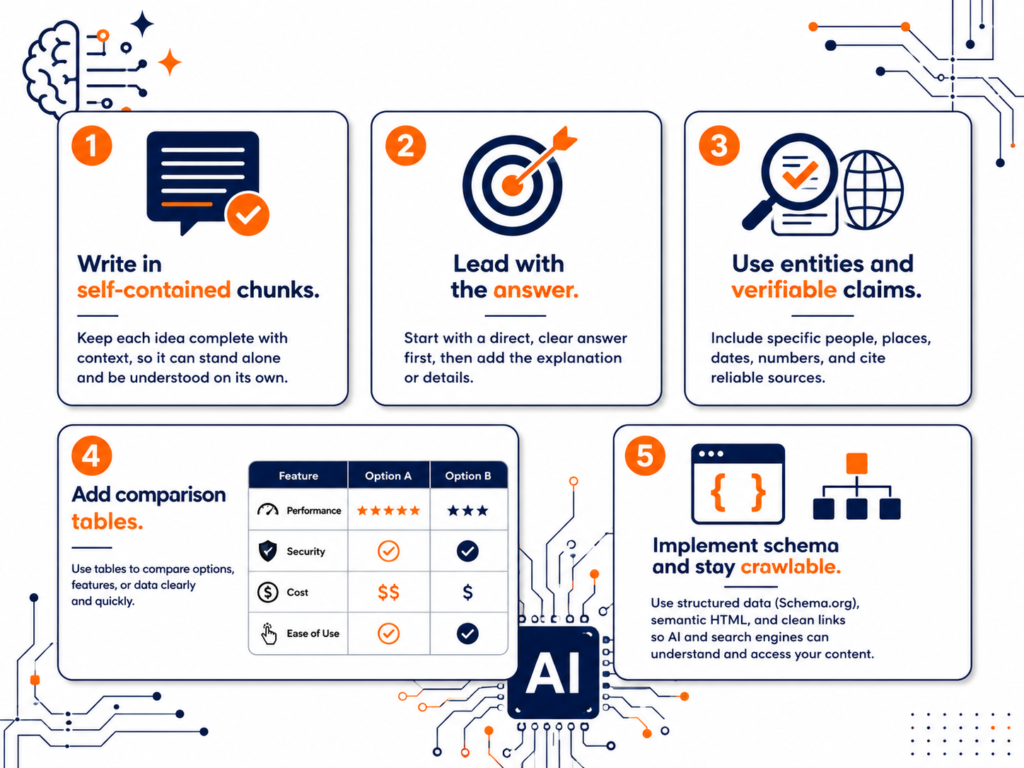
Write in self-contained chunks. Sources with clear, self-contained chunks of 50 to 150 words receive 2.3 times more citations than long-form unstructured content. Each section should answer one question completely, so a model can lift it without needing the rest of the page.
Lead with the answer. Put a direct answer in the first 50 words of each section, use question-based headings, and add a TL;DR under your H1. Models lift answers cleanly when your page is already shaped like an answer.
Use entities and verifiable claims. Content with 15 or more connected entities shows 4.8 times higher selection probability, and LLMs use named entities and statistics as confidence signals. “Turnover costs U.S. businesses $1 trillion annually, according to Gallup,” is far more citable than “turnover is expensive.”
Add comparison tables. Structured comparisons are citation magnets, associated with a 32.5% lift in citations, because they package information in a format that models can extract easily.
Implement schema and stay crawlable. Schema markup, an llms.txt file, and FAQ blocks all help. And remember that AI crawlers like GPTBot, ClaudeBot, and PerplexityBot don’t execute JavaScript, so client-side-rendered content can be invisible no matter how authoritative it is.
Bringing the Two Halves Together
The brands winning AI citations in 2026 treat trust and structure as one system, not two tasks. The biggest misconception in 2026 is thinking “AI content” is the strategy. AI is the production method. Authority is the strategy.
In practice, that means: publish genuinely expert content under named authors, back every claim with sourced data and entities, structure it into clean extractable chunks, mark it up so machines understand it, and build your brand’s presence across multiple platforms so the model encounters your entity again and again. Each element reinforces the others. Authority without structure stays invisible. Structure without authority gets filtered out.
What This Means for Your Business in 2026
The shift is fundamental. In traditional search, authority improved where you ranked. In AI search, E-E-A-T and trust signals determine whether your brand becomes part of the answer at all. There is no page two in an AI answer. You are either in it or you are absent from the conversation entirely.
That makes becoming a trusted, citable source one of the highest-leverage investments a business can make right now, while most competitors are still optimizing for a search paradigm that is quietly shrinking.
The Takeaway
Traditional SEO earned you a ranking. AI citations earn you a mention inside the answer itself, and that requires a different kind of credibility.
Be the source a model can trust: named experts, original data, and a recognizable brand. Then, be the source a model can use: clean chunks, direct answers, entities, tables, and schema. Do both consistently, and you become what every AI engine is hunting for: a source worth repeating.
The conversation layer is being built right now. The brands that earn citations today will be the default answers tomorrow.
At Creative Bits AI, we help mid-market enterprises build AI citation readiness, combining the authority signals, structured data, and content architecture that get you surfaced across ChatGPT, Perplexity, and Google AI Overviews.
👉 Book a strategy session with our team to map your AI visibility (Click here)