AI sustainability assessment is collapsing a process that traditionally takes weeks into something that happens in minutes: point a camera at a room, a shelf, an appliance, or an entire property, and receive a detailed evaluation of its energy efficiency, environmental impact, and sustainability profile, complete with recommendations for improvement. For homeowners, property managers, retailers, and ESG teams who have long relied on slow, expensive, expert-led audits, AI image analysis isn’t just an incremental upgrade. It’s a 10x acceleration of the entire sustainability evaluation workflow, and it’s changing who can afford to measure — and improve — their environmental footprint.
In this article, we’ll break down why traditional sustainability audits are so slow, how AI image analysis works, where the 10x speedup comes from, and how organizations are already putting it to work.
Why Traditional Sustainability Audits Are So Slow
A conventional sustainability or energy audit is as much a logistics exercise as an analytical one. A certified auditor schedules a site visit, walks the property room by room, manually catalogs appliances, lighting, insulation, materials, and products, cross-references each item against efficiency databases, and then compiles a report — often weeks later.
The bottlenecks are structural. Expert auditors are scarce and expensive, so appointments are booked out. Manual cataloging is tedious: identifying every product, model, and material by hand takes hours per site. And the analysis itself requires looking up each item’s energy profile, recyclability, and environmental characteristics individually.
The result is that comprehensive sustainability assessment has been effectively rationed. Large enterprises with ESG budgets can afford it; households, small businesses, and mid-size property portfolios largely go unmeasured. The U.S. Department of Energy via ISA Insulation estimates that home energy assessments can cut energy bills by 5–30%, yet the majority of homes have never had one; the audit itself costs too much time and money relative to the perceived benefit.
That’s the exact gap AI sustainability assessment closes.
How AI Sustainability Assessment Works
At its core, an AI sustainability assessment system combines computer vision with large language models (LLMs). The workflow is remarkably simple from the user’s side: capture images of an environment — kitchen shelves, closets, bathrooms, utility rooms, product displays — and upload them.
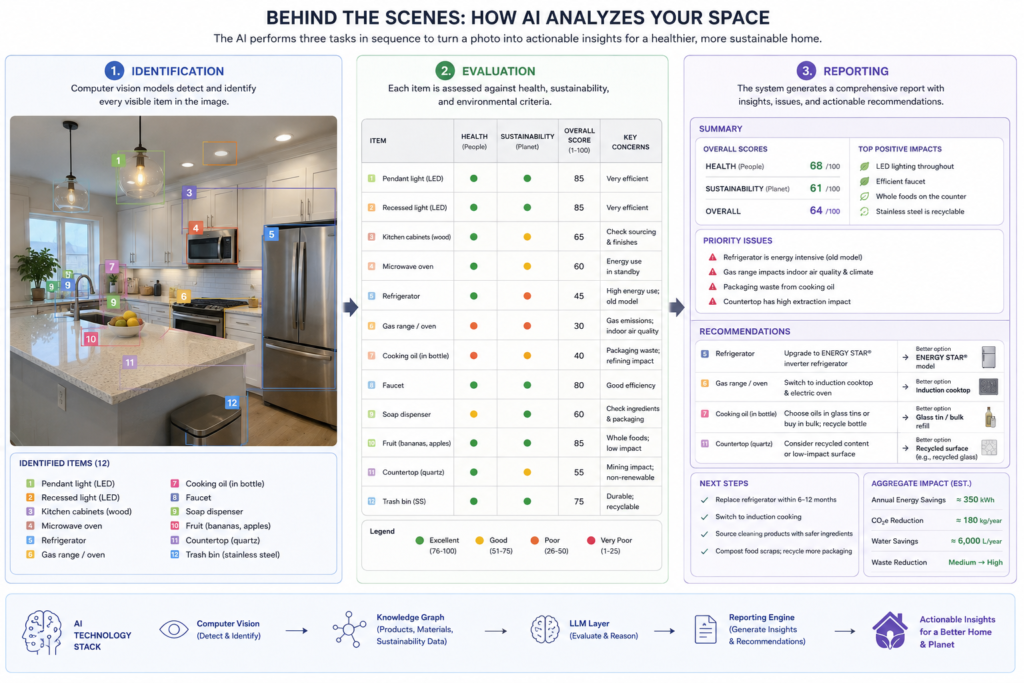
Behind the scenes, the AI performs three tasks in sequence:
1. Identification. Computer vision models detect and identify every visible item in the image: appliances, products, packaging, lighting fixtures, materials, and more. Modern vision-language models can recognize thousands of product categories, brands, and materials from a single photo.
2. Evaluation. Each identified item is then assessed against health, sustainability, and environmental criteria: energy consumption profiles, recyclability of packaging, material composition, water usage, chemical content, and expected lifecycle impact. The LLM layer draws on broad knowledge of products and materials to score items consistently.
3. Reporting. The system generates a comprehensive report — item by item and in aggregate — highlighting what’s performing well, what’s problematic, and, crucially, what to do about it: specific recommendations for more sustainable alternatives, efficiency upgrades, and healthier swaps.
This is precisely the approach behind our Sustainability Evaluation solution, which analyzes images of household environments and products to evaluate their health, sustainability, and environmental impact, and automatically generates actionable improvement reports. It builds on the same computer vision technology we deploy for inspection and analysis across industries.
Where the 10x Speedup Comes From
The acceleration isn’t one big saving; it’s the compound effect of removing every bottleneck at once:
No scheduling delay. There’s no auditor to book. Anyone with a smartphone can capture the images the moment they decide to assess. The days-to-weeks wait for an appointment simply disappears.
Instant cataloging. What takes a human auditor hours — walking a site and logging every item — happens in seconds per image. The AI identifies dozens of items per photo simultaneously, with no fatigue and no skipped shelves.
Parallel evaluation. Instead of looking up each product’s efficiency data sequentially, the AI evaluates every identified item at once, applying consistent criteria across the entire inventory.
Automated reporting. The report that an auditor assembles over days — findings, scores, and recommendations — is generated in minutes, formatted and ready to act on.
Add it up: a process that took two to four weeks end-to-end compresses into roughly a day, and often less, a conservative 10x improvement. And because the marginal cost of an AI assessment is a fraction of an expert site visit, organizations can assess more locations more often, turning sustainability from an annual snapshot into continuous monitoring. McKinsey’s sustainability research consistently finds that measurement frequency is a leading predictor of actual emissions and efficiency improvements; you improve what you monitor.
Who’s Using AI Sustainability Assessment and How
Homeowners and renters. Snap photos of the kitchen, laundry room, and storage areas and get an instant readout of energy-hungry appliances, non-recyclable products, and healthier alternatives, a personal sustainability advisor without the consulting fee.
Property managers and real estate. Portfolio-wide assessments that once required an auditor at every building can be crowdsourced through site staff photos, with AI generating comparable scores across every property. That consistency matters for green certifications and for prioritizing retrofit budgets where they’ll have the most impact, in line with frameworks from the World Green Building Council.
Retailers and e-commerce. Product ranges can be evaluated for sustainability claims and shelf-level environmental impact, feeding accurate eco-information into product detail pages and marketing, increasingly important as regulators scrutinize green claims.
ESG and compliance teams. As sustainability reporting requirements expand globally, AI-generated assessments create auditable, consistent documentation at a scale manual processes can’t match, the same way our AI research tools accelerate due diligence workflows.
Getting Started: What Makes an Implementation Succeed
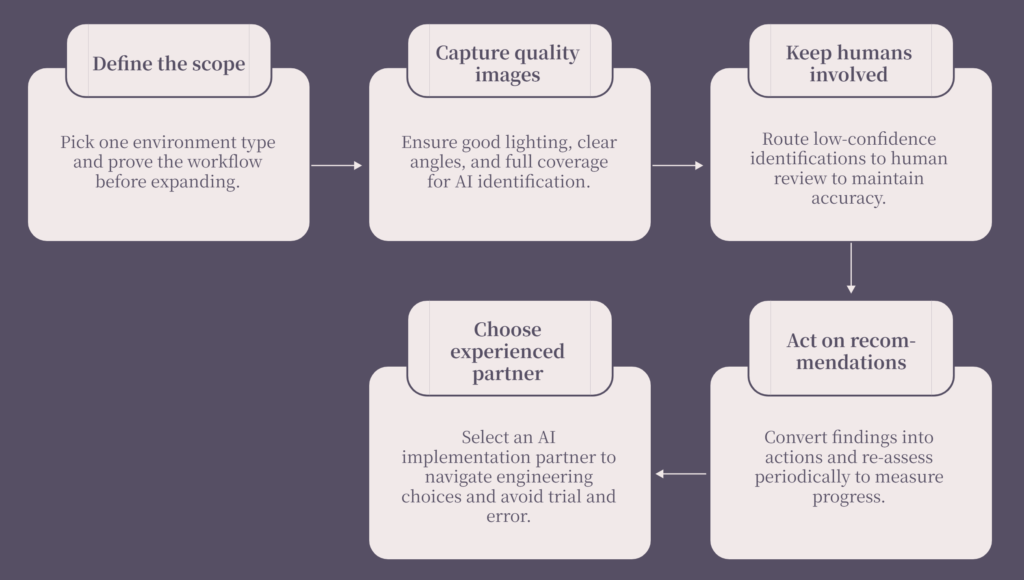
Start with a defined scope. Pick one environment type — kitchens, product shelves, utility areas — and prove the workflow before expanding. A focused pilot surfaces the practical lessons quickly.
Capture quality images. As with any vision system, image quality drives accuracy. Good lighting, clear angles, and full coverage of the space determine how much the AI can identify and evaluate.
Keep humans in the loop. The strongest deployments route low-confidence identifications to human review. This maintains accuracy from day one and continuously improves the system, the same human-in-the-loop pattern that makes our defect analysis deployments reliable.
Act on the recommendations. The report is the beginning, not the end. Build a simple process for converting recommendations into actions — swaps, upgrades, purchasing changes — and re-assess periodically to measure progress. Guidance from the EPA’s sustainability resources pairs well with AI-generated findings for organizations formalizing their programs.
Choose an experienced partner. Vision-plus-LLM systems involve real engineering choices: model selection, prompt design, scoring consistency, report structure. An AI implementation partner who has built these pipelines saves months of trial and error.
The Bottom Line
Sustainability improvement has always had a measurement problem: the audits that tell you where you stand were too slow and expensive to do often, or at all. AI sustainability assessment removes that barrier. By turning ordinary photos into comprehensive health, sustainability, and environmental evaluations with actionable recommendations, AI image analysis makes the audit 10x faster, dramatically cheaper, and available to everyone from a single household to a thousand-property portfolio.
The organizations that win on sustainability in the coming years won’t necessarily be the ones with the biggest ESG budgets. They’ll be the ones who measure continuously, act on what they find, and repeat because their assessment process finally moves at the speed of a photograph.
At Creative Bits AI, we build AI-powered sustainability evaluation systems that analyze images of homes, facilities, and products to deliver instant health, sustainability, and environmental insights, with clear recommendations for improvement. Request a free demo and see what an AI sustainability assessment reveals about your environment in minutes, not weeks.