Predictive SEO is the difference between writing about a trend and owning it. By the time a keyword shows real search volume, the opportunity is already crowded, every competitor sees the same number, and you are fighting for scraps of attention on a topic that peaked while you were still drafting. The brands winning search in 2026 aren’t reacting faster. They are forecasting earlier.
That shift, from reactive to predictive, is the single biggest change in how content strategy works now. Instead of chasing what’s popular today, predictive SEO uses AI to identify what your audience will search for next month, next quarter, or next year, while the keyword still has near-zero volume. As one practitioner put it, zero-volume keywords are the hidden gold mines of SEO in 2026, because writing early lets you capture rankings long before competitors notice the opportunity.
Here’s how predictive SEO works, and how to build it into your content engine.
Why Reactive SEO No Longer Wins
Traditional keyword research has a fatal flaw: it only shows you the past. Search volume is a record of demand that already exists, which means by the time you act on it, you are late by definition.
And the timing pressure is intensifying. Ranking shifts are already happening faster, and search engines now consider more than backlinks and on-page keywords; they look at how your brand connects to topics, how often you’re cited, and how consistent your messaging is across platforms. Visibility can change even when you haven’t touched a page. In that environment, waiting for a traffic drop to signal a problem is waiting too long.
Predictive SEO flips the model. Instead of measuring demand that exists, it forecasts demand that is forming, giving you a head start measured in months.
The Three Pillars of Predictive SEO
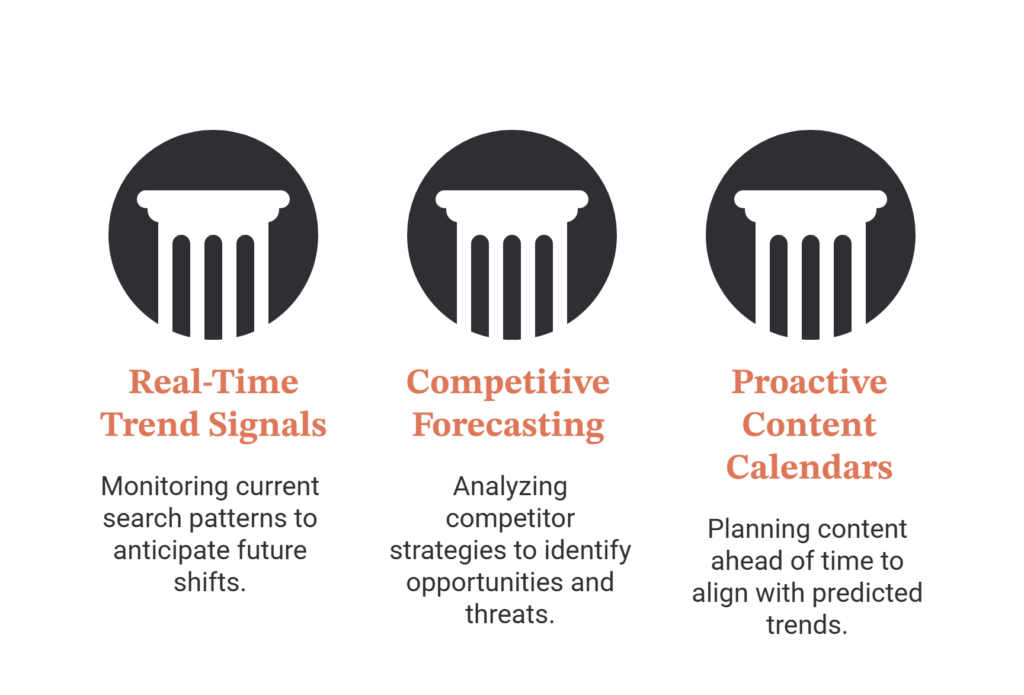
1. Real-Time Trend Signals
The foundation of predictive SEO is catching demand as it forms, not after it arrives. This means watching early indicators that move before search volume does: question patterns in AI tools, rising discussions in forums and communities, and velocity (how fast interest is accelerating) rather than just volume.
The signal sources have expanded well beyond Google. AI models like SGE and Perplexity, plus voice intent data from Siri, Alexa, and Google Assistant, now play a major role in shaping search behavior. Tools like Google Trends, Glimpse, and Exploding Topics surface rising interest early, and “breakout” trends signal momentum long before a keyword matures. A question like “How do brands appear in AI Overviews?” gaining traction today is a content opportunity forming for tomorrow.
2. Competitive Forecasting
Predictive SEO isn’t only about topics; it’s about timing relative to your competitors. The goal is to spot where rivals are gaining traction in adjacent topics before that movement shows up in rankings you can see.
AI makes this possible at scale. By analyzing large volumes of search behavior, content performance, and ecosystem signals, AI lets marketers spot rising topics, intent shifts, and competitive movements earlier than traditional reporting methods. The teams that monitor these early indicators, declining mentions, competitors entering new topic clusters, can move into a space while it’s still open rather than arriving after it’s saturated. This is the same authority-building logic we explored in our piece on AI citations and E-E-A-T: consistent, early presence in a topic compounds into trust.
3. Proactive Content Calendars
Forecasting is only valuable if it changes what you publish and when. The third pillar turns trend signals into a content calendar built around future demand instead of past performance.
In practice, this means writing with future search behavior in mind, anticipating what users will want to know next quarter or around seasonal moments, and building topic clusters that address both evergreen and emerging queries. The most effective approach pairs timing with focus. By 2026, publishing broadly without a clear niche is less effective; focused authority that repeatedly demonstrates expertise in a defined area carries more weight than sheer volume. Predictive calendars let you plant content early in the specific clusters where you want to own the conversation.
A Realistic Word on Forecasting
Predictive SEO is powerful, but it is not a crystal ball. The smartest teams treat forecasts as scenarios, not certainties. Because AI-driven search and zero-click results reduce predictable click patterns, forecasts should include conservative and aggressive scenarios rather than a single optimistic number. Not every emerging trend will peak, and some will fizzle. The win isn’t predicting perfectly, it’s being early and consistent across enough well-chosen bets that the ones that land deliver outsized returns.
What This Means for Your Business in 2026
Predictive SEO is especially valuable in fast-moving industries, such as finance, SaaS, healthcare, education, and digital marketing, where customer questions change quickly and demand spikes are often predictable. In these spaces, the gap between forecasting a trend and reacting to it can be the difference between owning a topic and being invisible on it.
The broader shift is from volume to velocity, and from reaction to anticipation. The brands that build forecasting into their content engine stop competing for keywords everyone already sees and start owning the ones that haven’t peaked yet.
The Takeaway
Reactive SEO asks, “What’s ranking now?” Predictive SEO asks, “What will people search for next, and how do I get there first?”
The tools for demand forecasting, real-time trend signals, AI-driven competitive analysis, and proactive content calendars are available right now. The brands that use them aren’t guessing. They’re publishing into demand before it arrives, and collecting the rankings while everyone else is still reading last month’s report.
The future of search belongs to those who see it coming.
At Creative Bits AI, we help mid-market enterprises build predictive, AI-driven content engines, turning real-time trend signals into proactive strategies that win search before the competition even sees it forming.
Are you ready to forecast demand before your competitors do?
👉 Book a strategy session with our team to map your predictive SEO roadmap.