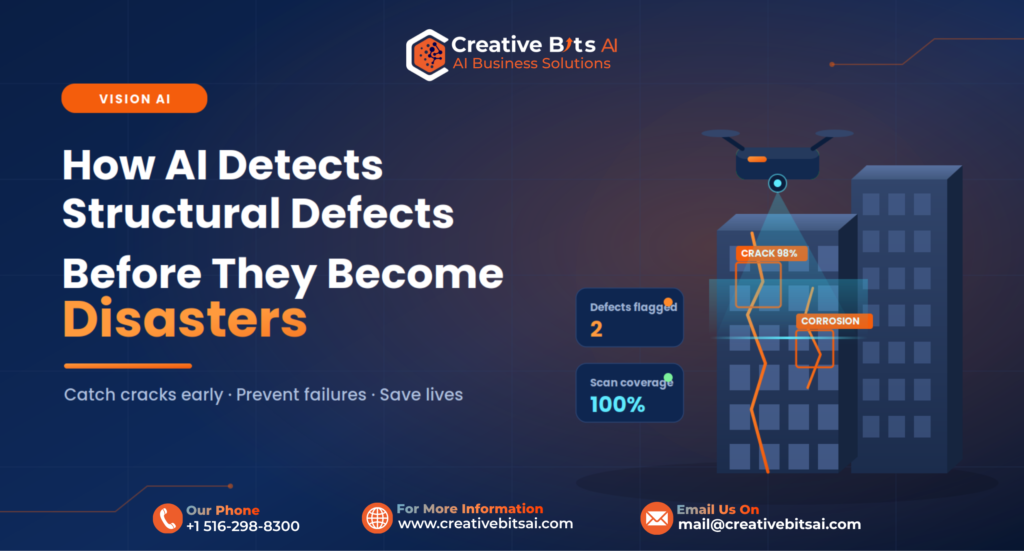
AI structural defect detection is changing a grim equation that has haunted the built environment for generations: by the time a crack, corrosion spot, or structural weakness is visible enough for a human inspector to flag it, the damage is often advanced, expensive, and sometimes catastrophic. Every collapsed bridge, failed balcony, or crumbling façade shares a common thread; the warning signs were there long before the failure, but nobody caught them in time. AI is closing that gap, spotting the earliest indicators of structural distress from images and sensor data with a speed and consistency no human team can match, and turning reactive emergency repairs into proactive, planned maintenance.
In this article, we’ll look at how AI structural defect detection actually works, why it outperforms traditional inspection, where it’s already being used, and how to bring it into your own maintenance program.
The Hidden Cost of Waiting for Defects to Show
Traditional structural inspection is periodic, manual, and dangerously incomplete. An inspector visits a site every few months or years, visually examines what they can reach, and records what they notice. The gaps in that process are enormous.
Human inspectors can only see what’s accessible. High façades, bridge undersides, roof structures, and confined spaces require scaffolding, rope access, or lane closures, which make inspections slow and expensive, so they occur rarely. Between inspections, defects progress silently.
Manual inspection is also inconsistent. Two inspectors examining the same structure often disagree on defect severity, and the same inspector’s judgment drifts with fatigue and experience. Subtle early-stage cracking, hairline corrosion, or minor displacement is exactly the kind of signal humans miss, and cameras catch.
The consequences aren’t abstract. Infrastructure failures cause loss of life, and the American Society of Civil Engineers has repeatedly given U.S. infrastructure poor grades, citing a massive backlog of structures in need of repair. When maintenance is reactive rather than preventive, small problems become structural emergencies, and emergency repairs cost many times what early intervention would have.
How AI Structural Defect Detection Works
At its core, AI structural defect detection pairs computer vision with deep learning models trained on thousands of examples of structural defects. The system ingests images — from handheld cameras, drones, fixed cameras, or robotic crawlers — and analyzes every pixel to identify and classify signs of distress.
Modern systems detect a broad range of issues: cracks in concrete and masonry, spalling and delamination, corrosion and rust staining, water intrusion and efflorescence, gaps indicating structural movement, missing or damaged fasteners, and surface degradation. Because the models learn from labeled examples rather than rigid rules, they recognize defects across varied lighting, materials, angles, and conditions.
Crucially, the AI doesn’t just flag a defect; it characterizes it. For each identified issue, the system provides a description, an estimated severity, and its location, giving inspectors and property managers the context they need to prioritize. This is precisely the approach behind our AI-Powered Defect Analysis solution, which uses large language models and computer vision to identify and categorize structural defects in images automatically.
The result is a shift from “inspect occasionally and hope” to “monitor continuously and act early.” When paired with drones or fixed cameras, AI structural defect detection can assess an entire structure in a fraction of the time a manual crew would need — and it never overlooks a section because it was hard to reach or late in the day.
Why AI Outperforms Traditional Inspection
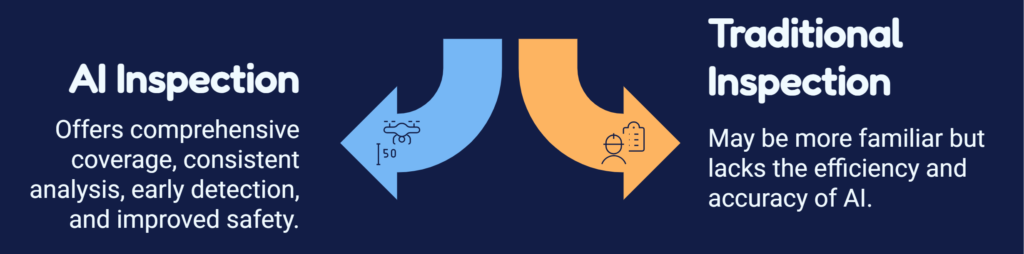
The advantages compound across four dimensions:
Coverage. A drone equipped with a camera can photograph an entire bridge span, high-rise façade, or industrial structure in hours, capturing every square meter. AI then analyzes 100% of that imagery, not a representative sample. Nothing is skipped because it was inaccessible.
Consistency. The AI applies identical criteria to every image, every time. It doesn’t get tired, distracted, or complacent on the hundredth inspection. This removes the subjective variability that plagues manual assessment.
Early detection. Deep learning models can identify sub-millimeter cracking and subtle discoloration that precede visible failure by months or years. Catching a defect at this stage is the entire point; it’s the difference between a scheduled patch and an emergency closure.
Speed and safety. Automated analysis returns results in minutes, not weeks. And because drones and cameras handle data collection, inspectors spend far less time in dangerous positions on scaffolding, ropes, or active roadways. Research published by the National Institute of Standards and Technology and academic groups on MDPI has repeatedly demonstrated that vision-based deep learning methods can match or exceed expert accuracy on crack detection tasks.
Where AI Structural Defect Detection Is Already Working
This isn’t a future promise; it’s deployed across sectors today:
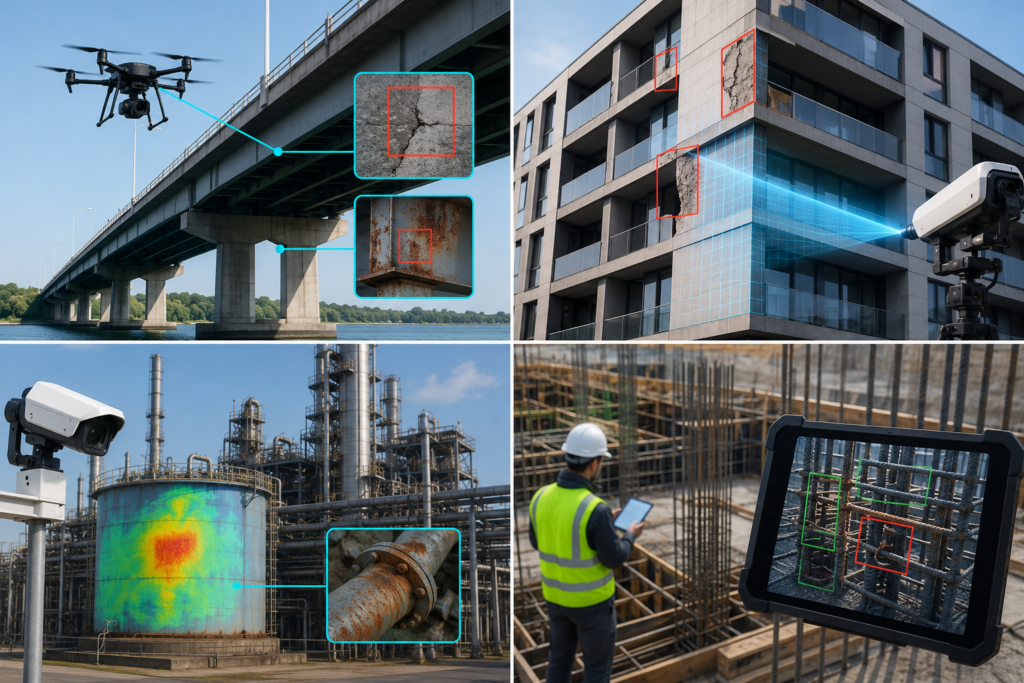
Bridges and highways. Transportation agencies use drone imagery and AI analysis to inspect bridge decks, girders, and supports without closing lanes, catching corrosion and cracking early.
Commercial and residential buildings. Property managers use AI to inspect façades, balconies, and parking structures — the exact elements behind many high-profile collapses — turning mandatory inspection cycles into continuous monitoring.
Industrial facilities. Plants and refineries deploy AI vision to monitor tanks, pipelines, and support structures for corrosion and fatigue, where a missed defect can mean a shutdown or a safety incident.
Construction quality assurance. During construction, AI verifies that structural elements meet specification before they’re covered up, catching defects while they’re still cheap to fix, a natural complement to the computer vision quality control methods used in manufacturing.
The common thread: environments where manual inspection is slow, dangerous, expensive, or simply too infrequent to catch problems in time. If a structural decision currently depends on someone climbing up to look, it’s a candidate for AI.
Building AI Defect Detection Into Your Maintenance Program
Adopting AI structural defect detection doesn’t mean replacing your engineers; it means giving them superhuman reach and consistency. Here’s how to get started effectively:
Start with your highest-risk assets. Identify the structures where a failure would be most costly or dangerous — aging bridges, high-traffic façades, critical industrial supports — and pilot there. Proving value on a high-stakes asset builds the case for wider rollout.
Get the imagery right. As with any vision system, image quality drives accuracy. Consistent lighting, resolution, and coverage — often best achieved with drones or fixed camera arrays — determine how much the AI can detect.
Keep engineers in the loop. The strongest deployments use AI to triage and prioritize, routing flagged defects to human experts for final judgment. This maintains accuracy and generates data that continuously improves the model, the same human-in-the-loop pattern we apply across our project management and procurement solutions.
Track defects over time. The real power emerges when you inspect repeatedly. Comparing scans over months reveals which cracks are growing and which are stable, transforming inspection into genuine structural health monitoring and true predictive maintenance.
Choose the right partner. The technology is only as good as its implementation. An experienced AI implementation partner helps you scope the right assets, integrate with existing workflows, and avoid the pilot-that-never-scales trap.
The Bottom Line
Structural failures are rarely sudden. They’re the visible end of a slow process that leaves warning signs for months or years, signs that periodic manual inspection is poorly equipped to catch. AI structural defect detection changes that by watching continuously, seeing what humans can’t reach, applying consistent judgment, and flagging the earliest indicators of distress while intervention is still cheap and safe.
For anyone responsible for bridges, buildings, or industrial infrastructure, the question is no longer whether AI belongs in the inspection process. It’s how quickly you can deploy it before the next small crack becomes the next big headline.
At Creative Bits AI, we build AI-powered defect analysis systems that identify and categorize structural issues from images, helping construction firms, property managers, and inspectors protect their assets and the people who use them. Request a free demo and learn how AI structural defect detection can strengthen your inspection program before problems become disasters.