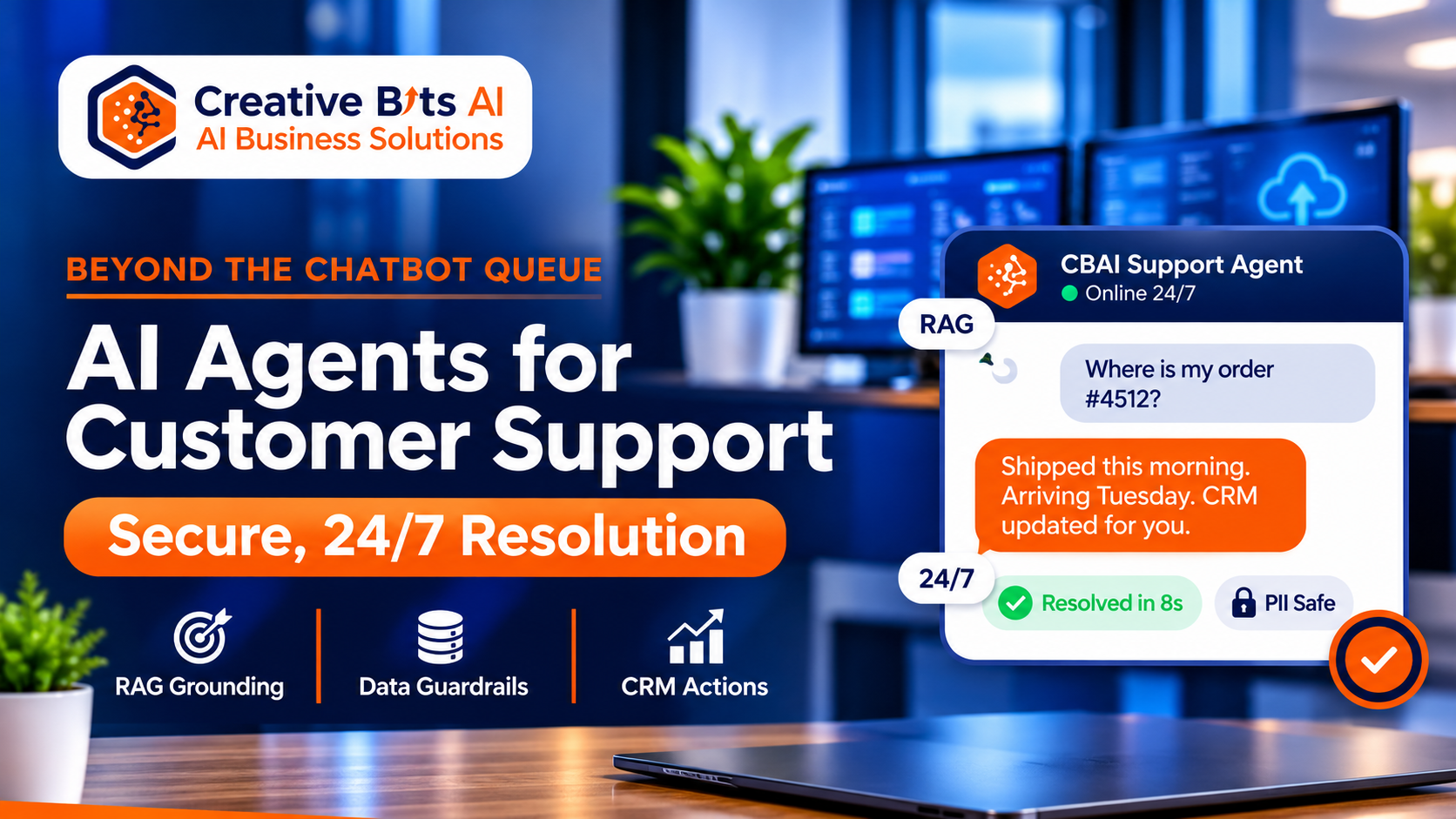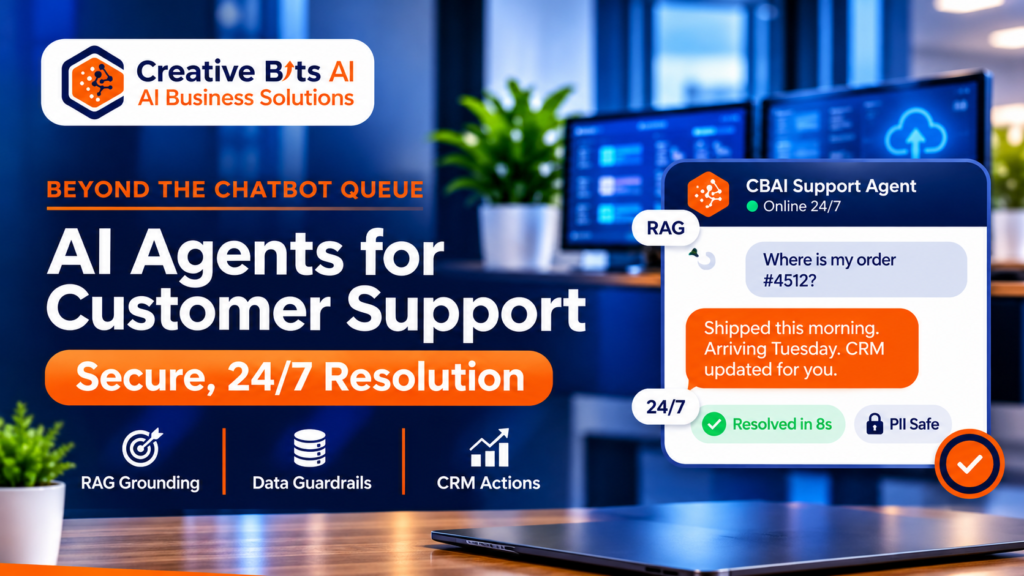
AI agents for customer support are goal-oriented systems that resolve inquiries from start to finish, authenticating accounts, checking inventory, adjusting billing, and escalating edge cases, instead of deflecting customers into a ticket queue. Grounded in your own knowledge base and wrapped in security guardrails, they answer in seconds, around the clock, without hallucinating or leaking data.
The pressure to get there is real. Gartner predicts that agentic AI will autonomously resolve 80% of common customer service issues without human intervention by 2029, cutting operational costs by roughly 30%. Yet most organizations are still running menu-based chatbot trees that frustrate customers, or raw LLM wrappers that invent answers.
The gap between those two states isn’t a bigger workforce. It’s smarter infrastructure: retrieval-grounded reasoning, enforceable guardrails, and deep integration with the CRM and work-management platforms where your customer data already lives. This guide breaks down how that architecture works and how to deploy it safely.
The Problem: What Fragmented Automation Actually Costs
Legacy chatbot trees and ungoverned LLMs fail for three distinct reasons, and each carries a measurable cost. Gartner’s own research found that only about 14% of self-service interactions fully resolve the customer’s issue today. The rest bounce back to expensive human channels.
1. The hallucination barrier. A general-purpose LLM has no real-time visibility into your pricing, policies, or product state. Without grounding, it generates convincing but wrong answers, and a confidently wrong refund policy is worse than no answer at all. It erodes trust, skews CSAT metrics, and can create legal exposure.
2. The integration void. A bot that can only talk cannot process a billing adjustment, verify inventory, or update an account status. Every transactional request becomes a handoff, which means the “automation” only added a step. The highest-volume support intents, such as order status, refunds, and plan changes, are transactional by nature.
3. Security and injection exposure. Customer-facing AI is an attack surface. Prompt injection, crafted input that manipulates a model into ignoring its instructions, has ranked #1 on the OWASP Top 10 for LLM applications for three consecutive years, precisely because agentic systems that call tools and act on a user’s behalf raise the stakes. Add PII leakage, credential exploitation, and token abuse, and an unguarded deployment becomes a compliance incident waiting to happen. Our guide to the AI risk register covers how enterprises formally track these exposures.
Pillar 1: RAG Grounding for Accuracy You Can Audit
Retrieval-Augmented Generation (RAG) is what separates a reliable AI agent from a plausible-sounding one. Instead of answering from general training data, the agent runs a semantic search across a curated, access-controlled knowledge base (product documentation, service wikis, policy pages, resolved-ticket archives) and composes its answer only from the passages it retrieved.
The practical effects:
- Verifiable answers. Every response is anchored to a source document, so agents can cite where an answer came from, and reviewers can audit it.
- Instant knowledge updates. Change the policy document and the agent’s answers change with it, with no retraining cycle.
- Scoped knowledge. The agent answers from what you approved, not from the open internet, which sharply reduces hallucination rates on support content.
RAG is not magic, though: retrieval quality depends on how your documentation is chunked, indexed, and maintained. B2B SaaS teams in particular are sitting on the raw material already. We walk through that transformation and how to turn product documentation into a support copilot. And before committing budget, the fastest way to validate accuracy on your own corpus is a tightly scoped test. Here’s how to plan a 14-day RAG pilot.
Pillar 2: Security Guardrails for PII Redaction and Injection Defense
A customer-facing agent needs enforcement layers that operate independently of the model itself. Enterprise-grade deployments typically stack four controls:
- PII redaction before processing. Automated screening strips names, emails, card numbers, and government IDs from inputs before any external API call, keeping sensitive data out of model context and vendor logs.
- Prompt-injection monitoring. Because injection cannot be “fixed” the way SQL injection was, OWASP recommends treating it as an ongoing operational risk: validate inputs, treat retrieved content as untrusted, and continuously monitor outputs for instruction-override patterns.
- Least-privilege tool access. The agent gets tightly scoped permissions: it can issue a refund up to a defined limit, not touch the payments API wholesale. Every action is logged and attributable.
- Topic and policy boundaries. Guardrails keep the agent inside company-defined scope, refusing out-of-bounds requests instead of improvising.
This is the architecture we detail in safeguarded RAG chatbots: useful answers without losing control, the pattern that lets CISOs say yes to customer-facing AI.
Pillar 3: Transactional Autonomy Through CRM and Work OS Integration
An AI agent delivers its highest value when it can act, not just answer. Secure internal API hooks create a bidirectional link between the customer conversation and your systems of record:
- CRMs and helpdesks (Salesforce, HubSpot, Zendesk). The agent authenticates the user, reads their service tier, and cross-references active contracts before composing a response, so a Platinum customer and a trial user get correctly differentiated handling, automatically.
- Work-management platforms (monday.com and similar Work OS tools). Integrating agents into the platform where back-office teams already work means support workflows synchronize with operations in real time. Agents can triage and classify incoming tickets, update customer pipelines, log every action to the record, and route genuine edge cases to the right specialist squad with full context attached.
- Inventory, billing, and order systems. Transactional intents such as “where’s my order,” “change my plan,” “apply this credit” resolve inside the conversation instead of spawning tickets.
The design principle throughout: the agent acts through governed APIs with scoped credentials, and every write is logged. That’s what turns automation from a deflection layer into genuine resolution, the model behind our AI-enhanced customer support solution.
Technical Blueprint: Custom Build vs. No-Code Workspace
Deployment generally follows one of two architectural paths, and the right one depends on your data-isolation requirements, engineering capacity, and timeline.
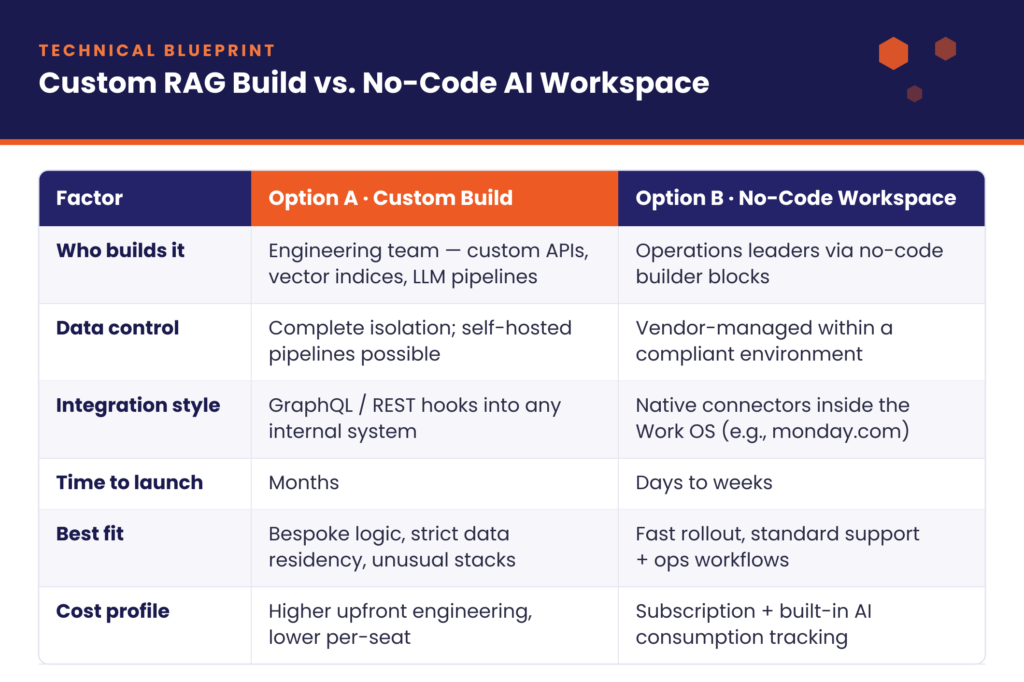
Option A, custom architecture, suits teams that need bespoke orchestration: custom servers receiving support webhooks, locally controlled LLM pipelines, purpose-built vector search, and structured writes back to enterprise databases.
Option B, unified workspace customization, lets non-technical leaders configure goal-driven agents, map data permissions, track AI consumption costs, and launch inside a single governed environment.
This is ultimately a build-vs-buy decision with familiar trade-offs, and our CEO’s guide to build vs. buy for enterprise AI gives the full decision framework.
Business Impact: Manual Support vs. Integrated AI Agents
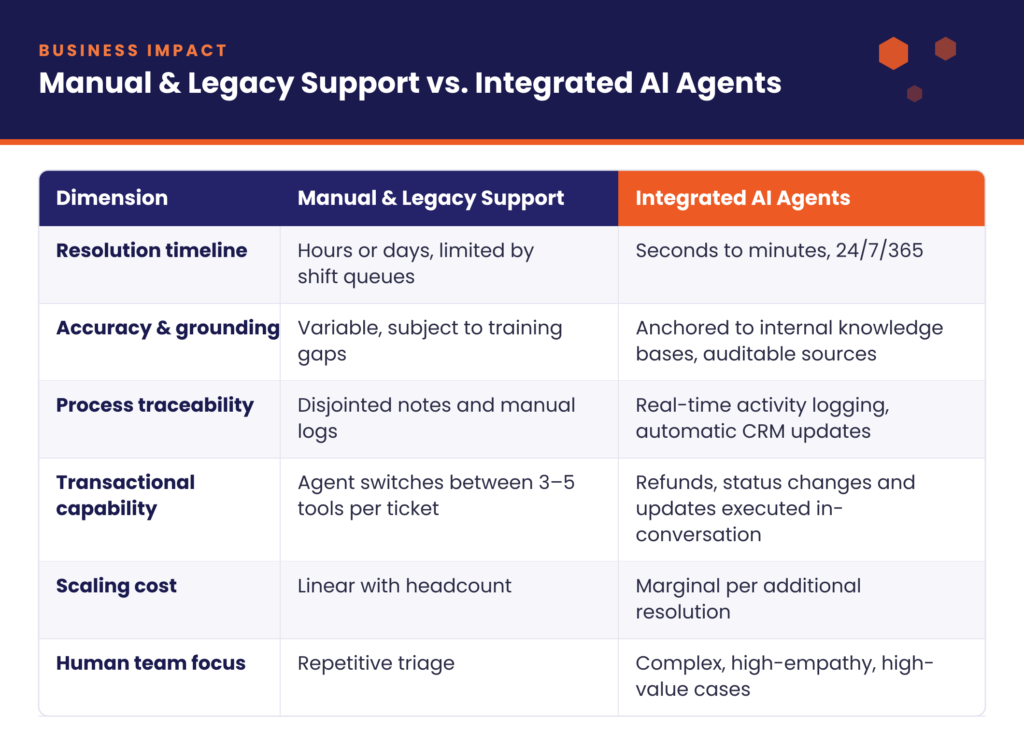
Adoption data backs the shift: Salesforce’s 2026 State of Service research found AI agent adoption in service organizations jumped from 39% to 66% in a single year, and 91% of service leaders report executive pressure to implement AI (verified statistics roundup). The organizations seeing returns are the ones pairing adoption with the grounding and guardrails above, not the ones bolting a chatbot onto a queue.
Implementation Roadmap: 6 Steps to a Safe Launch
- Pick one high-volume, low-risk intent. Order status or password resets, not disputed chargebacks. Prove resolution rate before breadth.
- Curate the knowledge base first. RAG output quality is capped by document quality. Deduplicate, date-stamp, and assign owners before indexing.
- Run a scoped pilot with a baseline. Two weeks, real queries, measured against your current first-contact-resolution and CSAT numbers.
- Layer guardrails before go-live. PII redaction, injection monitoring, least-privilege API scopes, and an escalation path a human reviews daily in week one.
- Wire the escalation loop into your Work OS. Edge cases should land with the right human squad carrying full conversation context, never a cold restart for the customer.
- Instrument everything. Resolution rate, escalation rate, grounding accuracy, and cost per resolution, reviewed weekly. Treat the agent like a product, not a project.
FAQ: AI Agents for Customer Support
What is a goal-oriented AI agent in customer support? It’s an AI system that pursues an outcome, resolving the inquiry, rather than following a scripted menu. It retrieves answers from your approved knowledge base, takes transactional actions through governed APIs (refunds, status updates, account changes), and escalates to humans with full context when needed.
How do AI agents avoid hallucinations? Through RAG grounding: the agent answers only from documents retrieved from your curated knowledge base, with sources attached, instead of improvising from general training data. Accuracy then becomes auditable and improves as documentation improves.
Are customer-facing AI agents safe for regulated industries? Yes, when deployed with enforcement layers: PII redaction before processing, prompt-injection monitoring, least-privilege API scopes, and complete activity logging. Treat prompt injection as an ongoing operational risk to monitor, as OWASP recommends, not a one-time fix.
Do I need engineers to deploy one? Not necessarily. Custom RAG architectures require engineering, but no-code workspace platforms like monday.com let operations leaders configure goal-driven agents, permissions, and cost tracking without writing code. The trade-off is control versus speed.
Will AI agents replace my support team? No. They absorb repetitive triage and transactional volume so humans handle complex, high-empathy cases. Gartner’s forecast is 80% of common issues resolved autonomously by 2029; the uncommon 20% is where human expertise concentrates.
Conclusion: From Deflection to Resolution
The shift from passive deflection to safeguarded, goal-oriented AI agents removes the administrative bottleneck at the heart of enterprise support. RAG grounding delivers accuracy you can audit; security guardrails keep PII and prompt injection contained; deep CRM and Work OS integration turns answers into completed actions. The result is a resilient 24/7 digital workforce, and a human team freed to focus on the cases that actually need them.
If you’re mapping this journey for your own organization, start small and measure: a two-week RAG pilot on one support intent will tell you more than any vendor deck. And when you’re ready to design the architecture, talk to the Creative Bits AI team, and we build safeguarded, integrated AI support solutions end to end.