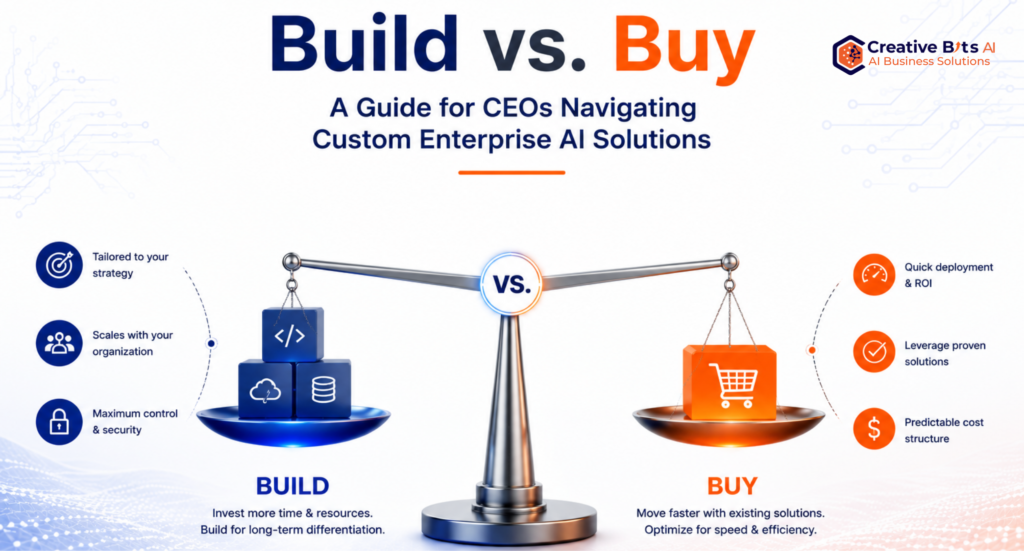
The build vs buy enterprise AI question has quietly become the single most expensive decision on a CEO’s desk in 2026. Not because the technology is hard to understand, but because the wrong answer is so easy to reach and so costly to unwind. Every vendor pitch makes buying sound like the safe bet. Every ambitious engineering lead makes building sound like the path to a moat. And somewhere between those two confident voices sits the person who has to answer to the board when the number doesn’t work.
So let us cut through it. This is not really a technology decision. It is a capital allocation decision wearing a technology costume, and the leaders who treat it that way are the ones getting AI into production while everyone else is still running pilots.
The Number That Should Frame Every Decision
Before you weigh a single vendor, you need to sit with one uncomfortable statistic. In its widely cited 2025 study, MIT’s NANDA initiative found that 95% of enterprise generative AI pilots delivered no measurable impact on the P&L. Billions were spent, and only about 5% of projects moved from pilot to production with real returns.
Here is the part that matters for your build vs buy call. The same body of research found the divide was not about model quality or regulation. It was about how the tool got implemented. Tools built by external vendors succeeded roughly twice as often as internal builds. Follow-on analysis put concrete numbers on it: specialist vendors reached production around 67% of the time, while pure internal builds landed closer to a 33% success rate.
Read that carefully, because it is easy to misread. It does not say building is bad. It says building blind, without deep deployment experience, triples your odds of joining the failure pile. That single insight reframes the entire decision.
What Building Actually Costs (The Whole Number, Not the Sticker)
When an engineering team proposes building, they almost always quote the build cost. That is the sticker price, and it is the least honest number in the room.
Current market data puts custom enterprise AI development at roughly $300,000 to $1.5 million upfront, with annual maintenance running 20% to 30% of that build cost every year afterward. A simple scoped chatbot might come in at $50,000 to $150,000. A mid-complexity system with retrieval, custom ML, or computer vision typically lands between $150,000 and $500,000. Full enterprise platforms with multiple models and real-time processing routinely cross $2 million.
But the sticker is not the story. The story is total cost of ownership, and this is where build decisions quietly detonate.
Across the research, a consistent picture emerges. Three-year total cost of ownership typically runs 1.5 to 2 times the initial build cost once you add retraining, compute, integration upkeep, and monitoring. One analysis found that initial creation costs represent less than one-third of total ownership, with operational costs eating 65% to 75% of the three-year spend. Then come the two silent killers. Integration complexity alone adds a 2x to 3x implementation premium on projects that assumed clean system connections, and data engineering accounts for 25% to 40% of total enterprise AI project spend.
The technical reason integration bites so hard is worth understanding. Your AI does not run in a vacuum. It has to read from your data warehouse, respect your identity and access controls, write back into systems of record, and survive schema changes in a dozen upstream services it does not own. Every one of those connection points is a maintenance liability that compounds monthly. This is exactly why the integration bill frequently exceeds model development cost by 3-5 times. The model was never the expensive part. The plumbing around it always was.
What Buying Actually Costs (Including the Costs Nobody Lists)
Buying looks cleaner on the spreadsheet, and often it genuinely is. Purchased platforms frequently start in the $5,000 to $30,000 range with predictable token-based usage costs, and SaaS-based AI buying has been benchmarked at a meaningfully lower three-year TCO than a comparable internal deployment.
The trade is not cost; it is control. When you buy, you inherit the vendor’s roadmap, their pricing decisions, and their availability. And 2026 made those risks concrete rather than theoretical. Model availability, API pricing, and even which model tier you are allowed to call all became dated events with real business consequences. Vendor lock-in is not an abstraction when a price change or a deprecated endpoint can reset your unit economics overnight.
There is also the accountability question that buying does not solve. Buying outsources the engineering, but it does not outsource the responsibility. If a purchased model makes a bad call inside your underwriting flow or your customer support queue, the reputational damage is yours, not the vendor’s. That is why the smartest buyers run vendor selection with the same rigor they apply to any high-stakes evaluation, the same discipline that powers rigorous AI research for due diligence. You are not buying a demo but a dependency.
The Real Answer Is Not Either/Or
Here is where the conversation has genuinely moved. The binary framing, build or buy, is now mostly obsolete for serious enterprises. The consensus that has formed across the 2026 research is a hybrid one, and it is nearly unanimous.
The pattern is simple to state. Buy the commodity, build the differentiation. In 2026, roughly 70% of enterprise AI workloads run on hybrid architectures that combine vendor and in-house components. You buy the foundation model, the inference infrastructure, and the compliance and governance layer, because none of those make your business different. Then you build the proprietary data layer and the task-specific logic that ties directly to your unique workflows and competitive differentiation.
This is not fence-sitting but the architecturally correct answer. Foundation models have become a commodity input, cheap enough that rebuilding one from scratch is almost always a waste. Your proprietary data and your specific operational workflows are the parts no vendor can replicate, so those are the parts worth owning. Model weights and infrastructure are increasingly treated as disposable commodities, while the durable advantage lives in where you place your differentiation in a rapidly commoditizing intelligence market.
A Framework You Can Actually Use
So how do you decide, workflow by workflow? Strip away the noise, and it comes down to four questions.
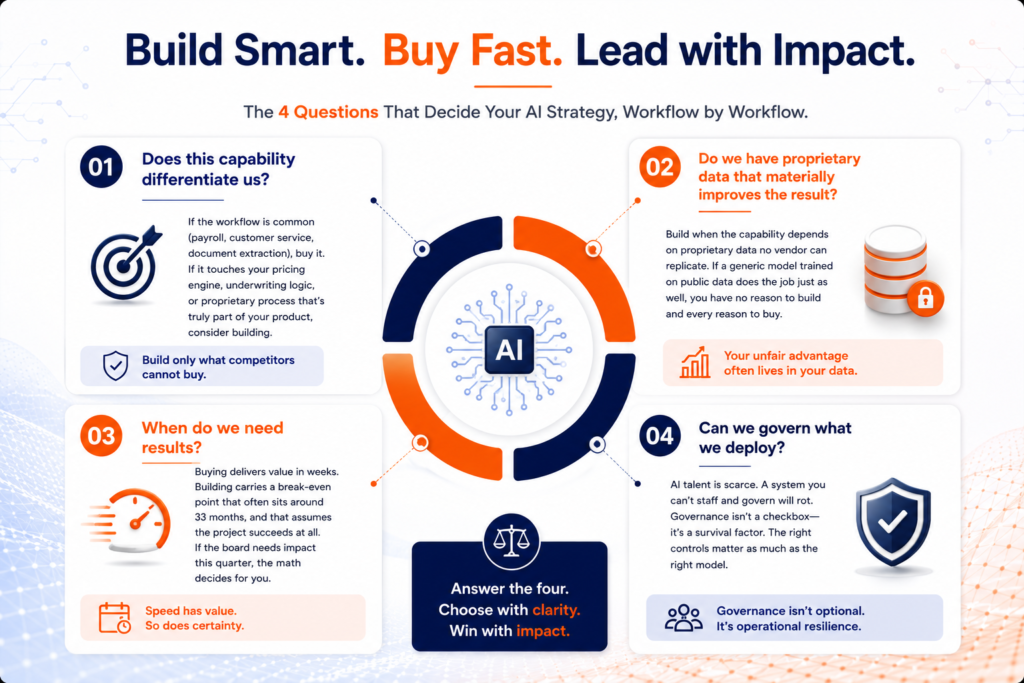
- Does this capability differentiate us? If the workflow is common, like payroll, standard customer service, or document extraction, buy it. If it touches your pricing engine, your underwriting logic, or a proprietary process that is genuinely part of your product, that is a candidate to build. The clean test is this: build only what competitors cannot buy.
- Do we have proprietary data that materially improves the result? Build when the capability depends on proprietary data no vendor can replicate. If a generic model trained on public data does the job just as well, you have no reason to build and every reason to buy.
- When do we need results? Buying delivers value in weeks. Building carries a break-even point that often sits around 33 months, and that assumes the project succeeds at all. If the board needs impact this quarter, the math decides for you.
- Can we govern what we deploy? This is the one leaders skip, and it is where builds quietly rot. AI talent is now among the hardest skills to hire globally, and a system you cannot staff to maintain is a liability regardless of how impressive the pilot looked. Governance is not a compliance afterthought here; it is a survival factor, which is why choosing the right controls matters as much as choosing the right model, a decision we broke down fully in our guide to picking the right AI security framework.
Run every proposed use case through those four questions, and the build vs buy answer usually stops being a debate and starts being obvious.
Where the Decision Really Lives
Step back, and the pattern from the failure data becomes clear. The 5% who succeed share a profile. Tightly scoped initiatives. Deep workflow integration. Domain-specific focus. And smart partnerships rather than heroic solo builds. The companies that fail tend to bolt AI onto a legacy process, overspend on a flashy hero project, and treat AI like traditional software that ships once and runs forever.
The reframe worth holding onto is this. Build vs buy enterprise AI is not a question your IT department should answer alone, because it is not really about technology. It is about where you place your capital, how fast you need returns, and which capabilities are worth owning versus renting. That is a CEO-level judgment call, and like every high-stakes call, it gets sharper when AI itself is used to pressure-test the assumptions behind it, a shift we explored in reframing AI as a decision-making ally.
Get the framework right, and the follow-through matters just as much. A well-chosen build still fails if the workflow around it is designed poorly, which is why designing workflows that know when to think and when to act is the companion discipline to any build decision. And once a solution is live, keeping it on time and on value is an execution problem, exactly where tools like AI in project management turn a smart decision into a shipped result.
Key Insights
The old question was, should we build our own AI or buy someone else’s? The better question is, where exactly should we build, and what should we buy so we can move faster on the parts that matter?
Buy the commodity. Build the moat. Govern all of it. Do that, and you stop gambling on the 95% failure rate and start engineering your way into the 5% that actually see returns. The technology will keep changing. The discipline of knowing what is worth owning will not.
Are you weighing a build vs buy enterprise AI decision and want a framework your CFO will actually approve? At Creative Bits AI, we help mid-market enterprises separate the commodity from the moat, build the custom layers that create real differentiation, and buy the rest so you reach production faster, with the governance to keep the whole thing accountable.
Book a CEO’s free virtual 1-hour call to learn more from our leadership team at Creative Bits AI.