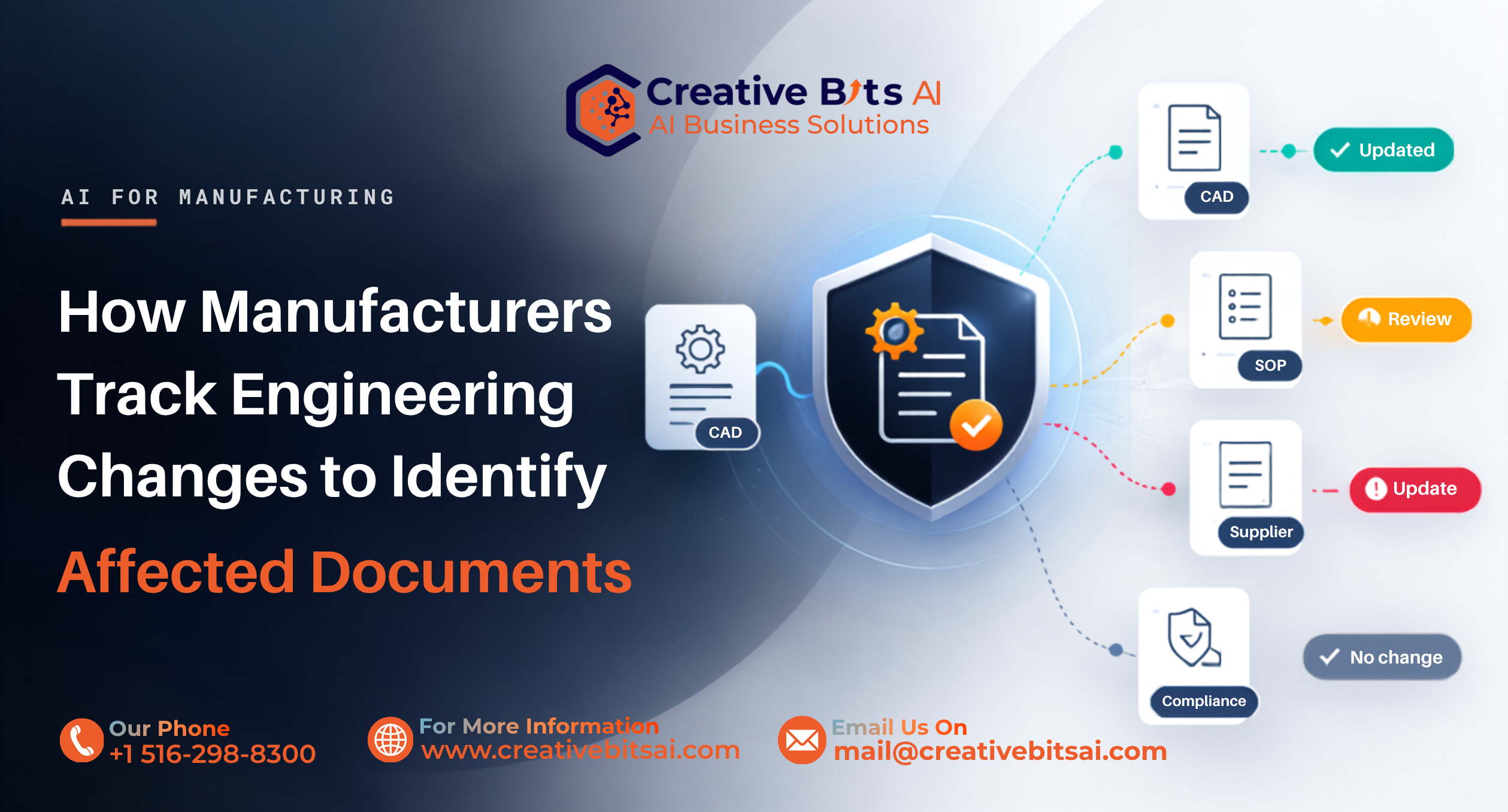
One product change can trigger a massive documentation crisis. When a single engineering specification changes, it doesn’t exist in a vacuum. It ripples across engineering drawings, standard operating procedures (SOPs), supplier agreements, procurement records, and maintenance manuals. If a team misses even one document, the consequences are severe. Manufacturers face costly production delays, scrap material, and compliance violations.
As GroupBWT’s Manufacturing Insights highlight, modern manufacturing teams are shifting from manual reviews to advanced retrieval models. These systems secure digital continuity across operations. As a result, factory managers use these tools to track engineering changes with advanced retrieval and safeguarded AI.
One Product Change Affects Multiple Documents
What happens when one product specification changes? In a typical manufacturing environment, a single component update requires a cascade of documentation updates. For example, a team might alter the diameter of a specialized fastener.
According to cross-functional industry frameworks from Arena Solutions, a change disrupting interconnected silos impacts several downstream domains. Therefore, teams must track engineering changes across these specific business areas:
- Engineering Drawings & CAD Metadata: Geometric changes alter tolerances and assembly mating rules.
- Shop Floor SOPs & Work Instructions: Assemblers require updated torque specs or step-by-step sequencing.
- Supplier & Procurement Contracts: Purchasing agents must update purchase orders to ensure vendors manufacture the correct revision.
- Quality & Compliance Logs: Regulatory filings must match the physical asset exactly to avoid compliance penalties.
Why Manual Systems Fail to Track Engineering Changes Quickly
Manual impact analysis forces highly skilled engineers to act as digital detectives. They spend hours, sometimes days, hunting for keywords across network drives. They also search legacy Product Lifecycle Management (PLM) tools and disconnected PDFs.
Keyword searches fail because terms vary across departments. A part might be listed as a “Hex Bolt” in procurement. However, the PLM system lists a part number, and the shop floor guide says “Fastener.” Traditional search cannot bridge these linguistic gaps. As a result, teams miss hidden relationships between documents.
Furthermore, engineers lack a unified view of dependencies. Because cross-referencing files manually is slow and error-prone, outdated revisions inevitably slip through to production. This oversight results in expensive scrap and rework.
Example Workflow to Track Engineering Changes
Consider how an industrial equipment manufacturer handles a material change:
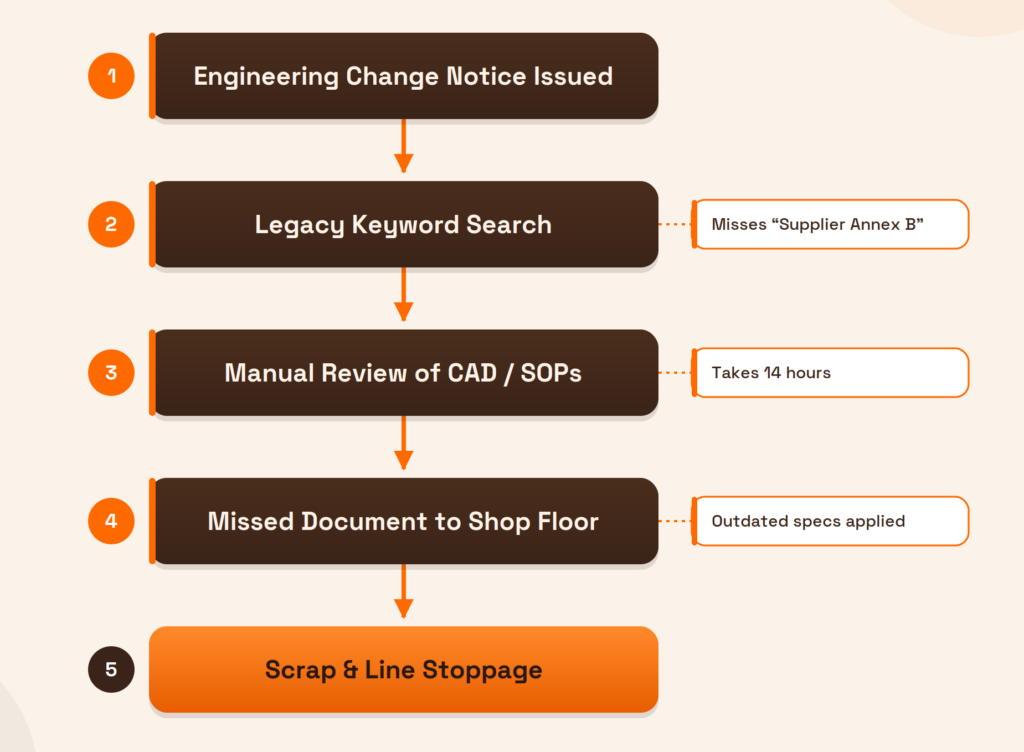
When changing a component from high-carbon steel to a lightweight composite, the engineering team updates the main CAD model. However, a legacy search misses the supplier packaging annex and a specific field-service manual. As a result, the supplier ships the wrong housing components. The assembly line stalls, and the manufacturer incurs thousands of dollars in daily downtime.
How AI Helps Teams Track Engineering Changes
Advanced Software-as-a-Service (SaaS) knowledge bases powered by Retrieval-Augmented Generation (RAG) fundamentally change this workflow. The software searches approved material before compiling answers. Instead of relying on exact keyword matching, a RAG system reads your documentation like an experienced engineer. It understands context, synonyms, and semantic dependencies.
As detailed in Aras’s GraphRAG Framework, an AI tailored for engineering change impact analysis maps data across disparate formats. Thus, it allows teams to track engineering changes and solve complex information gaps:
| Document Type | What RAG Connects | Impact Identified |
| Engineering Change Notices (ECN) | Parent-child part relationships | Identifies all assemblies using the modified part. |
| Shop Floor Work Instructions | Textual assembly steps | Highlights text blocks requiring new torque values. |
| Supplier Agreements & NDAs | Part descriptions and SKU variations | Flags contracts tied to the legacy part number. |
What should a RAG assistant do when it cannot find an answer? A robust engineering RAG system must not hallucinate or guess. When explicit documentation is missing, the AI must report a confident null response. It clearly states what info is missing and where the gap lies.
How can support and engineering teams identify documentation gaps from unanswered questions? By analyzing these null responses, system administrators receive a direct roadmap of missing documentation. Consequently, they fill gaps before production lines encounter them.
Human Review Controls How Users Track Engineering Changes
AI accelerates discovery, but critical operations require human oversight. Per the safety-critical guidelines outlined by LeewayHertz, high-impact actions must remain within an enforced approval boundary. No automated system should update a live engineering drawing or an active shop floor SOP without a human engineer signing off.
Safeguarded AI relies on strict frameworks to guarantee accuracy on the factory floor:
- Verifiable Citations: A reliable manufacturing assistant must cite its sources. Every suggested document change must include an exact link, paragraph number, and version history of the source material. Thus, engineers can instantly verify the context.
- Role-Based Access Controls (RBAC): The AI must respect strict enterprise permissions. If an engineer lacks permission to view sensitive specifications, the AI will not surface those documents during the impact analysis.
- Human-in-the-Loop (HITL) Workflow: The AI compiles the change package and highlights the exact sentences requiring edits. Then, it presents them as draft recommendations. The certified quality manager retains the final approval authority to push updates live.
Minimize Your Production Risks
Stop relying on manual keyword searches to safeguard your engineering changes. Prevent scrap, rework, and compliance gaps with an automated, traceably cited impact analysis.
Book an Engineering Change Impact Assessment with our technical team at Creative Bits AI today to audit your current documentation workflow and see RAG technology in action.
To help tailor your Engineering Change Impact Assessment, could you share:
- What primary PLM, ERP, or document storage systems (e.g., Windchill, SAP, Teamcenter, SharePoint) does your team use?
- The average number of engineering changes your facility processes each month?