Intelligent workflow design starts with an uncomfortable truth. Most companies are putting AI in the wrong places. They treat it like a universal fix, dropping a model into every process they can find, when what they actually need is better architecture. The result is a lot of impressive demos that quietly fail to change anything. If you have ever watched an AI pilot stall out after the excitement wore off, you already know the feeling.
There is now hard data behind that feeling. A widely cited 2025 MIT study found that despite roughly 30 to 40 billion dollars in enterprise AI investment, about 95% of generative AI pilots delivered zero measurable return, and the gap came down to approach rather than model quality. The models were fine. The way they were slotted into the business was not. So let us talk about what a better approach actually looks like.
Not Every Step in a Workflow Needs Intelligence
Here is the idea that changes everything once it clicks. Intelligence is not something every step needs.
Think about a simple example. A customer owes you $10,000 and pays $2,000. What is the remaining balance? You do not need an AI agent to answer that. It is arithmetic, and a fixed rule will get it right every single time, at zero cost, with no chance of a surprise. Handing that step to a language model does not make it smarter. It makes it slower, more expensive, and less reliable.
This is not just a cost argument. It is a stability argument. As one engineering guide put it plainly, you do not want creative reasoning in your payroll system; you want the same result every time with no surprises, which is exactly what a deterministic pipeline gives you. Predictability is a feature, not a limitation. The moment you add a model to a step that has one correct answer, you trade away the thing that made it trustworthy.
So the first move in intelligent workflow design is almost counter-intuitive. Before you ask where AI fits, ask where it does not belong at all.
Where AI Actually Earns Its Place
Now change the scenario. That same customer sends an angry email instead of a clean payment. What are they actually upset about? What happened, and what do they need from you right now? Are they asking for a refund, a payment plan, an apology, or just an answer?
That is a completely different kind of problem. There is no formula for it. It takes interpretation, reading context, sensing intent, and pulling the real signal out of a messy paragraph of frustration. This is exactly where AI shines, and it is the same strength that powers everything from support triage to AI research for due diligence, where the value comes from making sense of unstructured information at speed.
The distinction here is not a small one, and it is the foundation of good design. Anthropic draws a clean architectural line between the two, noting that workflows orchestrate models and tools through predefined code paths, while agents are systems where the model dynamically directs its own process, and their advice is to find the simplest solution first and only add complexity when the task genuinely needs it. In other words, reach for intelligence when the problem is genuinely ambiguous, and reach for a rule when it is not.
The 4 Layers of an Intelligent Workflow
Once you accept that different steps need different things, a clear structure appears. A genuinely intelligent workflow runs on four distinct layers, and the skill is knowing which one each step belongs to.
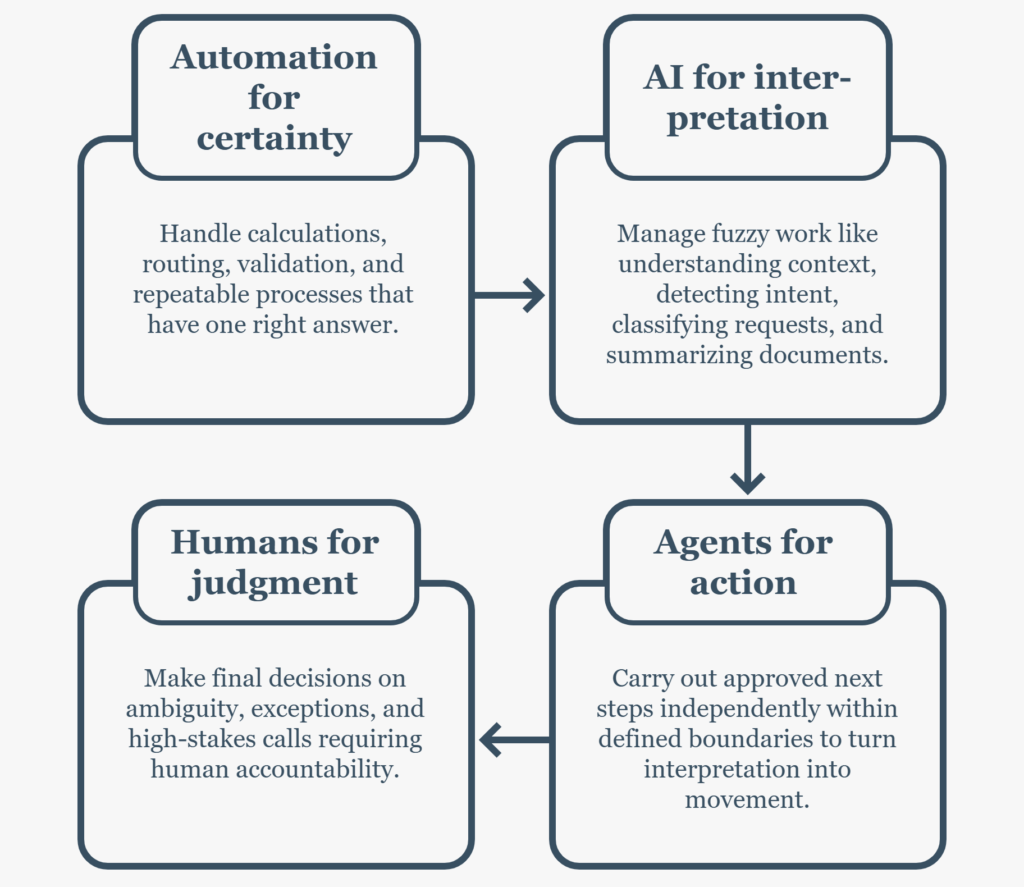
- Automation for certainty. This is the bedrock. Calculations, routing, validation, and repeatable processes that have one right answer. These steps should be deterministic, fast, and boring in the best possible way. They never need a second opinion, so do not give them one.
- AI for interpretation. This layer handles the fuzzy work. Understanding context, detecting intent, classifying a request, summarizing a document, or spotting the one meaningful signal in a pile of noise. Anything that requires judgment about meaning rather than a lookup or a calculation lives here.
- Agents for action. Once something has been understood, an agent can choose and carry out an approved next step on its own, inside the boundaries you have defined. This is where interpretation turns into movement, and it is also where design discipline matters most. If you want to see how structured this can get, the patterns behind reliable agents are worth studying, and we broke many of them down in our guide to agentic AI patterns for large-scale systems.
- Humans for judgment. The top layer is reserved for ambiguity, exceptions, and high-stakes calls. When a step could cost real money, change an agreement, or damage a relationship, a person should make the final decision. Not because the AI cannot produce an answer, but because accountability for that class of decision should stay with a human.
The point of these 4 layers is not to rank them. It is to stop forcing every step through the same tool. When you map a process this way, the AI stops being a gimmick sprinkled on top and starts being one deliberate part of a system that also knows when to simply follow a rule. That shift, from bolting on AI to designing coordinated intelligence, is the same one we describe in our work on AI in project management, where the win comes from orchestration rather than raw automation.
When Agents Act and When Humans Decide
The layer people get wrong most often is the boundary between agents and humans. It is tempting to let an agent run the whole way, because full autonomy feels like the impressive version. In practice, the reliable version almost always keeps a person at the decision points that carry weight.
The rule of thumb is simple. Let the agent execute freely when the action is reversible, low cost, and clearly inside policy. Route the decision to a human when it is expensive, hard to undo, or touches a relationship. An agent approving a routine $40 refund is good design. An agent unilaterally canceling a $90,000 contract is a governance incident waiting to happen.
This is where the conversation stops being about capability and starts being about authority. The real question is no longer “can the AI make this decision,” because increasingly it can. The better question is “where does this organization want the AI’s authority to end?” Answering that consistently is a governance problem as much as a technical one, and it deserves the same rigor you would apply to any other control in your stack, which is exactly the thinking behind choosing the right AI security and governance framework. Guardrails, permissions, and human approval gates are not obstacles to a good workflow. They are what make autonomy safe enough to use.
How to Redesign a Workflow the Right Way
So how do you actually apply this? You go step by step through a process and interrogate each one with a single question. Does this step need interpretation, action, judgment, or just a rule?
When the answer is only a rule, automate it and proceed. When interpretation is needed, AI handles it. If it needs an approved action carried out within boundaries, that is an agent. If it carries real risk or genuine ambiguity, keep a human in the loop. Most steps in most businesses turn out to need far less intelligence than people assume, and the handful that truly need it become obvious once you stop treating everything the same.
This is also why the MIT finding matters so much. The pilots that failed were not failing because the models were weak. They were failing because organizations dropped AI onto processes without redesigning the process itself. Intelligent workflow design flips that order. You fix the architecture first, then you place the right kind of intelligence, or the right kind of certainty, exactly where each step calls for it.
The Takeaway
The goal was never to put AI everywhere. That is how you end up in the 95%. The goal is to put the right kind of intelligence, or the right kind of certainty, at every single step of the work.
Automation handles what is certain. AI interprets what is ambiguous. Agents act within clear boundaries. Humans own the decisions that matter. Get that mix right, and you get a workflow that knows when to think, when to act, and when to simply follow the rules. Get it wrong, and you get an expensive demo. The difference is not the model you choose. It is the architecture you design around it.
Are you ready to build workflows that know exactly where intelligence belongs? At Creative Bits AI, we help companies design intelligent workflows that combine automation, AI, agents, and human judgment into systems that actually work in the real world, with the guardrails to keep every decision in the right hands.