AI agents for business are reshaping how enterprises handle approvals, cutting procurement, budget, and policy cycles by up to 60% through intelligent triggers, escalation routing, and built-in governance. In 2026, organizations that depend on layered sign-offs, manual handoffs, and email-based approvals are paying a measurable price in speed, compliance, and competitive agility. With agentic AI and intelligent workflow automation, enterprises can transform fragmented approval chains into continuously optimized digital systems. At Creative Bits AI, we treat approvals as strategic control points, not administrative chores, and engineer multi-step automation architectures that turn governance into operational advantage.
1. Why Traditional Approval Systems Are Operational Bottlenecks
Most enterprise approval processes were never designed to scale. Procurement requests bounce between departments, finance approvals require layered sign-offs, and policy changes pull in legal, HR, and executive stakeholders. These workflows typically run on email chains, spreadsheets, and disconnected enterprise systems, introducing friction that slows decisions and inflates administrative overhead.
Research highlights that 20–30% of operating expenses are wasted on inefficiency, much of it tied to redundant approvals, miscommunication, and fragmented systems. Procurement delays alone can extend vendor onboarding, miss savings windows, and disrupt supply chains. The deeper issue is coordination, not speed. Every step adds dependency risk, and silent bottlenecks become operational liabilities once cycle times start dictating strategy. AI agents for business solve this by treating approvals as dynamic, orchestrated systems rather than static processes.
2. How Multi-Step Approval Automation Uses Agentic AI to Cut Cycle Times
Modern agentic AI systems automate complex approval chains using intelligent triggers, decision routing, and escalation management. Unlike rigid rule-based workflow tools, AI agents for business read contextual data, apply governance policies, and dynamically recalculate workflows based on real-time conditions. A procurement approval, for example, can begin with automated document validation, move through budget threshold checks, escalate to legal review when limits are crossed, and only reach executive sign-off when policy exceptions emerge. AI agents track every stage, enforce deadlines, and auto-escalate stalled work.
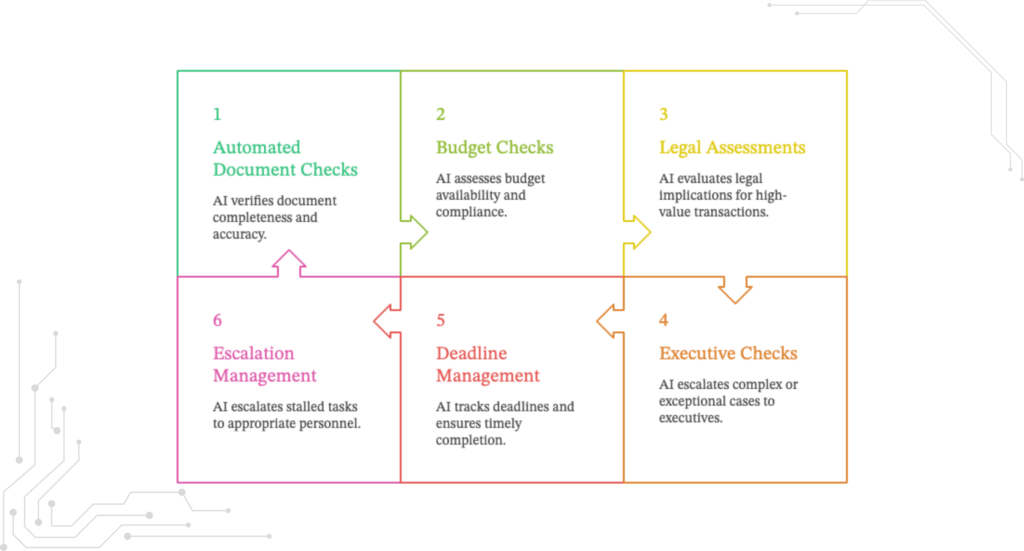
Industry analysis shows that AI-driven workflow agents are boosting productivity by 30 to 60 percent in targeted tasks like reconciliations, PO tracking, and anomaly flagging. The strategic value is orchestration, transforming disconnected, manual approvals into intelligent, self-optimizing pipelines.
3. Automated Triggers, Escalation Paths, and AI Governance
Automation only delivers ROI when it is paired with governance, and this is where AI agents for business become enterprise-grade. Automated triggers fire on predefined business events such as purchase requests, policy amendments, or budget submissions. AI agents validate documentation, evaluate workflow conditions, and route tasks to the right stakeholders. Escalation paths ensure stalled approvals never become bottlenecks, automatically routing to higher authority when SLAs are breached. Governance frameworks make automation auditable. AI systems maintain decision logs, track approval histories, and preserve traceability across every step, which is non-negotiable in regulated industries.
The NIST AI Risk Management Framework emphasizes that trustworthy AI systems must be accountable, transparent, and explainable, principles that map directly to enterprise approval architectures. At Creative Bits AI, we build approval systems where every trigger, escalation, and decision is auditable by design, turning compliance from cost into capability.
4. Procurement, Budget, and Policy Workflows: High-Value AI Use Cases
Not every workflow benefits equally from automation. Approval-intensive systems deliver the strongest ROI because they combine repetitive logic, multiple stakeholders, and high time costs.
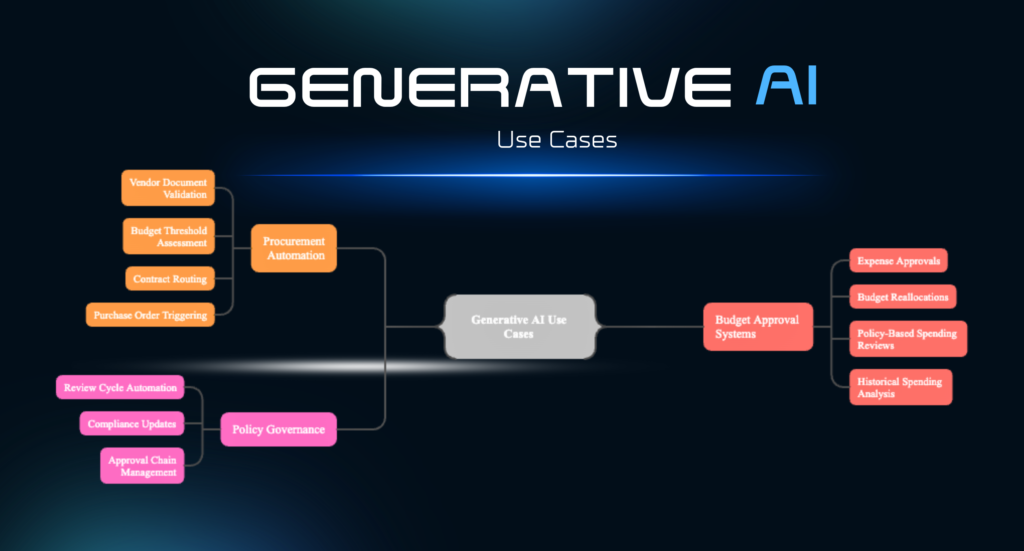
Procurement automation validates vendor documents, checks budget thresholds, routes contracts for legal review, and triggers purchase orders without manual intervention, compressing vendor cycles and tightening compliance. Budget approval systems automate expense reviews, reallocations, and policy-based spending checks, with AI cross-referencing historical patterns to flag anomalies before they reach approvers.
Policy governance workflows automate review cycles and approval chains across legal, HR, and executive stakeholders, eliminating version-control chaos. Research confirms that enterprises using AI-based workflow automation save between 20% and 30% in operational costs and reduce errors by up to 50%. These are precisely the verticals where AI agents for business convert administrative friction into strategic agility.
From Approval Friction to Approval Intelligence
Approval systems were long treated as administrative plumbing. In reality, they are strategic control points that shape organizational speed, compliance posture, and execution velocity. With AI agents for business, enterprises can re-architect procurement, budgeting, and policy workflows into intelligent systems that run continuously, transparently, and efficiently. Automated triggers compress cycle times, escalation paths eliminate bottlenecks, and governance frameworks lock in compliance.
At Creative Bits AI, we design enterprise-grade approval architectures that combine agentic AI, scalable governance, and operational excellence. Whether you are modernizing procurement, financial controls, or policy management, the future belongs to organizations that replace approval friction with approval intelligence. In 2026, competitive advantage is not about making faster decisions; it is about building systems where decisions flow automatically. Talk to our enterprise AI team to design your approval automation roadmap.