Over the years, the formula for digital growth was straightforward: the higher the rank, the more clicks, the greater the traffic revenue. Visibility and traffic were closely linked, with one being a direct cause of the other. That relationship is now breaking. The rise of zero-click search is fundamentally reshaping how users interact with information online.
As AI-powered search experiences emerge, including Google AI Overviews, conversational search, and LLM-based interfaces, users are finding answers directly within the search results page. The outcome is a paradigm shift: visibility is growing, but traffic is declining. This is commonly referred to as the Great Decoupling, and it is now a widespread phenomenon across all industries.
According to DigitalApplied, 64.82% of Google searches now end without a click: The zero-click rate has climbed steadily from 50% in 2019 to 64.82% in 2026. This is not a temporary blip caused by AI Overviews: the trend predates generative AI and has been accelerating since featured snippets and knowledge panels matured. The remaining 35% of clicks are increasingly concentrated on navigational and transactional queries where user intent demands a destination.
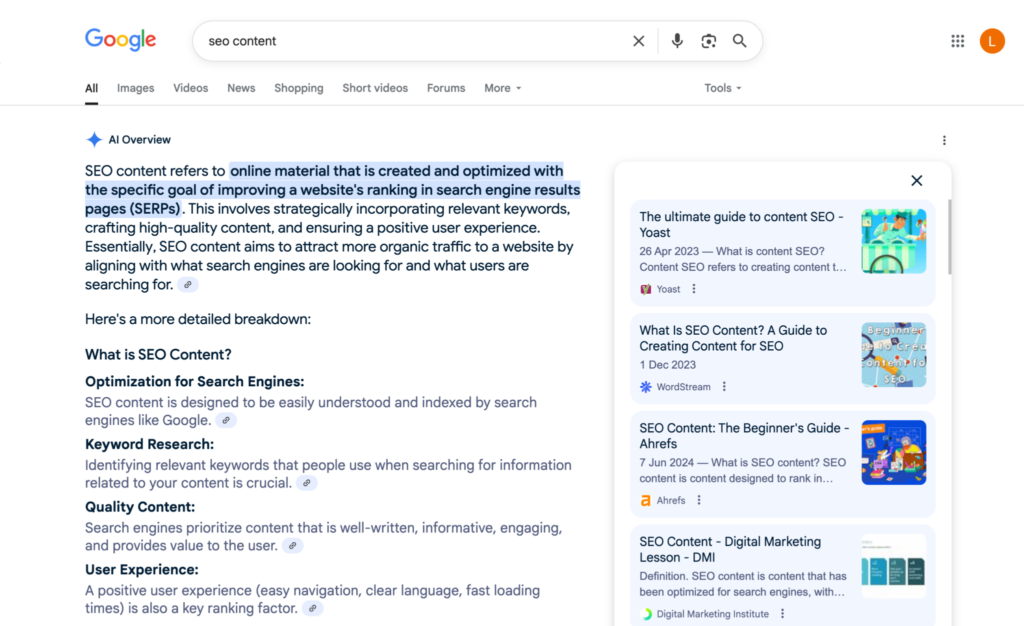
At Creative Bits AI, we view the rise of AI-driven search not as a mere disruption of SEO, but as a paradigm shift in how value is captured in the information economy. This perspective aligns with a broader industry consensus that AI has shifted the focus from merely ranking websites to providing direct, authoritative answers.
1. From Search Engine to Answer Engine: The Zero-Click Search Era
Conventional search engines functioned as intermediaries. They catalogued, ranked, and directed users to external websites. Visibility was almost entirely manifested as traffic. AI search systems operate differently. They function as answer engines, processing and presenting information directly within the conversation.
Studies of generative search behavior confirm that users increasingly prefer summarized, synthesized, and contextual answers over traditional lists of links, particularly for informational queries. This behavior, often resulting in “zero-click” searches, allows users to receive immediate answers, reducing the need to browse multiple sources.
Websites are no longer solely destinations. They are data sources that feed AI systems. Your content is still being used. It is just not being clicked.
2. Why Zero-Click Search Is Driving the Visibility-Traffic Gap
The Great Decoupling paradox is this: brands are appearing more frequently in AI-generated answers, yet they are receiving less traffic. This occurs because AI systems aggregate and compress information from multiple sources into a single response. Only a small percentage of users proceed further to explore the sources.
Google’s AI Overviews, for example, typically present summarized content with very few outgoing links. User behavior shifts from navigation to consumption. Research from Ahrefs in early 2026 found that AI Overviews correlate with a 58% lower average click-through rate for the top-ranking page. In early 2025, studies reported a 34.5% drop in CTR for position one results.
Interface design also plays a critical role. Answers generated by AI are designed to be comprehensive, concise, and immediately useful. This reduces friction and, consequently, the motivation to click through. The zero-click search phenomenon means that visibility can no longer guarantee engagement. Organizations must rethink what success looks like in this environment.
3. The New Metrics That Matter Beyond Zero-Click Search
If traffic is no longer the primary indicator of success, what should organizations measure? Several new metrics are emerging as essential performance indicators in the age of zero-click search.
The first is AI citation visibility, which tracks how often your content is mentioned or utilized in AI-generated responses. This measures influence rather than traffic and captures your share in shaping the answers users receive.
Second is semantic authority. AI systems do not favor content based on keyword optimization alone but on topical excellence. Models such as BERT and retrieval-augmented systems assess meaning, context, and the relationships among ideas.
Third is the quality of engagement. As click volume declines, the intent behind each visit becomes stronger. Users who do click through have typically advanced further into the decision-making process, making their conversions more valuable.
Fourth is brand imprinting within AI responses. Repeated appearance in AI-generated answers builds familiarity and trust, even when users do not click. This aligns with consumer behavior research indicating that repeated exposure influences decision-making regardless of direct interaction.
Finally, organizations must monitor multi-touch attribution. Discovery is no longer linear. A customer may first encounter your brand through an AI-generated response and then convert at a later point via a completely different channel.
4. Strategic Adaptation: Designing for AI Inclusion in a Zero-Click Search Landscape
The strategic response to the Great Decoupling is not to chase clicks but to maximize AI inclusion. This requires a fundamental shift in how content is planned, structured, and measured.
The priority is developing answer-first content. AI systems prioritize content that is clear, accurate, and thorough in addressing user queries. Content should be structured in a way that allows it to be easily extracted and synthesized by AI models.
Second, organizations should focus on topical depth rather than keyword breadth. Rather than targeting isolated keywords, building comprehensive knowledge clusters makes your site more likely to be selected as an authoritative source in a zero-click search environment.
Third, content structure matters more than ever. Clear headings, logical hierarchy, and well-defined information blocks increase the probability of inclusion in AI-generated answers.
Fourth, credibility signals are vital. AI systems increasingly prioritize authoritative sources, evaluating domain expertise, citation quality, and content consistency. Research on retrieval-augmented generation confirms that models favor content relevance and reliability when formulating responses.
Finally, AI visibility must be integrated into the broader business strategy. Traffic may decrease, but influence and the outcomes it drives can grow substantially.
From Clicks to Influence in the Zero-Click Search Economy
The Great Decoupling is not a temporary disruption. It is a structural transformation of the digital landscape. Visibility no longer correlates directly with traffic. It now concerns being part of the answer.
Organizations that continue to measure success solely in terms of clicks will increasingly misread their performance. Those that adapt to the realities of zero-click search and AI-driven discovery will build a competitive advantage as trusted sources within intelligent systems.
The future belongs to organizations that embrace AI-aware content design early: those that do not merely rank, but are chosen, synthesized, and trusted by AI. In the new search economy, the goal is not to be clicked. It is to be the source of the answer.