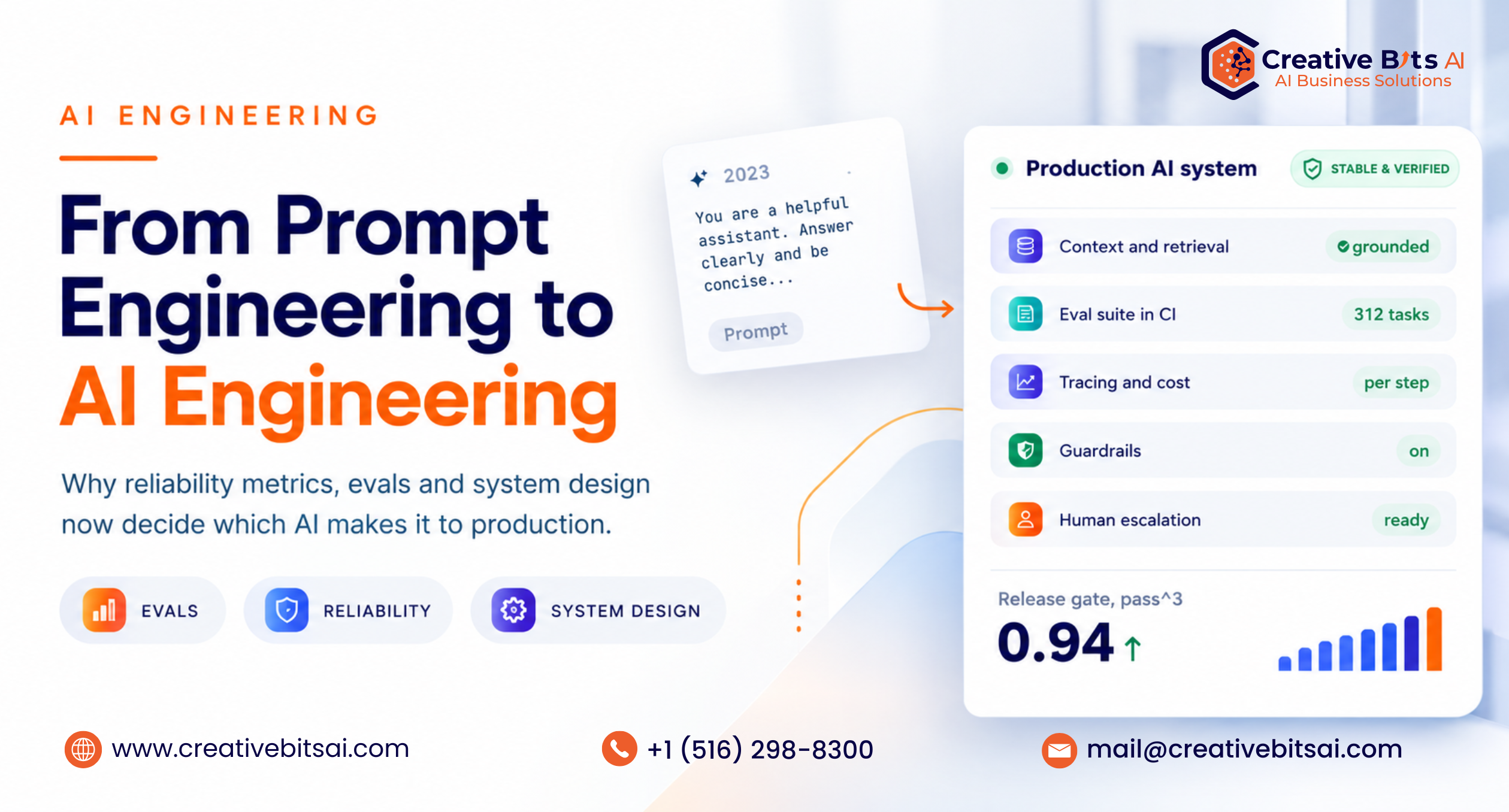
AI engineering is the discipline of building AI systems that work reliably in production, not just in a demo. Where prompt engineering focuses on writing better instructions, AI engineering covers the whole system: context and retrieval, tools, evaluation suites, reliability metrics such as task success and pass^k, observability, guardrails, and human escalation. In 2026, it is the skill set that decides which AI projects reach production and which ones quietly stall.
The demo was flawless. A product team had spent two weeks perfecting a prompt for their customer support assistant, and in the boardroom it answered every question beautifully. Leadership approved the rollout on the spot.
Three weeks into production, the story looked very different. The assistant handled most questions well, but every so often it quoted last year’s refund policy, called the wrong tool, or confidently answered something it should have handed to a person. Nobody could say how often it happened, which questions triggered it, or whether yesterday’s prompt tweak had made things better or worse. The prompt had not changed. The world around it had.
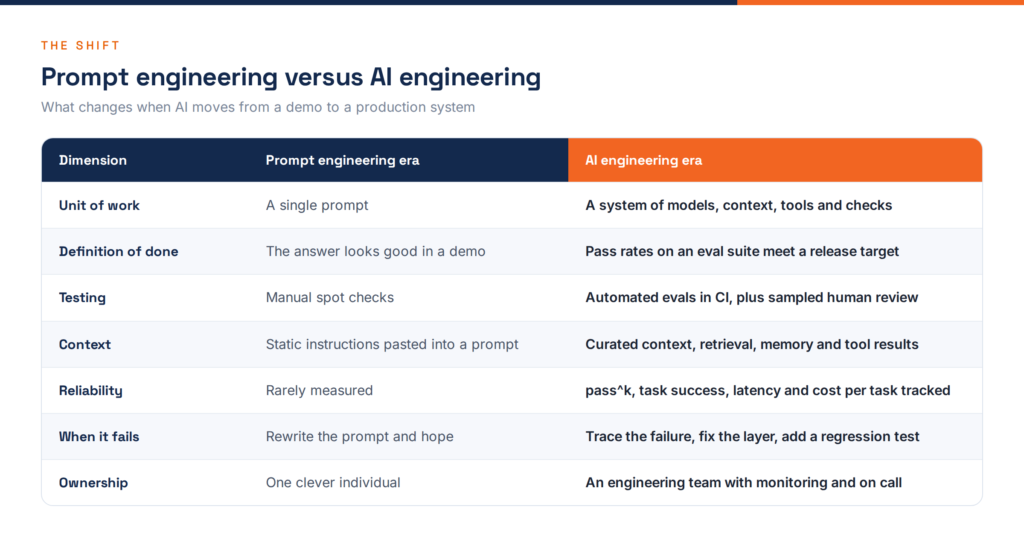
If that sounds familiar, you are watching the shift this guide is about. The industry is moving from prompt engineering, the craft of writing clever instructions, to AI engineering, the discipline of designing, measuring, and operating AI systems that stay reliable when real users, real data, and real consequences arrive.
In this guide, we look at why that shift happened so quickly, the reliability metrics that now define success, how evaluation suites actually work, and the system design patterns that separate dependable AI from impressive demos.
Why prompt engineering stopped being enough
In 2023, prompt engineering looked like the job of the future. By 2025, the picture had changed. The Wall Street Journal reported that the stand-alone prompt engineer role had become “basically obsolete”, as models got better at inferring intent and companies trained people across every role to use AI tools directly.
The skill did not disappear. It got absorbed into something bigger. In January 2026, LinkedIn named AI engineer the fastest-growing job in the United States, with four of the top five fastest-growing roles tied directly to AI. The market is no longer paying for people who can coax a good answer out of a model. It is paying for people who can make good answers happen consistently, at scale, inside real business workflows.
Three forces drove that change.
(1) Models became systems. Modern AI applications rarely make a single model call. They retrieve documents, call APIs, run tools, hand work between agents, and loop until a task is done. METR’s research found that the length of tasks AI agents can complete has been doubling roughly every seven months. Longer tasks mean more steps, and more steps mean more places for things to go wrong.
(2) Trust became the bottleneck. In the 2025 Stack Overflow Developer Survey of more than 49,000 developers, 84% said they use or plan to use AI tools, yet 46% said they do not trust the accuracy of the output, up from 31% the year before. Adoption is rising while confidence is falling, and the gap between them is exactly where AI engineering lives.
(3) Business cases got stricter. Gartner predicted that over 40% of agentic AI projects will be canceled by the end of 2027, citing escalating costs, unclear business value, and inadequate risk controls. None of those problems can be fixed with a better prompt. All of them can be addressed with better engineering.
The math that changed everything: reliability compounds
Here is the idea that turns prompt tinkering into an engineering discipline. When a system completes a task in many steps, and every step has to succeed, small error rates multiply.
Imagine an agent where each step, whether a retrieval, a tool call, or a model decision, succeeds 95% of the time. That sounds excellent. But if the task needs 20 steps, the chance that all of them succeed is 0.95 raised to the 20th power, which is about 36%. At 99% per step, the same 20-step task succeeds about 82% of the time.
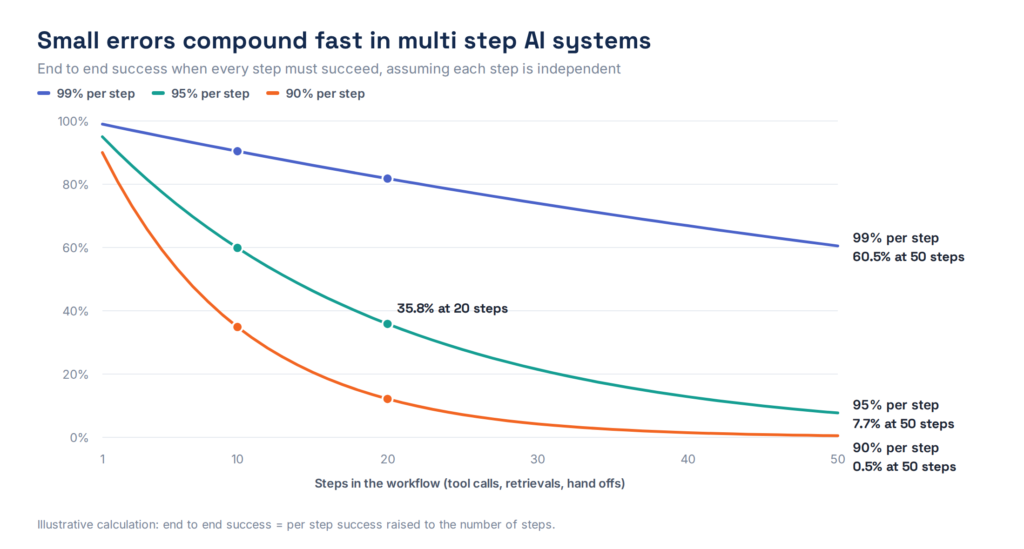
This is why the conversation has moved from “is the answer good?” to “how reliable is the system, measured how, and against what target?” A prompt can improve a single step. Only system design, evaluation, and monitoring can protect the whole chain.
Context engineering: the bridge between prompts and systems
The first stop on the journey from prompts to systems is what the industry now calls context engineering. Anthropic describes it as the natural progression of prompt engineering, defining it as “the set of strategies for curating and maintaining the optimal set of tokens” the model sees while it works.
The key insight is that context is a finite resource. Anthropic’s engineers point to context rot: as the context window fills up, a model’s ability to recall and use information accurately declines. More context is not automatically better context. In practice, good context engineering means:
- Just-in-time retrieval. Instead of loading every document upfront, the agent keeps lightweight references, such as file paths or saved queries, and pulls in data only when it needs it.
- Compaction. When a long-running task nears the context limit, earlier work is summarized so the agent can continue with the essentials rather than the noise.
- Curated tools. A small set of clear, well-described tools beats a sprawling toolbox that confuses the model about which one to use.
- Approved sources only. For business use, the most important context decision is what the model is allowed to know. Grounding answers in approved, current documents is the foundation of trustworthy output, a pattern we cover in depth in our guide to Safeguarded RAG Chatbots.
Context engineering makes each step better. The next layer makes the whole system measurable.
Reliability metrics: what AI engineering actually measures
Mature AI teams do not ask whether their system “seems good.” They define metrics, set targets, and track them release after release. Here are the ones that matter most.
Task success rate. The share of tasks where the system reached the correct outcome, verified against a known answer or end state. This is the headline number.
pass@k and pass^k. Anthropic’s January 2026 guide to evaluating AI agents draws a distinction every leader should understand. pass@k “measures the likelihood that an agent gets at least one correct solution in k attempts,” which suits tasks where one success is enough, like generating code a developer will review. pass^k “measures the probability that all k trials succeed,” which suits customer-facing systems where consistency matters. An agent that succeeds 75% of the time per trial has only about a 42% chance of succeeding three times in a row. Your customers experience pass^k, not pass@k.
Groundedness. The share of answers fully supported by the retrieved sources. For knowledge assistants, this is the guardrail against confident fabrication.
Tool call accuracy. Whether the agent chose the right tool with the right arguments. Many production failures are not language failures at all. They are wrong API calls.
Escalation rate and reasons. How often the system hands work to a person, and why. A healthy escalation rate is a feature, not a flaw, especially in high-stakes workflows.
p95 latency and cost per successful task. Speed and spend measured on completed work, not raw tokens. A cheap system that fails half the time is not cheap.
Many teams roll these into service level objectives, just as they would for any production service. For example, an illustrative target might read: 95% of answers grounded in approved sources, pass^3 of at least 0.90 on the regression suite, and p95 latency under six seconds.
Evals: the test suite for systems that never answer the same way twice
If reliability metrics are the destination, evaluation suites are the road. Traditional software tests assume the same input produces the same output. AI systems do not work that way, so AI engineering borrows a new vocabulary.
In Anthropic’s framework, a task is a single test case with defined inputs and success criteria. A trial is one attempt at that task, and because outputs vary, good suites run several trials per task. A grader is the logic that scores performance, and the transcript is the full record of what happened, including tool calls and intermediate steps.
There are three kinds of graders, and strong teams use all of them:
- Code-based graders check things deterministically, such as whether the right tool was called or the database ended in the right state. They are fast and cheap but brittle for open-ended answers.
- Model-based graders, often called LLM-as-a-judge, score outputs against a rubric. They are flexible but need calibration against human judgment.
- Human graders remain the gold standard, used to calibrate the other two and to review samples from production.
Teams also run two different kinds of suites. Capability evals stretch the system with hard tasks it cannot yet handle, giving the team a hill to climb. Regression evals cover tasks the system already handles well and should pass close to 100% of the time, so any drop signals that a change broke something.
Here is a simplified release gate that turns pass^k into a go or no-go decision before a new version ships:
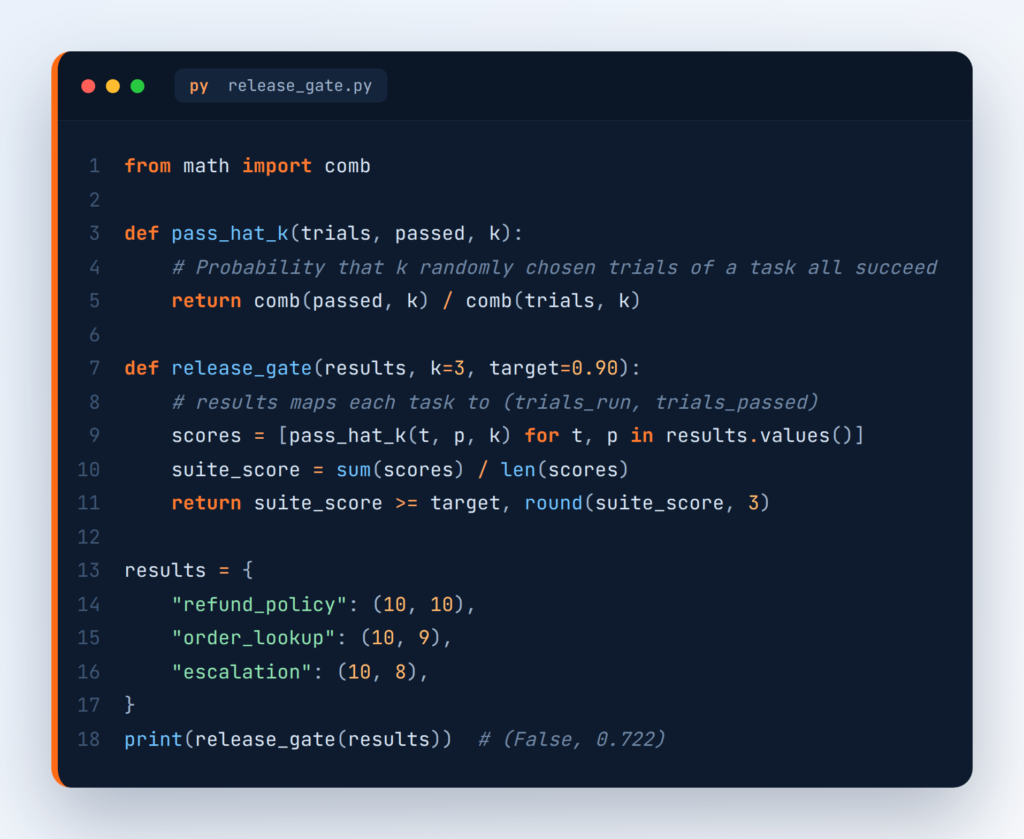
In this example, the suite scores 0.722 against a target of 0.90, so the release is blocked. Notice that the escalation task, which passed 8 out of 10 trials, drags the score down hardest. A system that is right 80% of the time feels reliable in a demo and unreliable to the customer who hits it three times in a week.
The eval gap most teams still have
Here is where the industry stands today. LangChain’s State of Agent Engineering report, based on a survey of 1,340 professionals, found that 57% of respondents already have agents in production, and that quality is the number one barrier, cited by about a third of respondents. Yet testing lags behind monitoring.
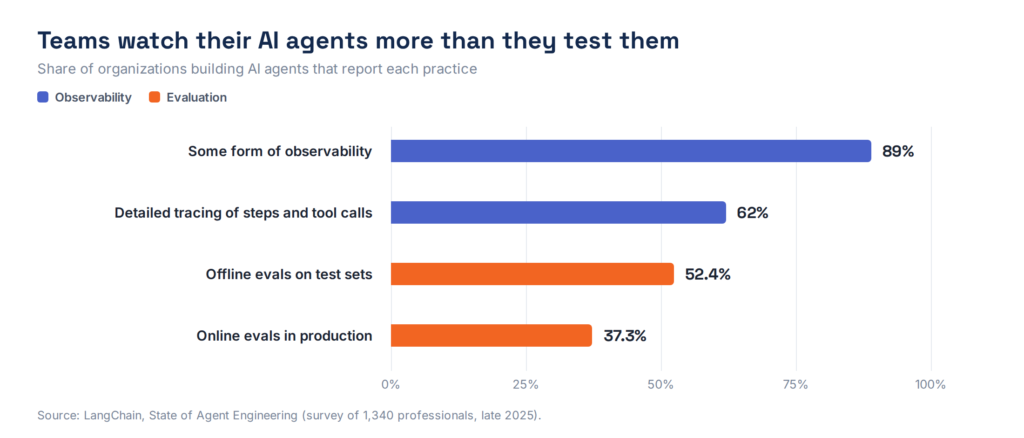
Most teams can see what their agents did after the fact. Far fewer test what their agents will do before a change ships. Observability tells you a fire happened. Evals keep it from starting. Closing that gap is one of the highest return investments an AI team can make in 2026.
System design: the architecture of dependable AI
With context, metrics, and evals in place, the final piece is architecture. Reliable AI systems tend to share the same building blocks.
A narrow, well-defined scope. The most reliable agents do a few things extremely well. Every additional responsibility adds steps, and every step multiplies risk. Deciding where AI should act and where people should decide is a design choice in itself, one we explore in our guide to intelligent workflow design.
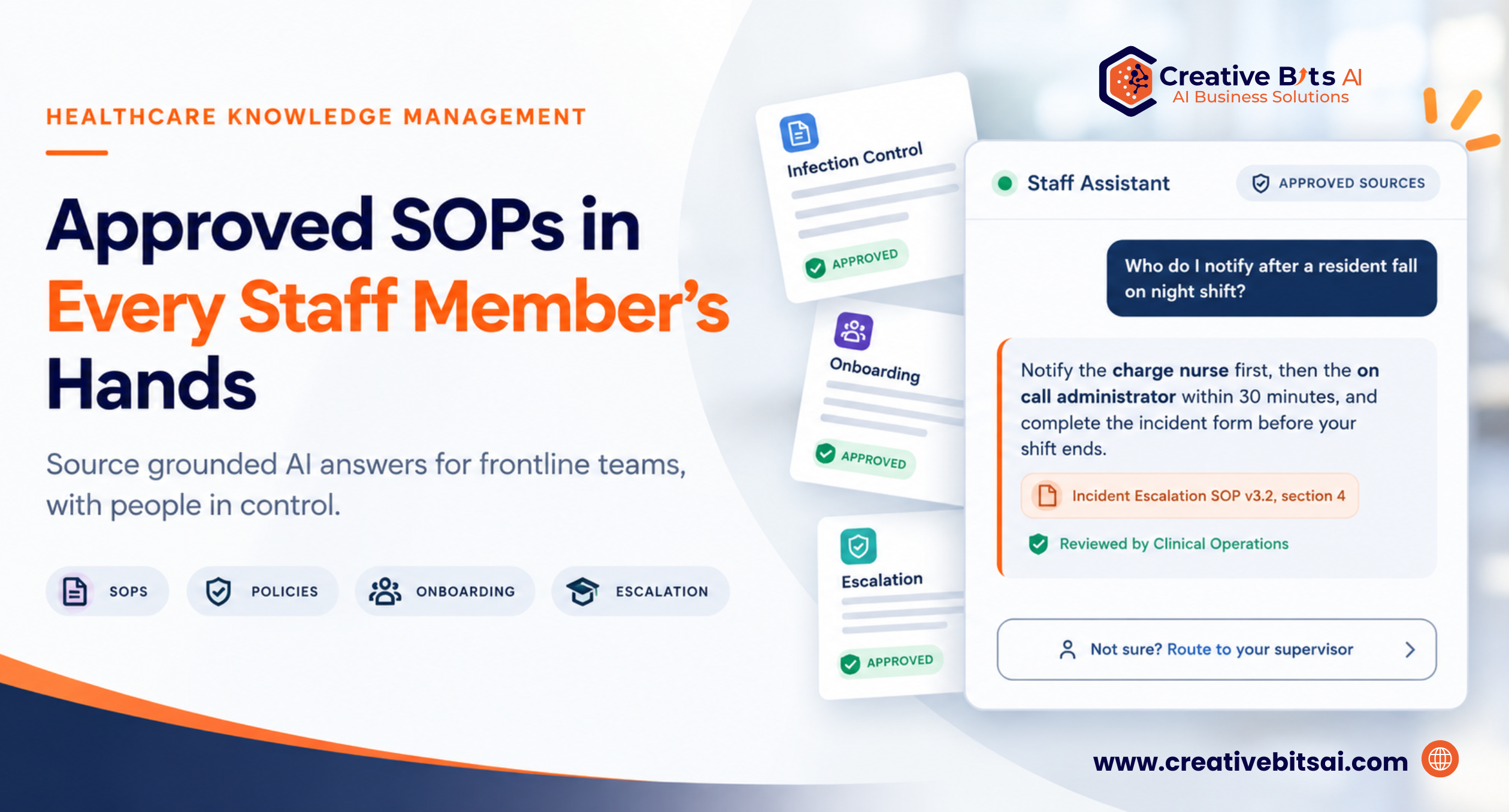
A governed knowledge layer. Retrieval from approved, versioned, access-controlled sources, so the system answers from what your organization stands behind. We show what this looks like in a regulated industry in our guide to healthcare knowledge management.
Deterministic code wherever possible. If a step can be handled by ordinary software, such as a calculation, a lookup, or a validation, it should be. Use the model for judgment and language, not for arithmetic.
Guardrails on inputs and outputs. Checks for prompt injection, data leakage, policy violations, and unsupported claims before anything reaches a user or a downstream system.
Observability built on open standards. The OpenTelemetry community has been standardizing how AI calls are traced through its GenAI semantic conventions, with shared attributes such as gen_ai.request.model, gen_ai.usage.input_tokens and gen_ai.tool.name plus spans for agent invocations and tool executions. Instrumenting to a common standard means your traces survive a change of model, vendor, or framework. The conventions are still marked as in development, so expect some names to evolve.
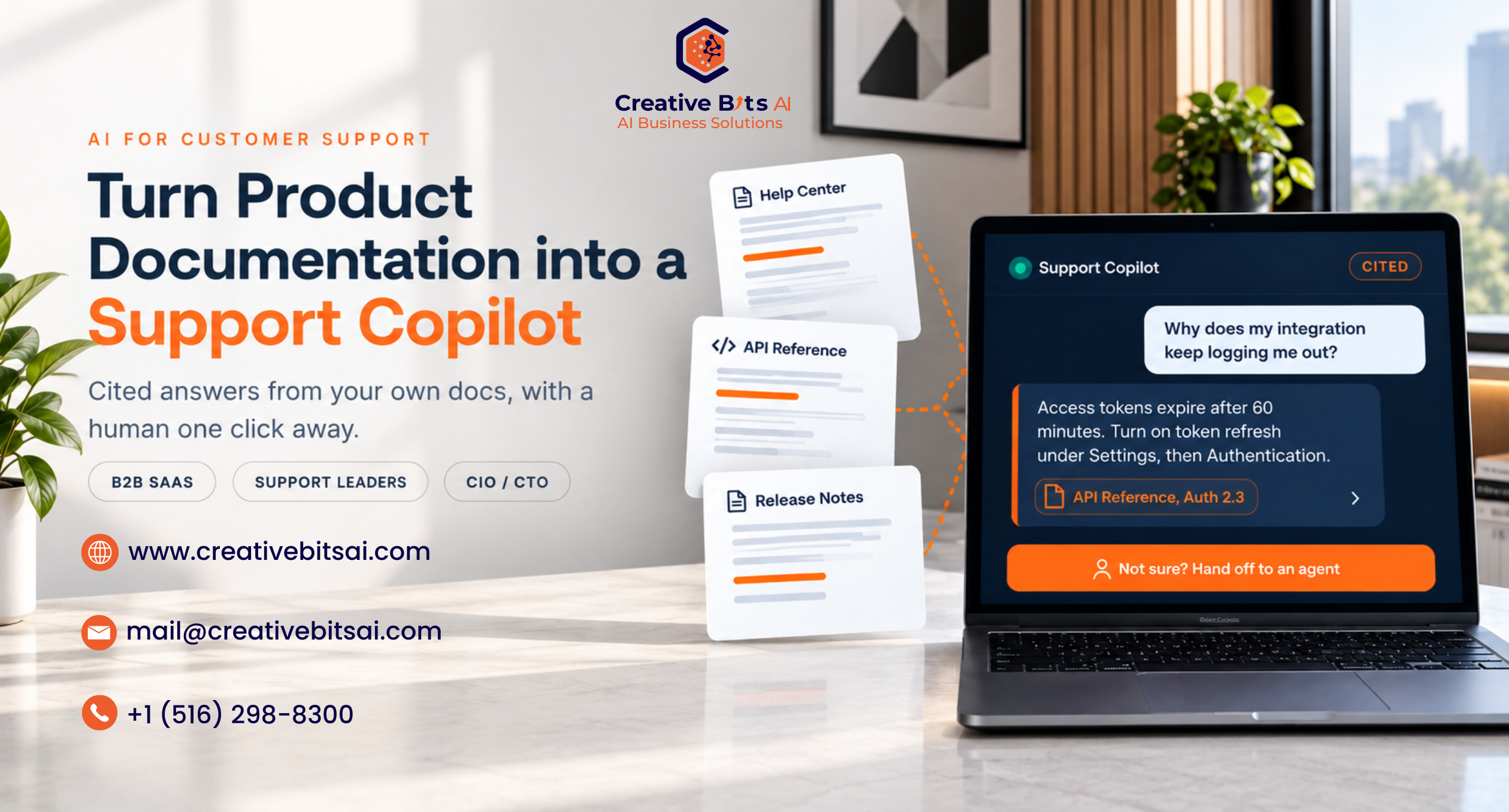
Human escalation by design. A clear, fast path to a person whenever confidence is low, a source is missing, or the stakes are high. In our AI support copilot guide, we show how escalation logic turns uncertainty into a better customer experience rather than a failure.
Risk managed like any other enterprise risk. Record the system, its owners, and its controls in your AI risk register, and map your safeguards to a recognized standard using our AI security framework comparison.
What this means for leaders and teams
For engineering leaders, the shift changes how teams are built. The most valuable people are no longer the ones with the cleverest prompts. They are the ones who can write a grader, read a trace, set a reliability target, and explain a regression. LinkedIn’s data shows software engineers, data scientists, and full-stack engineers are among the people most likely to move into AI engineering roles, which tells you the discipline is fundamentally an engineering one.
For business leaders, it changes how AI projects should be approved. Before funding a rollout, ask four questions. What is the target task success rate? How is it measured, and on what test set? What happens when the system is unsure? And who owns the system when it misbehaves at two in the morning?
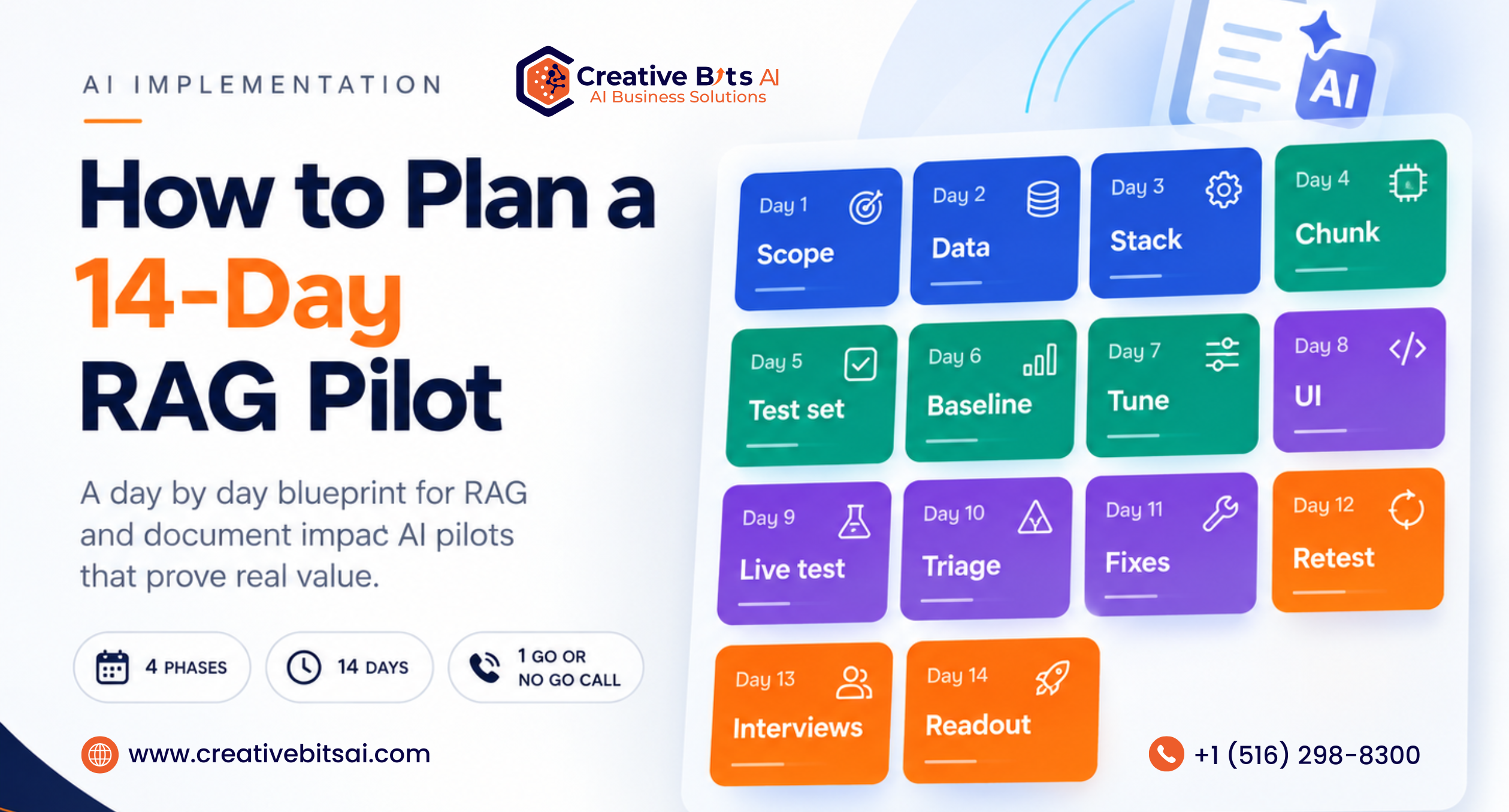
For organizations just starting, the fastest way to build this muscle is a focused pilot with real metrics from day one. Our guide on how to plan a 14-day RAG pilot walks through building a ground truth test set, measuring retrieval and generation separately, and ending with a clear go or no-go decision. And when the pilot succeeds, our build vs buy guide for enterprise AI helps you decide how to scale it.
Common mistakes on the road to AI engineering
- Shipping on vibes. If nobody can state the system’s task success rate, it is not ready for production.
- Treating evals as a one-time project. Every model update, prompt change, and new document can shift behavior. Evals belong in your release pipeline.
- Measuring pass@k when customers feel pass^k. Best of several attempts is a research metric. Consistency is a customer metric.
- Monitoring without testing. Dashboards show you failures after users find them. Evals find them first.
- Letting the model do everything. Every step you hand to deterministic code is a step that cannot hallucinate.
- Hiding the human. Systems without a clear escalation path force users to trust answers they should not.
Frequently asked questions about AI engineering
What is AI engineering?
AI engineering is the discipline of designing, evaluating, and operating AI systems so they perform reliably in production. It combines context engineering, retrieval, tool design, evaluation suites, reliability metrics, observability, guardrails, and human oversight.
Is prompt engineering dead?
No, but it is no longer a standalone job. Writing clear instructions is now a core skill inside AI engineering, alongside context design, evaluation, and system architecture.
What is the difference between pass@k and pass^k?
pass@k measures the chance that at least one of k attempts succeeds. pass^k measures the chance that all k attempts succeed. Customer-facing systems should be judged on pass^k, because users experience consistency, not best attempts.
What metrics should an AI system be measured on?
Start with task success rate, pass^k on a regression suite, groundedness, tool call accuracy, escalation rate, p95 latency, and cost per successful task.
How do you test an AI system that gives different answers every time?
Run multiple trials per task, score them with a mix of code-based, model-based, and human graders, and track pass rates over time rather than judging single responses.
The bottom line
Prompt engineering taught the world how to talk to models. AI engineering is teaching organizations how to depend on them. The difference shows up in the questions a team can answer: how reliable the system is, how that reliability is measured, what happens when it fails, and who is accountable when it does.
Back to that support assistant that dazzled in the boardroom and wobbled in production. The fix was never a better prompt. It was a test suite built from real customer questions, a reliability target the team could track, grounding in approved policy documents, traces that showed exactly where things went wrong, and a clean handoff to a person whenever the system was unsure. That is what AI engineering looks like in practice.
Are you building AI that has to work every time? At Creative Bits AI, we help organizations design safeguarded AI systems that answer from approved sources, are measured against clear reliability targets, and keep people in control of review and approval. Our solutions can be configured for your existing systems, including AWS through our AWS services, subject to a short technical discovery. Book a consultation or request a demo.