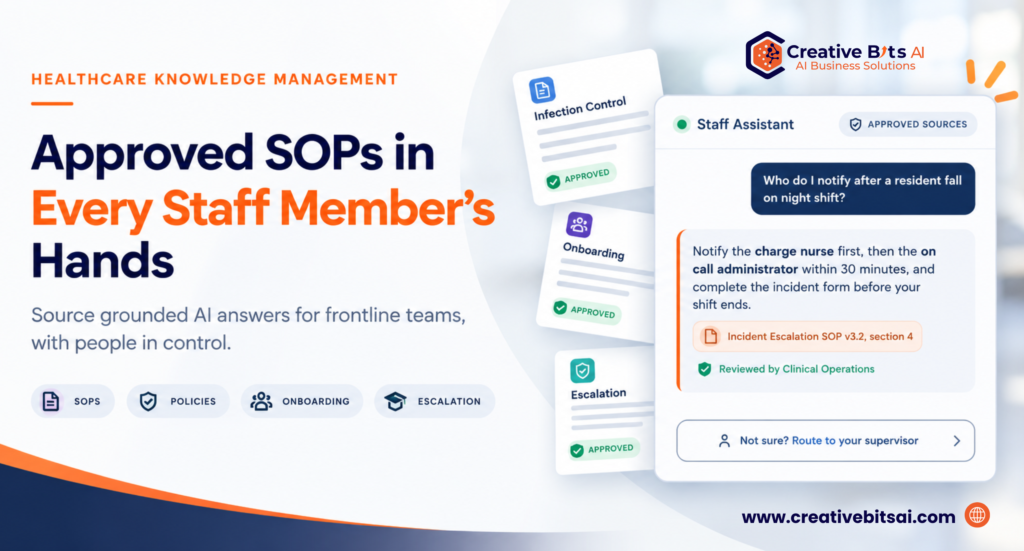
Healthcare knowledge management is the practice of keeping SOPs, policies, onboarding materials, and escalation paths current, approved, and easy for staff to find when they need them. A safeguarded AI knowledge assistant makes that practical by answering staff questions only from approved, current documents, citing the exact source, scoping answers to each site and role, and routing anything uncertain or high risk to a person for review.
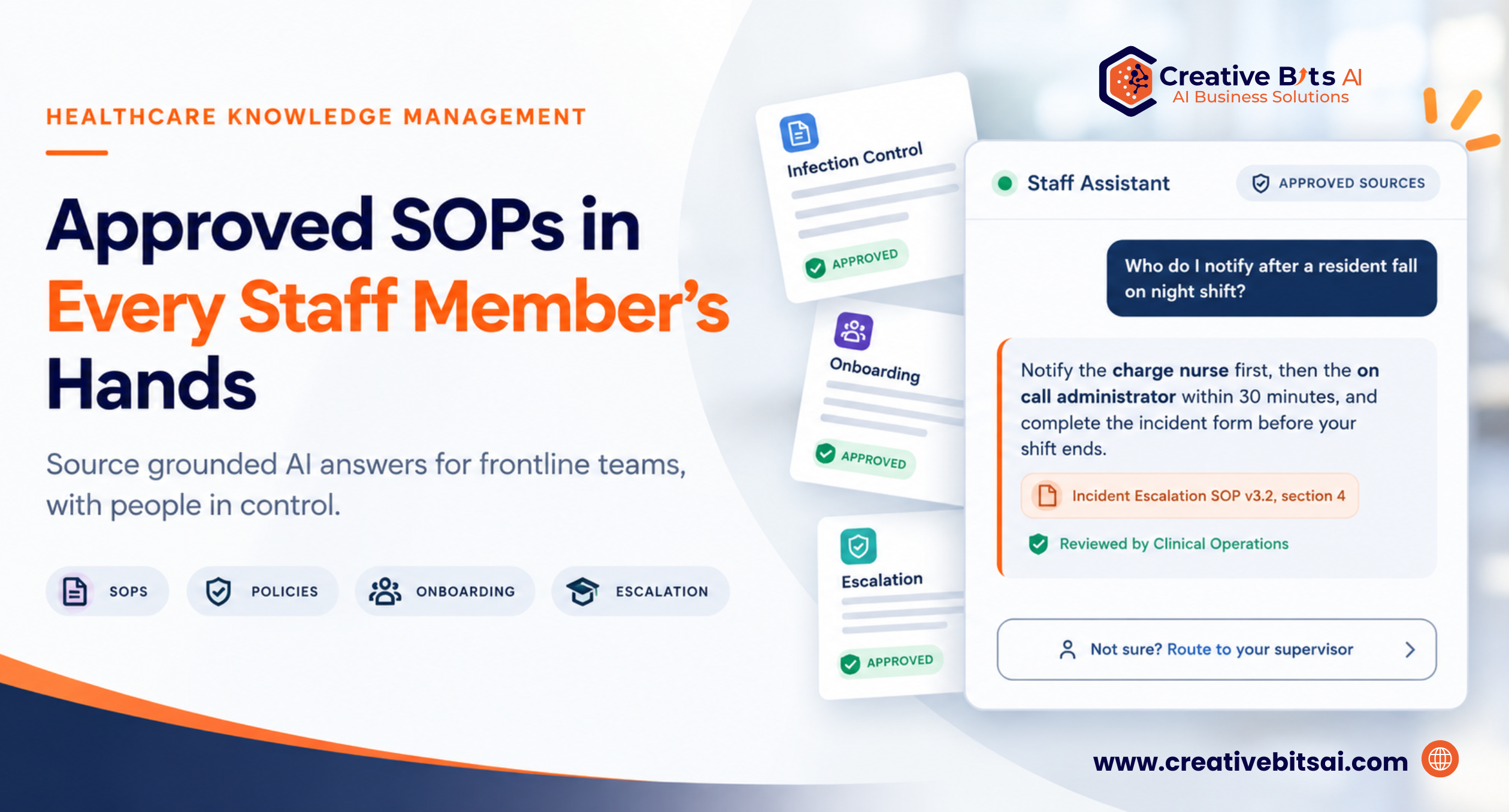
It is 2:40 in the morning in a senior living community. A caregiver who joined three weeks ago finds a resident on the floor beside the bed. She knows there is a procedure for this. She remembers it from orientation. What she cannot remember is who gets called first, how quickly, and which form needs to be completed before the end of her shift.
The answer exists. It sits in an incident escalation SOP, version 3.2, saved somewhere on a shared drive, right next to version 3.1, which a few colleagues still keep printed in a binder at the nurses’ station. So she does what frontline staff everywhere do. She texts a colleague, waits for a supervisor to call back, and hopes the version she follows is the right one.
This is the everyday reality of healthcare knowledge management. The problem is rarely that the guidance does not exist. The problem is that the right, current, approved version is not reachable at the exact moment someone needs it.
In this guide, we look at why that gap is so persistent across healthcare providers, senior living operators, behavioral health organizations, and healthcare advisory firms, why a generic AI chatbot is the wrong fix, and how a safeguarded, source-grounded assistant with human review closes it. We also go under the hood for the technical teams who will build and govern it.
Why healthcare knowledge management is harder than in almost any other industry
Every industry has documentation. Healthcare has documentation that carries regulatory, legal, and safety consequences, that changes constantly, and that has to be followed by people who are rarely sitting at a desk.
The volume of rules is enormous.
The American Hospital Association’s landmark Regulatory Overload analysis counted 629 discrete regulatory requirements across nine domains that health systems, hospitals, and post-acute care providers must follow. It estimated that providers spend nearly $39 billion a year on administrative compliance activities, and that an average community hospital dedicates 59 full-time equivalent staff to compliance, more than a quarter of them physicians, nurses, and allied health professionals.
Every one of those requirements eventually becomes a policy, a procedure, a training module, or a checklist that somebody on the front line has to find and follow.
The rules keep moving.
Healthcare regulation is never a fixed target. The National Center for Assisted Living reported that 18 states, including the District of Columbia, updated their assisted living regulations during 2025, with direct care staff education and training the most common area of change. Behavioral health providers that handle substance use disorder records have been working through the updated 42 CFR Part 2 rule, which took effect in April 2024, with compliance required by February 16, 2026.
Then come the local changes: new programs, new sites, updated escalation contacts, and revised forms after a survey. For a multi-site operator, the same question can have a different correct answer in different buildings, and last quarter’s answer may no longer be correct at all.
Information is scattered across too many places.
Most healthcare organizations keep their operational knowledge in a patchwork of shared drives, intranet pages, learning management systems, binders, email attachments, and the memory of a few experienced people. Each source may be accurate on its own, but nobody can see them all at once.
Even in office settings, this is expensive. Atlassian’s State of Teams 2025 research, based on 12,000 knowledge workers, found that leaders and teams lose 25% of their time just searching for answers. Frontline healthcare staff do not have the luxury of a desk and time to search. They are mid-shift, often with a resident or patient waiting.
The people who need the answers keep changing.
Turnover turns knowledge management from a documentation problem into a continuous onboarding problem.
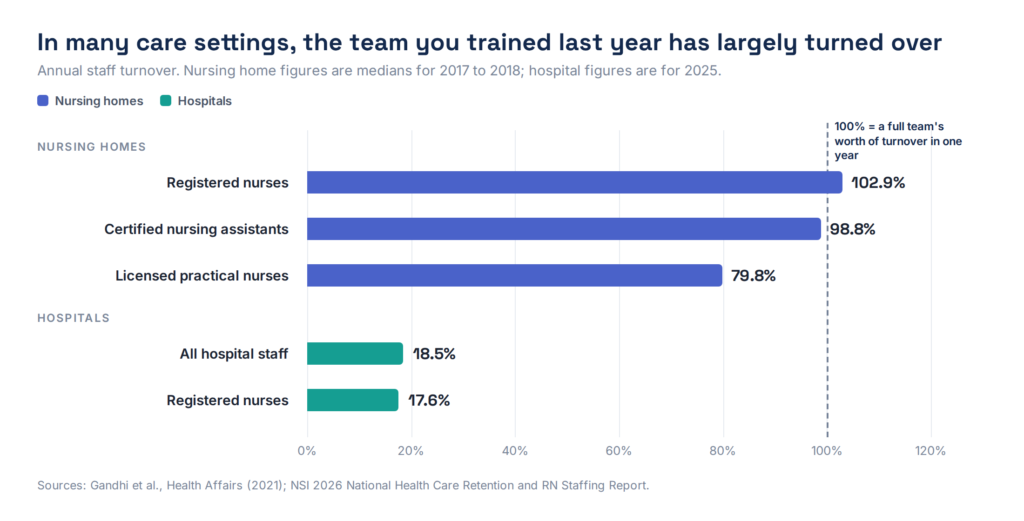
A Health Affairs study of payroll data from more than 15,000 nursing homes found median annual turnover of 102.9% for registered nurses and 98.8% for certified nursing assistants. In hospitals, the NSI 2026 National Health Care Retention and RN Staffing Report puts 2025 hospital staff turnover at 18.5%, with 29.5% of new hires leaving within their first year. Behavioral health is under similar strain. In a National Council for Mental Wellbeing survey, 93% of behavioral health workers reported experiencing burnout and 65% reported increased caseloads.
When a large share of your team is new every year, the knowledge that “everybody knows” quietly stops being known. Your SOP library has to do the teaching that experienced colleagues used to do.
What weak healthcare knowledge management really costs
It is tempting to treat this as an inconvenience. It is not.
When staff cannot find the current procedure, they improvise or rely on memory, and practice starts to drift between shifts and sites. Supervisors and educators become human search engines, answering the same questions again and again instead of coaching. Outdated versions stay in circulation, which is exactly the kind of inconsistency that surveyors and auditors notice. And new hires take longer to work independently, which matters a great deal when nearly a third of new hospital hires leave within a year.
None of these costs show up as a single line item. Together, they form one of the largest hidden operational drains in healthcare.
Why a generic AI chatbot is the wrong fix
Given all this, it is understandable that teams want to point a general-purpose AI chatbot at the problem. In healthcare, that is a risky shortcut.
ECRI, the independent patient safety organization, placed the misuse of AI chatbots at the top of its Top 10 Health Technology Hazards for 2026. ECRI warns that chatbots are “programmed to sound confident and to always provide an answer,” even when that answer is not reliable, and recommends AI governance committees, AI training for clinicians, and regular audits of how AI tools perform.
The Joint Commission and the Coalition for Health AI reached a similar conclusion in their September 2025 Guidance on the Responsible Use of AI in Healthcare. The guidance centers on seven elements: AI policies and governance structures, patient privacy and transparency, data security and data use protections, ongoing quality monitoring, voluntary blinded reporting of AI safety-related events, risk and bias assessment, and education and training.
The message is consistent. In a high-stakes environment, the question is not whether AI can produce an answer. It is whether that answer comes from an approved source, whether anyone can verify it, and whether a person stays accountable for it.
What a safeguarded healthcare knowledge assistant does differently
At Creative Bits AI, our healthcare approach rests on three principles that map directly to that guidance.
1. A source-grounded assistant
It turns your static, approved operational knowledge, including SOPs, policies, onboarding guides, training materials, and escalation paths, into an assistant staff can simply ask. Answers are drawn from your own documents and arrive with a citation to the document, section, and version, so staff can check the source in one tap.
2. Safeguarded infrastructure
The assistant answers only from verified internal sources. It does not pull from the open internet or fill gaps with general knowledge. If the approved content does not contain the answer, it says so instead of guessing, and every search is scoped to the user’s site and role.
3. Human-in-the-loop review
People stay in control. Policy owners approve what goes into the library, uncertain or high-risk questions are routed to a supervisor or designated owner, and every routed question becomes a signal about where documentation needs to improve.
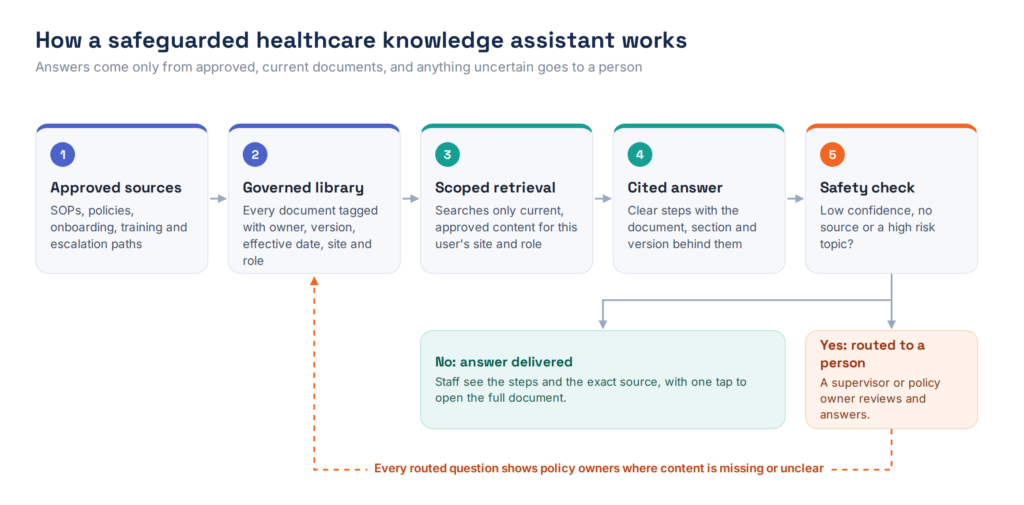
This design does not replace supervisors, educators, or compliance teams, and it does not make compliance decisions. It supports human review and gives frontline staff faster access to guidance your organization has already approved. We explore the wider security model in our guide to Safeguarded RAG Chatbots.
Under the hood: how to build it properly
This section is for the Cos, IT leaders, and compliance partners who will build, secure, and govern the system. Modern healthcare knowledge management is built on retrieval-augmented generation (RAG), with healthcare-specific controls layered on top.
Build a governed knowledge library first.
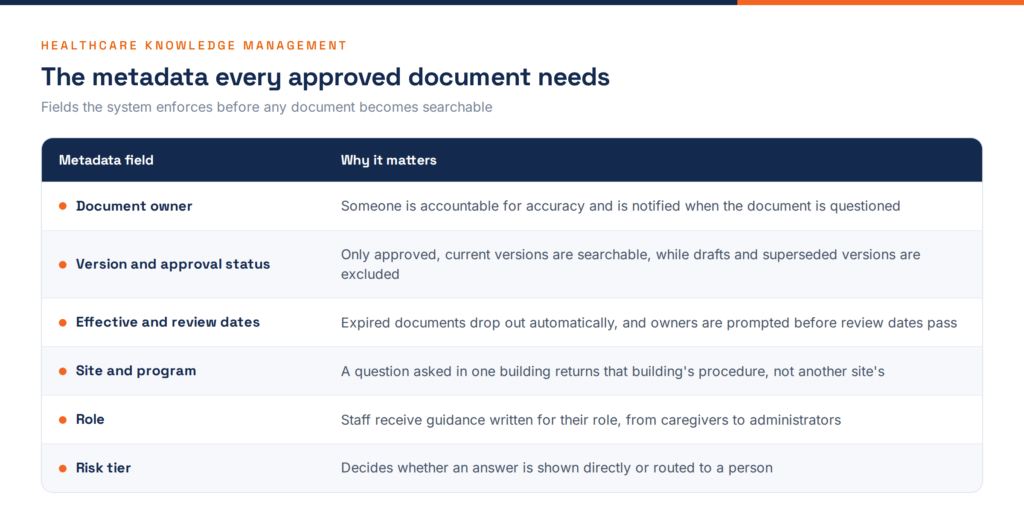
Good healthcare knowledge management starts with the library, because the quality of every answer depends on what sits beneath it. Before anything is indexed, each document needs metadata that the system can enforce, not just display.
Chunk by procedure, not by page
Healthcare documents are full of numbered steps, tables, and conditional instructions. If a chunk cuts a procedure in half, the answer will be incomplete in the most dangerous way possible: confidently partial. Split on headings and procedure boundaries, keep numbered steps and tables together, and begin with a sensible size. Microsoft’s Azure AI Search guidance suggests starting with chunks of about 512 tokens with a 25% overlap, then tuning against your own test questions.
Exact terms matter too. Staff searches for form names, unit codes, and policy numbers that pure vector search can miss. Anthropic’s research on contextual retrieval found that adding document context to each chunk and combining it with keyword search cut retrieval failures by 49%, rising to 67% when a reranking step was added.
Scope retrieval before the model sees anything.g
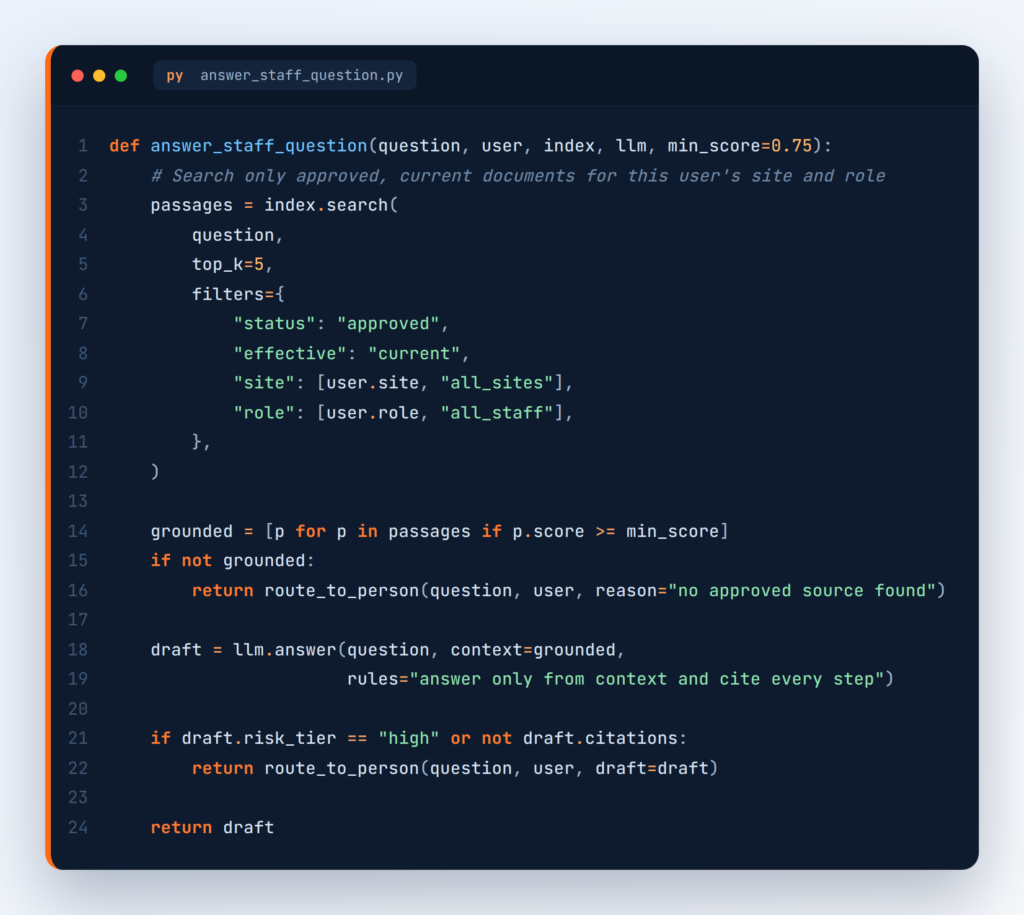
The most important safeguard happens before any answer is generated. Filters for approval status, effective date, site, and role are applied at search time, so content a user should not see never reaches the model. Here is a simplified version of that logic in Python:
Answer with citations, or do not answer.
The system prompt should require the model to answer only from the retrieved passages, cite every step, and say plainly when the approved documents do not cover the question. In healthcare, “I could not find an approved procedure for this, so I have sent your question to your supervisor” is a far better answer than a fluent guess.
Route by risk, not just by confidence
Confidence scores catch weak retrieval. They do not catch topics that should always involve a person. That is why we pair them with risk tiers set by your clinical and compliance leaders.
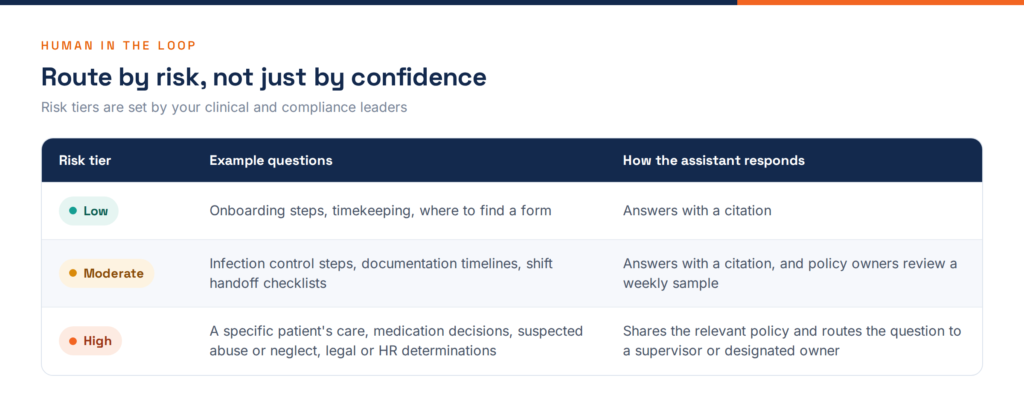
Deciding where AI should act and where people should decide is a design choice in its own right, one we explore in our piece on intelligent workflow design.
Keep protected health information out by design.
SOPs and policies rarely contain protected health information, which is one reason operational knowledge is such a strong starting point for AI in healthcare. Staff questions are a different matter, because people naturally type names and details. Build in prompts that discourage it, redact identifiers before anything is logged, and keep pilots free of PHI.
Where PHI could be processed, run the system only on HIPAA-eligible cloud services covered by a business associate agreement. AWS, for example, states that customers may not use its HIPAA-eligible services with PHI without first entering into an AWS business associate agreement. Behavioral health organizations should also map any flow that touches substance use disorder records against 42 CFR Part 2.
Monitor it like a quality program.m
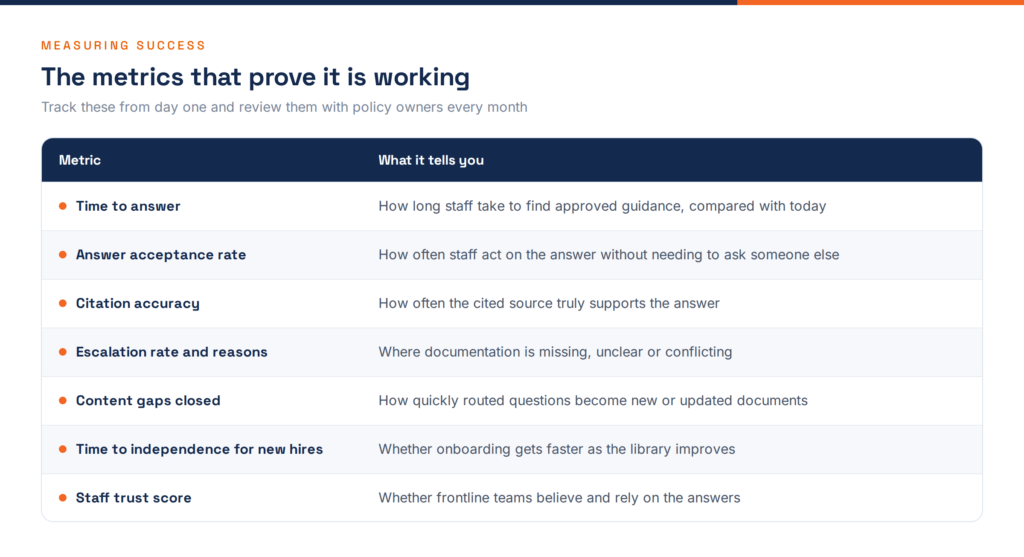
Following the emphasis on ongoing quality monitoring in the Joint Commission and CHAI guidance, track a small set of metrics from day one (see the table further down). Open-source evaluation frameworks such as Ragas can score faithfulness and context precision against a test set built from real staff questions. Anchor the program to a recognized framework such as the NIST AI Risk Management Framework, record the system in your AI risk register, and compare your controls against the standards in our AI security framework comparison.
What this looks like across healthcare segments
The core design of healthcare knowledge management stays the same across settings, but each segment brings its own questions and its own moving parts.
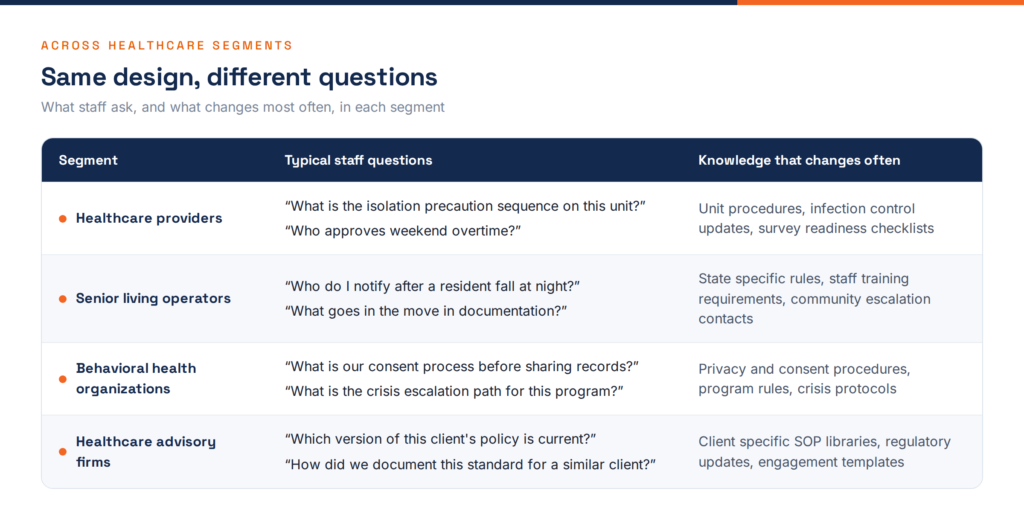
For advisory firms in particular, strict separation between client libraries is essential, so one client’s procedures can never surface in another client’s answers.
The healthcare knowledge management metrics that prove it is working
How to start without boiling the ocean
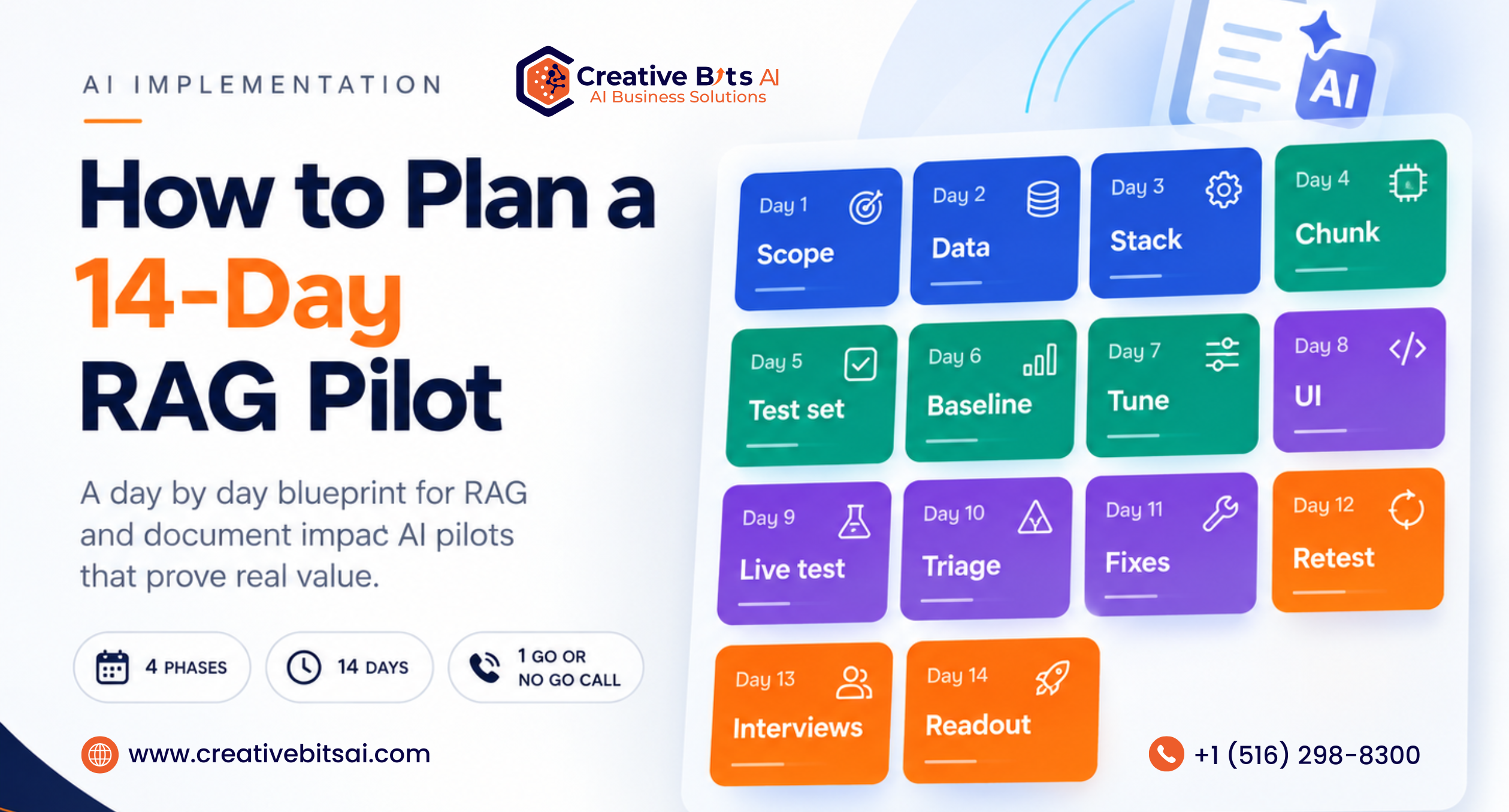
The fastest way to prove the value of AI for healthcare knowledge management is a focused pilot, not an enterprise rollout. Choose one site or program, one workflow such as onboarding or incident escalation, 50 to 100 approved documents, and three to five frontline testers. Build a test set of 20 to 30 real staff questions, including a few the documents should not be able to answer, and measure retrieval, answer accuracy, and escalation behavior separately. We share the complete day-by-day plan in our guide on how to plan a 14-day RAG pilot.
If the pilot proves its value, the next decision is usually whether to build the production system in-house or work with a partner. Our build vs buy guide for enterprise AI walks leaders through that choice.
Common healthcare knowledge management mistakes to avoid
- Indexing everything at once. Outdated and duplicate documents are the fastest route to wrong answers.
- Skipping document ownership. If nobody owns a policy, nobody fixes it when the assistant flags a gap.
- Treating every question the same. Risk tiers matter more in healthcare than in almost any other industry.
- Hiding the human. If staff cannot reach a person easily, they will not trust the assistant.
- Ignoring site differences. One organization often has several correct answers to the same question.
- Launching without training. Both ECRI and the Joint Commission stress education. Staff need to know what the assistant does, what it does not do, and how to check a source.
Frequently asked questions about healthcare knowledge management
What is healthcare knowledge management?
Healthcare knowledge management is the practice of capturing, approving, organizing, and delivering the operational knowledge that healthcare staff relies on, including SOPs, policies, onboarding and training materials, and escalation paths, so the right current version is available at the point of need.
Is an AI knowledge assistant a clinical decision support tool?
No. The approach in this guide focuses on operational knowledge such as procedures, policies, onboarding, and workflows. Questions about an individual patient’s care are routed to qualified staff.
Can an AI knowledge assistant be HIPAA compliant?
HIPAA compliance depends on how the whole system is deployed and governed, not on the AI model alone. Keeping PHI out of the knowledge base, using HIPAA-eligible services under a business associate agreement wherever PHI may be involved, and enforcing access controls are the foundations.
How does the assistant handle policy updates?
When a new version is approved, the previous one is retired from search automatically through version and effective date metadata, so staff only ever see current guidance.
Will it replace supervisors or educators?
No. It takes on the repetitive lookup questions so supervisors and educators can spend more time coaching, and it routes anything sensitive or uncertain straight to them.
The bottom line
Healthcare runs on approved procedures, and those procedures only protect people when staff can find and follow the current version at the moment it matters. Healthcare knowledge management has always been about that last mile. AI finally makes it practical, as long as it is built with the same discipline healthcare applies to everything else: approved sources, clear accountability, and people in control.
Think back to the caregiver at 2:40 in the morning. With a safeguarded assistant, she asks a plain question and gets the current escalation steps, the exact SOP section behind them, and a one-tap route to her supervisor if anything is unclear. That is the standard frontline teams deserve.
Are you ready to put approved knowledge in your team’s hands? At Creative Bits AI, we build safeguarded AI systems for healthcare providers, senior living operators, behavioral health organizations, and healthcare advisory firms. Our assistants answer from approved sources, cite every answer, and keep people in control of review and approval; they can be configured for your existing systems, subject to a short technical discovery with us.