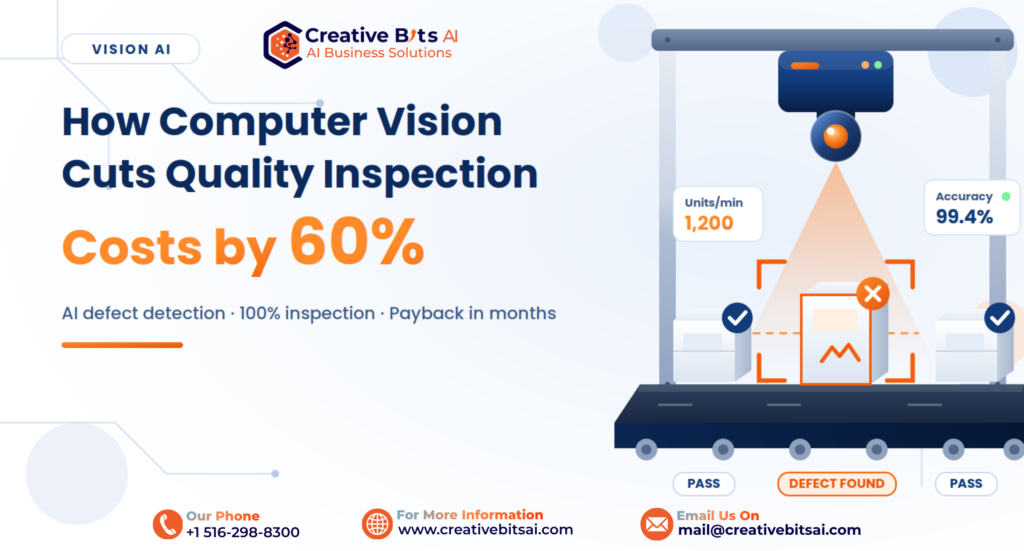
Computer vision quality control is quietly doing what decades of process improvement programs could not: cutting quality inspection costs by 60% or more while catching defects human inspectors routinely miss. For manufacturers squeezed between rising labor costs and zero-tolerance customer expectations, AI-powered visual inspection has moved from experimental technology to competitive necessity. And the economics are hard to argue with: a camera and a trained model inspect every single unit at production speed, never fatigue at hour seven of a shift, and cost a fraction of a staffed inspection line.
In this guide, we’ll break down exactly where that 60% saving comes from, what the technology actually does, and how to implement it without disrupting your production line.
The Real Cost of Traditional Quality Inspection
Before understanding the savings, it helps to understand what manual inspection actually costs. The obvious expense is labor: inspectors’ salaries, benefits, training, and turnover. But the hidden costs run deeper.
Human visual inspection is inherently inconsistent. Studies of manual inspection accuracy consistently find that human inspectors catch only 70–80% of defects under production conditions, with accuracy degrading sharply with fatigue, monotony, and speed pressure. Every defect that slips through becomes a downstream cost: rework, scrap, warranty claims, returns, and — most expensive of all — damaged customer trust.
Then there’s the sampling problem. Since manual inspection is slow and expensive, most factories inspect a sample of units rather than every unit. Sampling catches systemic problems but misses intermittent ones, which is precisely how a single bad batch reaches customers.
Add it up, and quality-related costs typically consume 15–20% of sales revenue in manufacturing organizations, according to quality cost research from ASQ. That’s the number of computer vision attacks.
What Computer Vision Quality Control Actually Does
A computer vision quality control system pairs industrial cameras with deep learning models trained to recognize what “good” and “defective” look like for your specific products. Positioned over a production line, the system captures images of every unit and classifies them in milliseconds: pass, fail, or flag for human review.
Modern systems detect flaws far beyond what rule-based machine vision of the 2010s could handle: surface scratches and dents, color and texture inconsistencies, missing components, misaligned labels, incorrect assembly, contamination, weld and solder defects, packaging damage, and dimensional deviations. Because the models learn from examples rather than hand-coded rules, they handle natural product variation, the reason older machine vision systems drowned teams in false rejects.
The NVIDIA industrial inspection ecosystem and open-source frameworks like OpenCV have also driven hardware and development costs down dramatically, which is why what once required a seven-figure integration now fits mid-market budgets. This is the same underlying technology we deploy in our computer vision solutions across manufacturing, logistics, and infrastructure clients.
Where the 60% Savings Come From
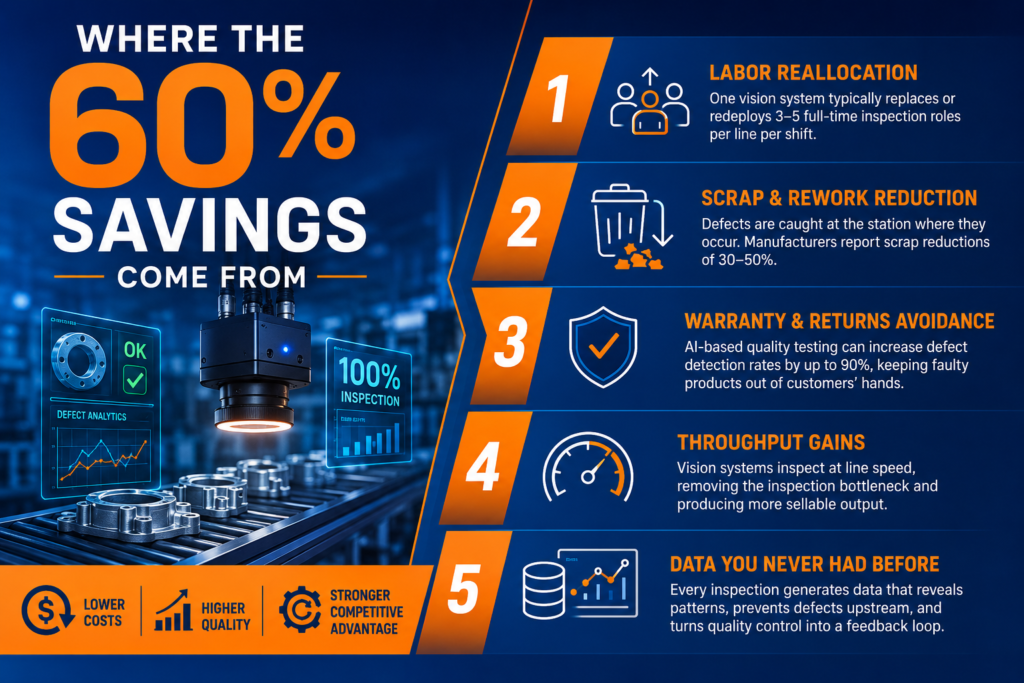
The headline number isn’t from a single line item. It’s the compound effect of 5 reductions:
1. Labor reallocation (the largest single driver). One vision system typically replaces or redeploys 3–5 full-time inspection roles per line per shift. Inspectors aren’t eliminated so much as promoted, moved from repetitive visual checks to exception handling, root-cause analysis, and process improvement, where human judgment actually adds value.
2. Scrap and rework reduction. Because AI inspects 100% of units in real time, defects are caught at the station where they occur, not three stations later. Catching a flaw before additional material and labor are invested in a doomed unit cuts rework costs sharply; manufacturers implementing AI-driven inspection routinely report scrap reductions of 30–50%.
3. Warranty and returns avoidance. Escaped defects are the most expensive kind. McKinsey’s research on AI in manufacturing has found that AI-based quality testing can increase defect detection rates by up to 90% compared to human inspection, directly shrinking the population of faulty products that reach customers.
4. Throughput gains. Vision systems inspect at line speed. Removing the inspection bottleneck means lines can run faster without sacrificing quality coverage, effectively producing more sellable output from the same fixed costs.
5. Data you never had before. Every inspection generates structured data: defect type, location, frequency, time, line, shift. Patterns emerge within weeks: a die wearing out, a supplier’s material drifting out of spec, a specific machine misbehaving on Mondays. This turns quality control from a filter into a feedback loop that prevents defects upstream, the same data-driven approach we apply in our structural defect analysis solution for infrastructure inspection.
A Realistic ROI Example
Consider a mid-size manufacturer running two production lines, two shifts, with four inspectors per shift at a fully loaded cost of $55,000 per inspector per year:
- Current inspection labor: 16 inspectors × $55,000 = $880,000/year
- Current scrap, rework, and escape costs (conservative): $600,000/year
- Total addressable quality cost: ~$1.48M/year
A computer vision deployment for two lines — cameras, lighting, edge compute, model development, and integration — typically lands between $150,000 and $400,000 depending on complexity, with modest ongoing costs for maintenance and model retraining.
If the system redeploys 10 of 16 inspectors ($550,000), cuts scrap and rework by 40% ($240,000), and reduces escapes by half ($100,000+ in warranty avoidance), the annual saving approaches $890,000 — roughly 60% of the addressable quality cost — with payback in under six months. Your numbers will differ, but this is the arithmetic behind the headline, and it’s consistent with what Deloitte’s smart factory research reports across early adopters.
Implementation: How to Get It Right
The technology works. Most failed deployments fail on process, not algorithms. Here’s the path we recommend:
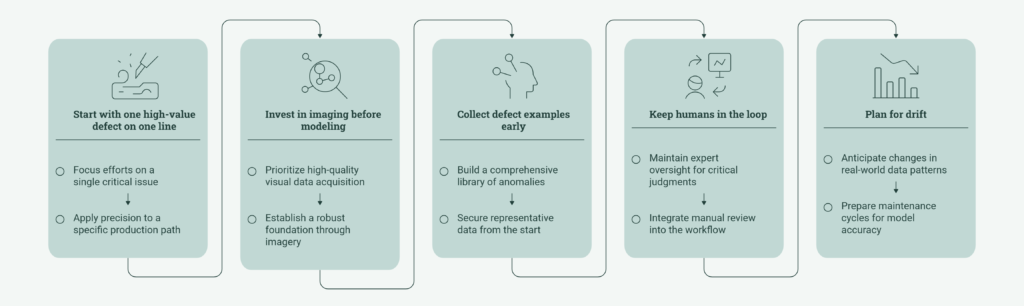
Start with one high-value defect on one line. Pick the defect type that costs you the most, not the easiest one to detect. A focused pilot proves ROI in 8–12 weeks and builds the internal case for scaling.
Invest in imaging before modeling. Lighting, camera angle, and resolution determine 80% of system performance. A great model can’t recover information from a poor image never captured.
Collect defect examples early. Deep learning models need labeled examples of both good and bad units. Start saving images of defects now, even before a project kicks off; historical defect libraries dramatically shorten development time.
Keep humans in the loop. The best deployments route low-confidence classifications to human reviewers. This maintains accuracy from day one and generates continuous training data that improves the model every week, the same human-in-the-loop pattern that makes our AI-powered project management and procurement solutions reliable in production.
Plan for drift. Products change, suppliers change, lighting ages. Budget for periodic model retraining as an operating cost, not a surprise. This is where an experienced AI implementation partner matters more than any single technology choice.
Beyond the Factory Floor
While manufacturing is the flagship use case, the same computer vision quality control approach is spreading fast: food processors checking fill levels and contamination, pharmaceutical lines verifying packaging and labeling compliance, logistics operations inspecting parcels for damage, agriculture grading produce, and construction teams assessing structural defects from drone imagery. E-commerce operations even apply it to verify product imagery and listing accuracy at scale.
If a quality decision currently depends on a person looking at something, it’s a candidate for computer vision.
The Bottom Line
Computer vision quality control delivers its 60% cost reduction through compounding effects: reallocated labor, less scrap, fewer escapes, faster lines, and defect data that prevents problems upstream. The technology is mature, the hardware is affordable, and the payback period is measured in months, not years.
The manufacturers winning with it aren’t the ones with the biggest budgets. They’re the ones who started with a focused pilot, got the imaging right, and kept humans in the loop while the system learned.
At Creative Bits AI, we design and deploy computer vision systems tailored to your production environment, from feasibility assessment through pilot to full-line rollout. Book a free demo, and let’s calculate what a 60% inspection cost reduction looks like for your operation.