Choosing the right AI security framework has quietly become one of the most consequential decisions a business can make in 2026. As organizations move AI systems from pilot projects into production, powering customer support, financial reconciliation, and candidate screening, the question is no longer whether to secure AI, but which framework should guide that effort. The problem? There isn’t one standard. There are at least five major ones, each built for a different purpose, audience, and risk profile. Pick the wrong one, and you’ll either drown your team in compliance paperwork or leave dangerous gaps in your defenses.
This guide breaks down the leading AI security frameworks, what each one actually covers, and how to match the right framework (or combination) to your organization.
Why AI Security Needs Its Own Framework
Traditional cybersecurity frameworks were built for a world of servers, networks, and applications with predictable behavior. AI systems break those assumptions. They learn from data that can be poisoned, respond to prompts that can be manipulated, and make probabilistic decisions that can’t always be explained.
The threat landscape reflects this. Prompt injection, model theft, training data poisoning, adversarial examples, and sensitive data leakage through model outputs are attack vectors that simply don’t exist in conventional software. Meanwhile, regulators are moving fast: the EU AI Act is now enforcing obligations for high-risk AI systems, and procurement teams increasingly ask vendors which AI security framework they follow before signing a contract.
In other words, an AI security framework isn’t just a defensive measure anymore. It’s a business enabler, the difference between closing an enterprise deal and losing it at the security review stage.
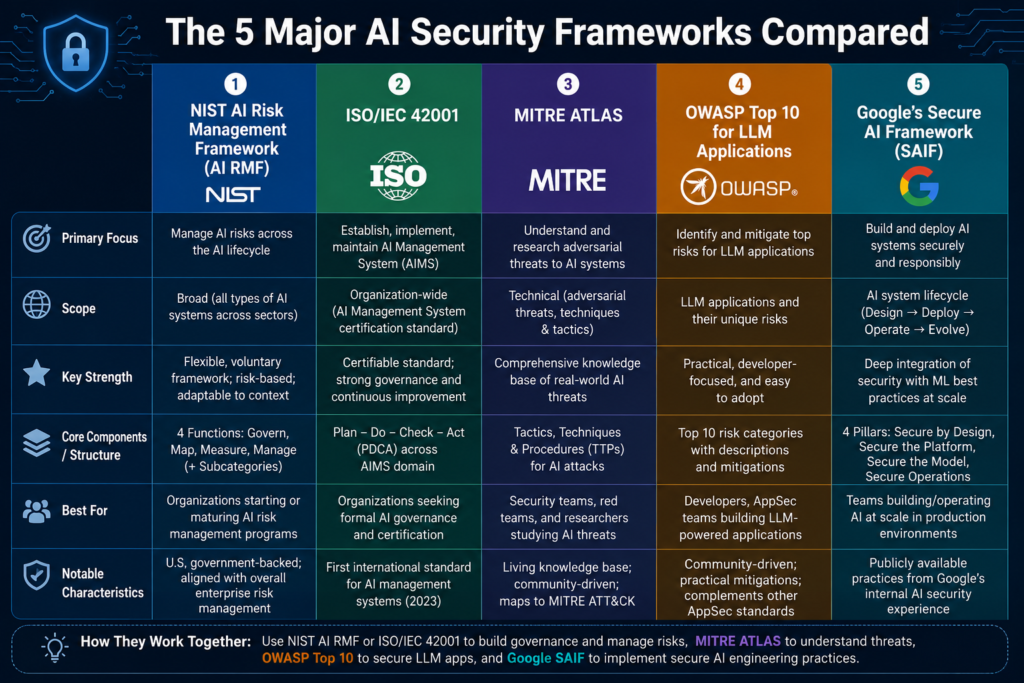
The 5 Major AI Security Frameworks Compared
1. NIST AI Risk Management Framework (AI RMF)
The NIST AI RMF is the closest thing the industry has to a universal starting point. Published by the U.S. National Institute of Standards and Technology, it organizes AI risk management into four functions: Govern, Map, Measure, and Manage.
What it’s best at: Building an organization-wide culture of AI risk awareness. It’s voluntary, flexible, and technology-neutral, which makes it adaptable to almost any industry.
Where it falls short: It’s a risk management framework, not a technical playbook. It tells you what to think about, not how to configure your model pipeline. Teams looking for concrete security controls will need to pair them with something more tactical.
Best for: Mid-size to large organizations that need a defensible, recognized foundation for AI governance, especially those selling into U.S. markets or government.
2. ISO/IEC 42001
ISO/IEC 42001 is the world’s first certifiable AI management system standard. Think of it as the AI equivalent of ISO 27001: it defines requirements for establishing, implementing, and continually improving an AI management system (AIMS).
What it’s best at: Third-party certification. If your customers or regulators want proof of responsible AI governance, ISO 42001 is currently the only internationally recognized certificate you can hang on the wall.
Where it falls short: Certification is expensive and process-heavy. For a startup shipping its first AI feature, the overhead can outweigh the benefit.
Best for: Enterprises in regulated industries (finance, healthcare, insurance) and vendors selling AI products to enterprise buyers who demand audited assurance.
3. MITRE ATLAS
MITRE ATLAS (Adversarial Threat Landscape for Artificial-Intelligence Systems) is the offensive-minded sibling of the well-known MITRE ATT&CK framework. It catalogs real-world adversarial tactics and techniques used against machine learning systems, from reconnaissance of ML artifacts to model evasion and exfiltration.
What it’s best at: Threat modeling and red teaming. If you want to know exactly how attackers compromise AI systems in the wild, ATLAS is the reference.
Where it falls short: It’s a knowledge base, not a governance program. It won’t help you satisfy auditors or structure policies.
Best for: Security teams, red teamers, and ML engineers who need to test and harden production AI systems against realistic attacks.
4. OWASP Top 10 for LLM Applications
The OWASP Top 10 for LLM Applications does for generative AI what the original OWASP Top 10 did for web apps: it names the most critical vulnerabilities in plain language. Prompt injection, insecure output handling, training data poisoning, and excessive agency all make the list.
What it’s best at: Practical, developer-friendly guidance. It’s free, concise, and immediately actionable for teams building LLM-powered products, whether that’s an AI article writer or an e-commerce recommendation engine.
Where it falls short: It’s scoped to LLM applications specifically. Computer vision systems, predictive models, and broader governance questions fall outside its lane.
Best for: Development teams shipping LLM features who need a security checklist they can apply this sprint, not next quarter.
5. Google’s Secure AI Framework (SAIF)
Google’s SAIF translates decades of Google’s internal security practice into six core elements for AI systems, covering everything from expanding detection and response to include AI to automating defenses and contextualizing AI risk within business processes.
What it’s best at: Bridging AI security with existing enterprise security operations. SAIF assumes you already have a security program and shows you how to extend it to AI.
Where it falls short: It’s a conceptual framework from a single vendor, without certification or regulatory standing.
Best for: Organizations with mature security operations centers that want to fold AI into existing detection, response, and hardening workflows.
How to Choose: A Decision Path
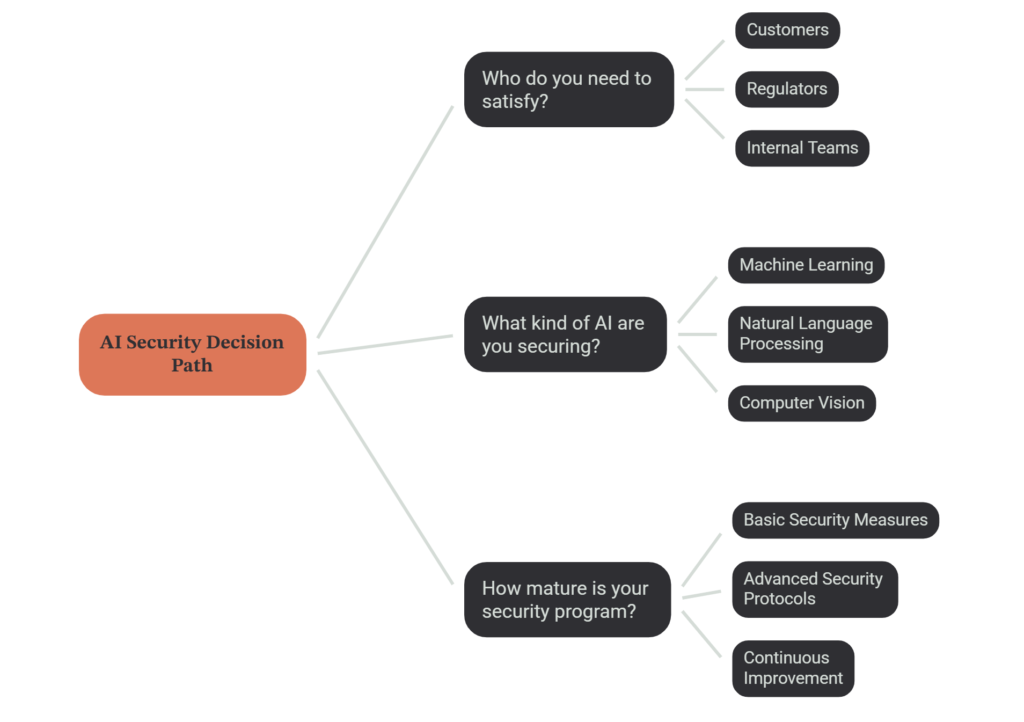
Rather than asking “which framework is best,” ask three questions:
1. Who do you need to satisfy? If the answer is auditors, regulators, or enterprise procurement teams, start with ISO 42001 (certifiable) underpinned by NIST AI RMF (widely referenced in U.S. policy). If the answer is your own engineering team, start with OWASP and ATLAS.
2. What kind of AI are you securing? LLM-based applications map cleanly to the OWASP Top 10 for LLMs. Computer vision, fraud detection, and other predictive systems benefit more from MITRE ATLAS threat modeling combined with NIST AI RMF governance.
3. How mature is your security program? If you already run a SOC with established incident response, SAIF helps you extend what you have. If you’re building AI governance from scratch, NIST AI RMF gives you the scaffolding first.
For most growing businesses, the practical answer is layered: NIST AI RMF for governance, OWASP for development, and ATLAS for testing, adding ISO 42001 certification when enterprise deals or regulators demand it.
Common Mistakes to Avoid
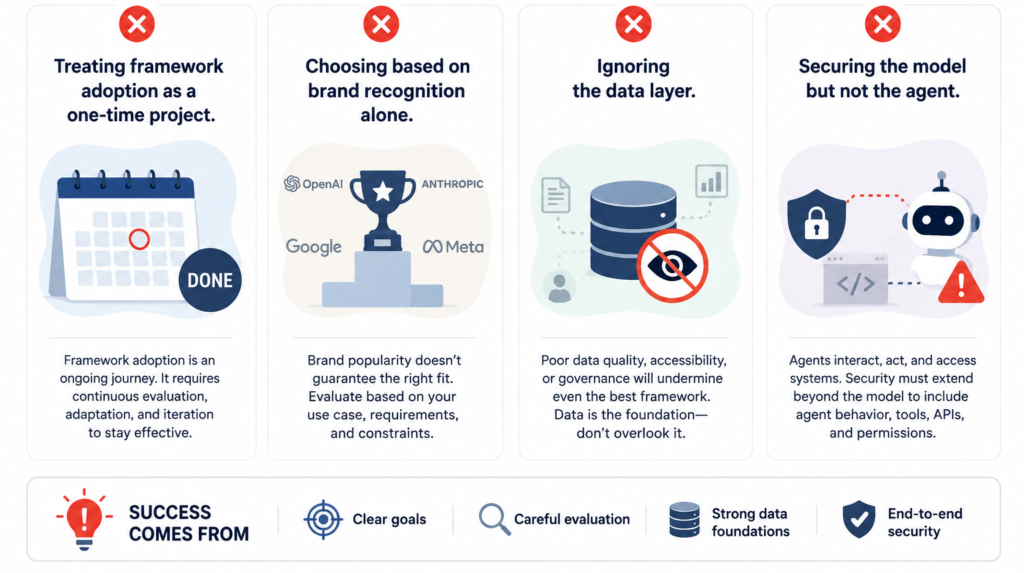
Treating framework adoption as a one-time project. AI systems drift, models get retrained, and new attack techniques emerge monthly. Framework alignment is a continuous practice, not a certificate on the wall.
Choosing based on brand recognition alone. ISO certification is impressive, but if your real risk is prompt injection in a customer-facing chatbot, the OWASP Top 10 will protect you faster and cheaper.
Ignoring the data layer. Every framework above assumes your training and inference data pipelines are governed. If you’re deploying AI for due diligence research or health insurance workflows, data governance isn’t optional; it’s where most real-world incidents begin.
Securing the model but not the agent. As businesses adopt multi-step approval automation and AI agents, the attack surface expands from a single model to entire workflows with tool access and permissions. Your framework choice must account for agentic behavior, not just model outputs.
The Bottom Line
There is no single “right” AI security framework; there’s the right framework for your risk profile, your buyers, and your stage of AI maturity. NIST AI RMF gives you governance language everyone recognizes. ISO 42001 gives you certifiable proof. OWASP and MITRE ATLAS give your engineers something concrete to build and test against. SAIF ties it all back to your existing security operations.
The organizations that get this right don’t pick a framework and file it away. They embed security thinking into every stage of the AI lifecycle, from data collection to model deployment to agent orchestration.
At Creative Bits AI, we build AI solutions with security and governance designed in from day one, not bolted on after launch. Whether you’re deploying your first AI-powered workflow or scaling agents across the enterprise, our team can help you map the right framework to your business. Reach out for a free consultation and put a security strategy behind your AI ambitions.