
AI can now write a blog post in seconds. But that speed has triggered a quiet arms race: as content generation gets faster, AI content detection tools are racing to keep up. For any brand publishing at scale, understanding this dynamic is now essential to protecting both search rankings and reader trust.
The good news? The goal is not to hide that you use AI. It is to publish content good enough that it does not matter. Let’s break down how AI content detection actually works, what search engines really reward, and how to strike the right balance.
How AI Content Detection Actually Works
AI content detection tools analyze writing for statistical patterns that machines tend to produce, mainly two signals: perplexity (how predictable the word choices are) and burstiness (how much sentence length and rhythm vary). Human writing tends to be less predictable and more varied. AI writing, by default, is smoother and more uniform.
But here is the catch: detectors are far less reliable than the marketing around them suggests. According to independent testing across leading detectors, even the best tools miss 15% to 30% of AI-generated content, with accuracy varying significantly depending on the model that produced the text. Academic research puts the range similarly, with most detectors achieving 70% to 88% accuracy, alongside a false positive rate of 1% to 8%.
That false positive rate matters. Non-native English writers and technical authors are disproportionately flagged by detection algorithms tuned for perplexity and burstiness patterns. In other words, AI content detection tools sometimes flag genuinely human writing as machine-made.
Here is the finding that reframes the entire debate. The same detector testing found that detection accuracy drops 20 to 30 percentage points with light editing, such as sentence restructuring or synonym replacement, and heavy editing that adds original insights and domain terminology drops accuracy below 50% for every detector tested.
This tells us something important. AI content detection is most effective against raw, unedited AI output and least effective against the AI-assisted content that professional writers actually produce. The line between “AI” and “human” content is already blurry, and getting blurrier.
What Google Actually Rewards (It’s Not What You Think)
Many people assume Google penalizes AI content on sight. It does not. In its official guidance on AI-generated content, Google explains that using automation, including AI, to generate content with the primary purpose of manipulating ranking in search results violates spam policies, but that not all use of automation is spam.
The real standard is quality, not origin. That same Google guidance confirms that its ranking systems aim to reward original, high-quality content that demonstrates E-E-A-T: expertise, experience, authoritativeness, and trustworthiness, with the focus on the quality of content rather than how it is produced.
Where AI genuinely causes ranking problems is scale without value. Google’s documentation on generative AI content warns that using generative AI to produce many pages without adding value for users may violate its spam policy on scaled content abuse. The penalty targets thin, mass-produced content, whether a human or a machine made it.
The Winning Strategy: AI-Human Collaboration
So AI content detection is imperfect, and Google rewards quality over origin. The practical takeaway is a hybrid workflow that combines AI speed with human judgment.
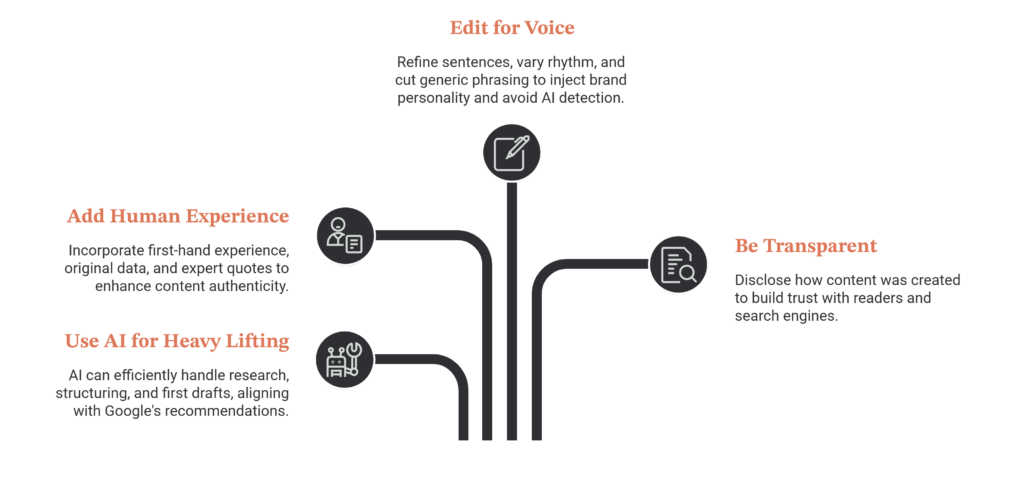
First, use AI for the heavy lifting: research, structure, first drafts, and outlines. This is exactly the use case Google endorses.
Second, add what AI cannot: first-hand experience, original data, real examples, expert quotes, and a genuine point of view. This is the “Experience” in E-E-A-T, and it is the single hardest thing for a detector or a competitor to replicate.
Third, edit for voice. Restructure sentences, vary rhythm, cut generic phrasing, and inject your brand’s personality. As a side benefit, this is also what neutralizes most AI content detection flags.
Fourth, be transparent where it counts. In its generative AI documentation, Google notes that sharing information about how content was created can give readers helpful context, particularly for automatically generated content. Clear authorship and honest disclosure build the trust that both readers and search engines value.
The Bottom Line
The AI content detector arms race is real, but it is the wrong thing to obsess over. Chasing a low detection score is a losing game because the tools are inconsistent and easily fooled. Building genuinely helpful, experience-rich content is the winning game because it satisfies readers, search engines, and AI answer engines all at once.
AI is a tool, not a shortcut. The brands that win in search will be the ones that pair AI efficiency with authentic human expertise.
At Creative Bits AI, we help brands build AI-first content systems that are fast, scalable, and unmistakably human, so your content ranks and actually connects. Let’s talk.