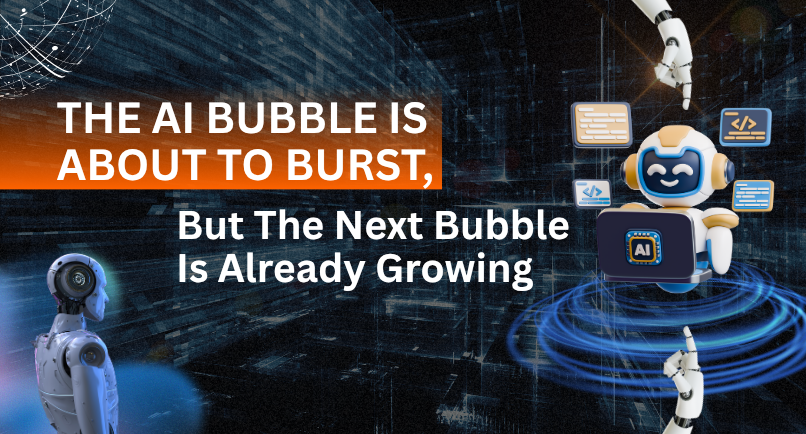
The AI bubble has reached its intoxication phase. Every technology headline claims artificial intelligence is rewriting industries at lightning speed. CEOs announce AI roadmaps to satisfy investors. Startups without products raise millions by renaming their pitch decks with the letters “AI.” Consultants preach disruption while enterprises rush deployment without a strategy, terrifying employees and confusing customers.
But behind the glittering hype cycle, an uncomfortable truth is forming: this AI bubble is already cracking, and most companies are not prepared for what happens next. According to Gartner’s AI Report, more than 85 percent of AI projects will fail to move past experimentation, and McKinsey’s Global AI Index reports that only 15 percent of companies have demonstrated measurable ROI from AI initiatives. The hype far exceeds reality, and the correction phase has already begun. Investors are tightening budgets, AI adoption is stalling, and enterprises are quietly retreating from overpromised AI transformation journeys.
But this is not a story about AI dying. It is about AI evolving. Bubbles don’t kill technologies—they expose weak strategies and force maturity. The dot-com bubble didn’t kill the internet. The crypto crash didn’t kill blockchain. Similarly, the AI bubble correction will not kill artificial intelligence. Instead, it will wipe out shallow “AI theater” and make room for a new wave of applied, agentic, operational AI—AI that works, scales, and produces results.
The AI bubble is bursting. But the next wave—the one that will transform industries with ruthless clarity—is already growing.
The Cracks in the AI Bubble Are No Longer Invisible
The current AI bubble resembles every historical hype cycle we’ve witnessed. The early excitement was driven by breakthrough models like ChatGPT, Google Gemini, Claude, Meta’s Llama, and Microsoft Copilot. But as adoption moved from demonstrations to actual business deployment, everything started collapsing under two brutal forces: cost and complexity.

Most AI initiatives fail because they are built on illusions that are inflating the AI bubble:
The Five Illusions Inflating the AI Bubble
Illusion #1: AI Will Replace Jobs. In reality, AI still depends heavily on human reinforcement. The Verge’s 2024 investigation revealed that many so-called “fully AI-powered” platforms secretly rely on outsourced workers to clean data and fix model failures.
Illusion #2: AI Adoption Is Simple. Enterprises were sold quick wins, but discovered that scaling AI requires a mature data infrastructure, governance, workflow architecture, and integration discipline. MIT Sloan’s research reported that 78 percent of companies trying to implement AI lack adequate data foundations, a factor known as “data debt,” which causes AI performance decay.
Illusion #3: AI Is Already Delivering Significant ROI Investors believe it. Boards want to believe it. But the truth is harsher—most AI tools sit unused. A Fortune 500 CIO study conducted by Accenture revealed that 61 percent of AI subscriptions purchased by enterprises remain underutilized due to poor integration and workflow misalignment.
Illusion #4: Bigger AI Models Equal Better Results. Yet, newer research from Cohere AI shows that smaller, domain-specific models outperform giant LLMs in real business use cases because they are customized and cost-efficient. This revelation is puncturing the AI bubble myth that size equals success.
Illusion #5: AI Will Automatically Drive Transformation, but AI without a system is just another expensive feature. Companies that rushed into AI by purchasing “AI tools” without building business architecture now face inefficient deployments that burn budgets and damage trust.
Within these cracks, trust in AI is eroding. The Stanford AI Trust Index confirms that 59 percent of executives express growing concerns about hallucinations, compliance risk, and AI model drift in production. Regulators are responding. The EU AI Act and upcoming U.S. AI compliance frameworks demand ethical enforcement, documentation, and traceability. The AI bubble gold rush is being replaced by AI accountability.
Why the AI Bubble Is Failing in Production
AI is not failing because it lacks power. It is failing because businesses implemented it backwards, contributing to the AI bubble burst. They started with AI models instead of AI foundations. They built prototypes instead of AI operating systems. They neglected the two things that matter most—workflow context and scalability.
Google Cloud’s 2024 report describes this problem as the “Deployment Gap”—an estimated 85 percent of AI initiatives work in sandbox environments but fail when faced with real operational variables such as changing data, compliance guardrails, and evolving workflows. This failure is predictable because most companies treat AI like a software plugin rather than a systems transformation effort.
AI does not fail for lack of intelligence—it fails due to poor systems design. Production environments require:
- Repeatability and version control
- Orchestration and observability
- Lifecycle management and MLOps discipline
- Model governance frameworks
That’s why Microsoft’s AI Adoption Survey found that the number-one barrier to AI success was not data quality or talent—it was a lack of workflow integration. AI that lives outside operational flow dies from inactivity. AI has to be embedded, not showcased.
Enterprises thought AI would eliminate manual work, but without orchestration, AI creates new chaos. Employees end up working harder because AI outputs still need verification and context alignment. The failure is systematic. Businesses tried to inject AI into broken processes. They automated chaos. AI does not fix poor workflows—it amplifies them. This is why the first AI bubble is cracking. The bubble was built on models. The next wave will be built on systems.
The Next AI Bubble: Intelligent Automation and AI Agents
The AI bubble is shifting. Not collapsing—shifting. The hype bubble around “general-purpose AI chatbots” is deflating, while a new bubble is silently expanding beneath the surface. It is the rise of AI agents, intelligent systems that do not just generate text but take action. They operate inside workflows and execute tasks autonomously. They read context, analyze data, trigger processes, and orchestrate multi-step business operations without supervision.
This is where AI gets real. The next wave is not generative—it is operational. Gartner predicts that by 2026, 40 percent of enterprise workloads will be executed by AI agents. Forrester’s 2025 research calls this shift “Transition to Agentic Workflows,” and McKinsey reports that companies combining AI + workflow automation achieve productivity gains 2.2 times higher than those using AI alone. [Internal link: Explore Our AI Agent Solutions]
These new AI systems will not rely on monolithic LLMs. They will use domain-specific AI models trained for:
- Healthcare diagnostics and patient management
- Logistics and supply chain optimization
- E-commerce personalization and inventory
- Manufacturing quality control
- Legal document processing
- Revenue operations automation
The winning AI systems will be hybrid: predictive AI for forecasting, generative AI for context synthesis, decision AI for routing logic, and agent execution engines for workflow orchestration. AI will move from answers to actions. From copilots to operators. The companies building AI factories—not AI demos—will survive the AI bubble burst and thrive in the next era.
Survival Strategy: Build AI That Works, Not AI That Impresses
The AI bubble correction will expose which companies are builders and which are marketers. The following 24 months will divide business leaders into two camps: those who survive with AI and those who drown in AI chaos.

The AI Bubble Survivor’s Playbook
The survivors will reject hype and follow a new AI strategy:
- Structure Before Scale: Build workflow intelligence first, then deploy AI
- Transparent Agents: Avoid black-box AI and demand explainable systems
- Unit Economics: Track AI through real ROI, not vanity metrics
- Infrastructure First: Invest in AI pipelines, agent orchestration, compliance frameworks, and monitoring systems before buying shiny AI features.
- Workflow Integration: Ensure AI lives within operational processes
They will evaluate AI through one brutal question: Does it do real work?
The AI bubble collapses where effort exceeds impact. The next AI wave grows where automation eliminates effort and compounds impact. The future is not AI-powered companies. It is AI-integrated companies—organizations where AI automates operational friction, reduces cycle time, and increases execution velocity. AI will not disrupt industries. Companies that build better AI systems will.
AI Isn’t Dying—It’s About to Take Over
AI is not in decline. The hype is. And that is good news. Because hype kills clarity—and clarity is precisely what this era demands after the AI bubble bursts. The first wave was about model competition. The next wave is about intelligent automation and AI agents. The companies that transition now will dominate their competitors by building operational leverage that scales forever.
At Creative Bits AI (CBAI), we are not interested in AI theater. We build production-grade AI that survives beyond the AI bubble. We engineer:
- AI agents that work in real business environments
- AI-integrated workflows that scale with your growth
- AI systems that generate measurable ROI
- Agentic automation models that plug into your real operations—CRM, ERP, e-commerce, customer success, finance, logistics, and sales pipelines
We build automation fabrics powered by AI so your company doesn’t drown in tasks—it dominates execution. We don’t ship demos. We build AI that performs. [Internal link: Schedule a Free AI Strategy Session]
The AI bubble is bursting. Good. It clears the noise so builders can build. If you’re ready to move beyond AI hype and step into operational AI, the future belongs to you. And we’re prepared to build it with you.
Ready to Build Real AI That Survives the Bubble?
Don’t get caught in the AI bubble burst. Let’s build AI systems that actually work for your business. Contact Creative Bits AI today for a free consultation on implementing operational AI agents that deliver real ROI.