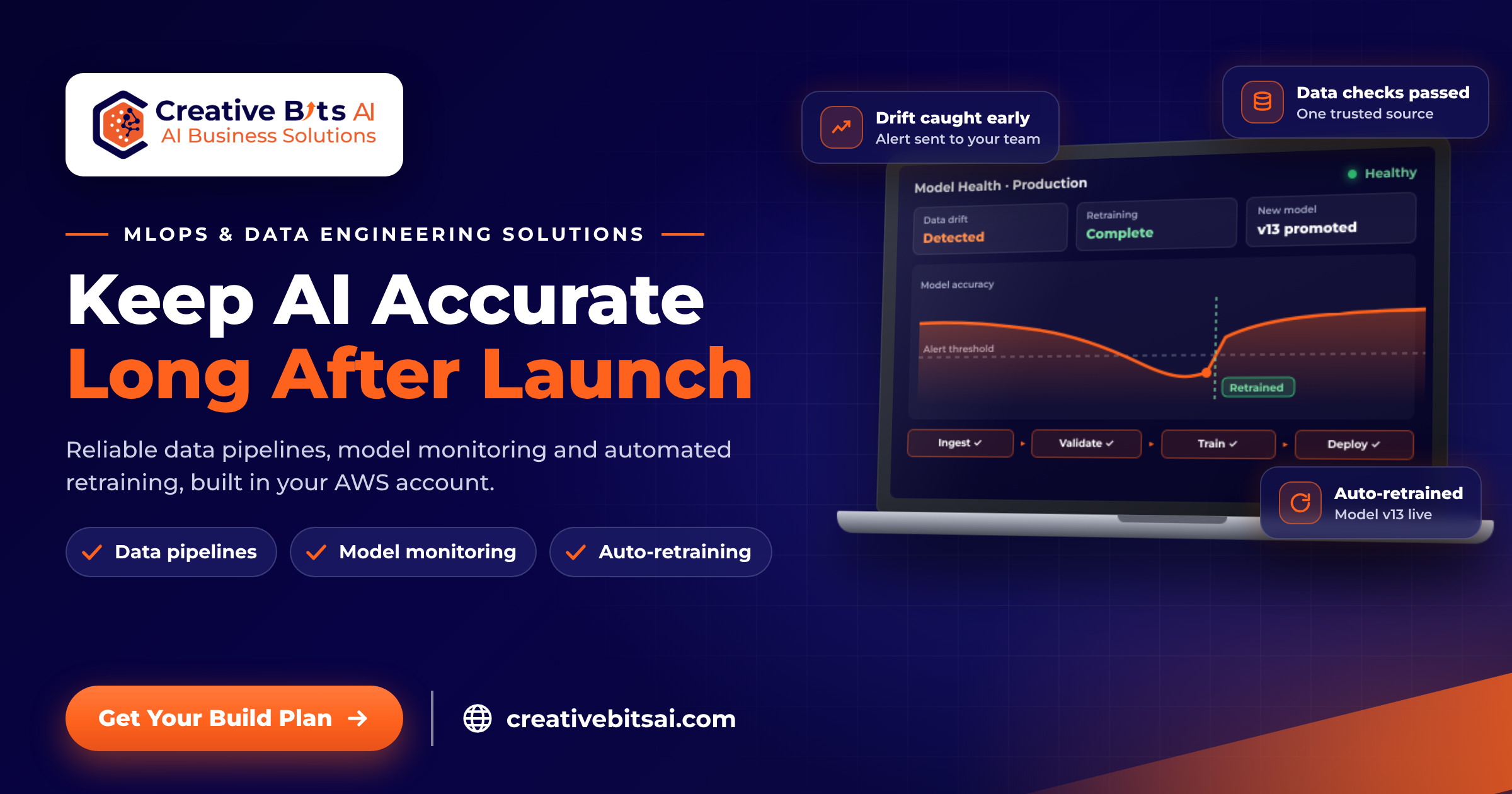
Your data is spread across systems nobody trusts, and models that worked in testing quietly get worse in production. The fix is not a better model. It’s data engineering and MLOps: clean, reliable data pipelines, plus monitoring and retraining that keep models accurate long after launch.
This guide explains the three solutions that turn an AI pilot into a system you can rely on: reliable data pipelines, model monitoring, and automated retraining. It also covers how to run them in your own AWS account and how to make sure your team keeps using what you build.
Key takeaways: the solutions at a glance
- MLOps (machine learning operations) is the practice of deploying, monitoring, retraining, and governing machine learning models so they stay accurate in production.
- Data is the main reason AI stalls. Gartner predicts that through 2026, organizations will abandon 60% of AI projects unsupported by AI-ready data.
- Problems surface after launch. In BARC’s research, the share of teams calling data quality a major concern jumped from 19% in planning to 44% once projects hit production.
- Models drift. A model’s accuracy starts to decline soon after training as customer behavior, products, and the economy change, and it drops quietly unless you monitor it.
- Mature teams keep AI running. 45% of high-maturity organizations keep AI projects operational for three years or more, compared with 20% of low-maturity ones.
- The fix is a system, not a one-off project: trusted pipelines, continuous monitoring, retraining triggered by real drift, and a team trained to use it.
Fix the real reason AI fails after launch: untrusted data and model drift
Most AI models don’t fail because the algorithm is wrong. They fail because the data feeding them is scattered and unreliable, and because nobody is watching once they go live. A pilot runs on a clean extract. Production runs on live data from CRMs, ERPs, spreadsheets, and apps that disagree with each other.
The research points the same way:
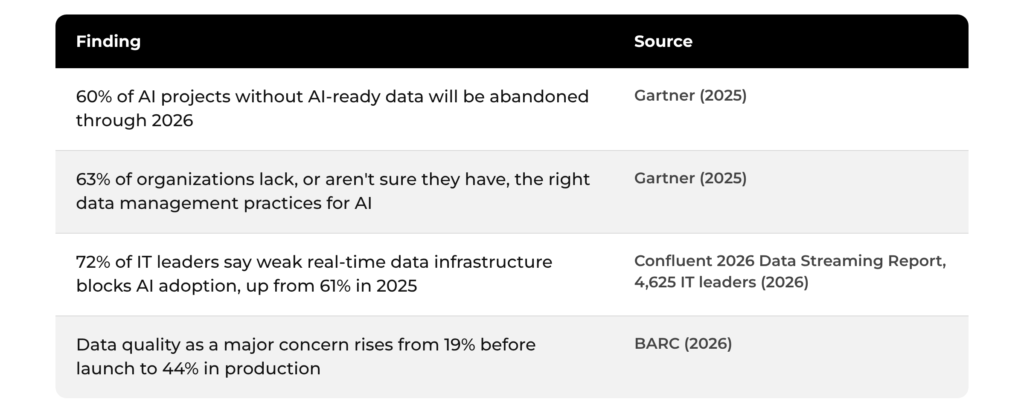
Sources: Gartner, IBM on the Confluent report, BARC.
The second problem is model drift. Customer behavior, prices, fraud patterns, and product catalogs change. When live data moves away from the data a model learned from, its predictions get worse without any error message. As an AWS machine learning guide from July 2026 points out, teams without monitoring only find problems when customers complain, or someone runs a spot check.
If you’re still deciding whether your business is ready for AI, start with our guide to evaluating AI readiness. The rest of this post assumes you have AI in progress and want it to keep working.
Solution 1: Reliable data pipelines that give AI one version of the truth
A data pipeline is the automated path that collects data from your systems, cleans and checks it, and delivers it to your AI models and reports in a consistent format. Good pipelines turn “data nobody trusts” into AI-ready data: current, complete, documented, and owned.
What a production-grade data pipeline includes:
- Connected sources: your CRM, ERP, finance tools, apps, and files feed one governed store instead of a dozen exports.
- Automated data quality checks: missing values, duplicates, out-of-range numbers, and schema changes are caught before they reach a model.
- Lineage and ownership: every dataset has a named owner and a record of its origin, so teams can trace and fix problems quickly.
- Batch and real-time feeds: daily loads for reporting, streaming for use cases like fraud checks or live recommendations.
- Access controls: sensitive fields are masked or restricted, which also reduces the shadow AI and data-leak risks we covered in our AI governance guide.
- Versioned training data: you can always see exactly which data trained which model.
Here’s what that looks like in practice. In AI-powered financial reconciliation, invoices, bank feeds, and ledger entries arrive in different formats. The pipeline standardizes them before the model ever matches a transaction, which is why the results can be trusted.
Solution 2: Model monitoring that catches drift before your customers do
Model monitoring is the continuous tracking of a model’s inputs, outputs, and accuracy in production, with alerts when something changes. It replaces “we’ll check it next quarter” with a dashboard and an alert the day performance slips.
What to monitor:
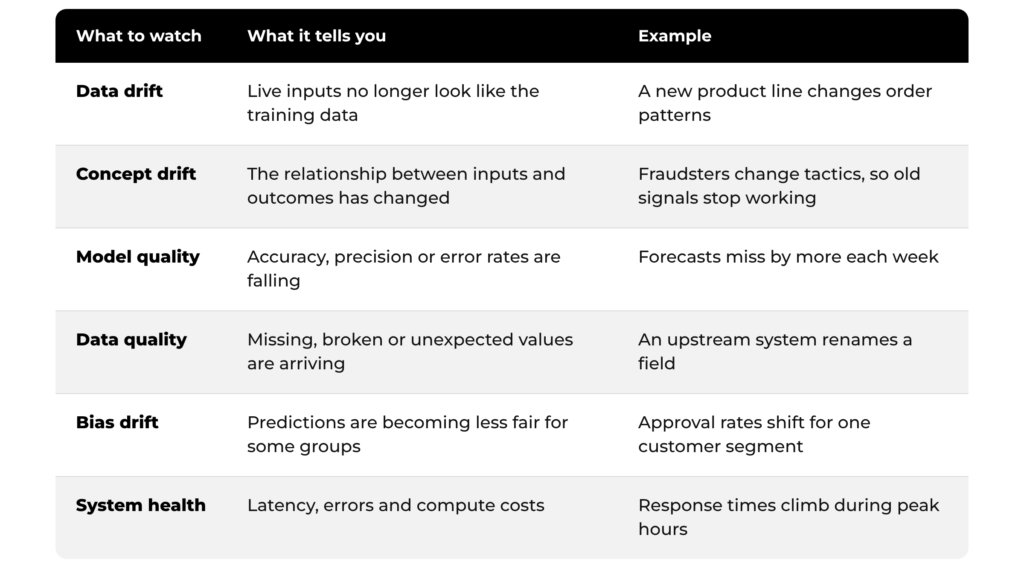
The key is setting a baseline at training time, then comparing live behavior against it automatically. Alerts should go where your team already works, such as email or Slack, with a clear owner for each model.
A note for AWS users: Amazon SageMaker Model Monitor is no longer open to new customers. AWS now points new projects to open-source monitoring built on SageMaker AI MLflow Apps and Evidently AI, with Amazon QuickSight dashboards and Amazon CloudWatch for system metrics. If you’re designing monitoring today, build on that newer approach.
Solution 3: Automated retraining that keeps models accurate without guesswork
Automated retraining is a pipeline that refreshes a model on new data, tests it against the current version, and promotes it only if it performs better. It turns model maintenance from a fire drill into a routine.
Retrain when the data says so, not on a fixed calendar. AWS’s July 2026 monitoring guide recommends starting retraining when drift stays above a threshold, not after a single spike. That saves compute costs and avoids needless changes.
A safe retraining loop looks like this:
- Trigger: a drift alert, a drop below your accuracy threshold, or enough new labeled data arrives.
- Retrain: the pipeline pulls the latest versioned data and trains a candidate model automatically.
- Evaluate: the candidate is tested against the live model on the same holdout data, including fairness checks.
- Approve: a human signs off on high-impact models before release.
- Deploy gradually: the new model takes a small share of traffic first, then all of it.
- Roll back fast: if results slip, the previous version is restored in minutes from the model registry.
On AWS, this loop is typically built with Amazon SageMaker AI Pipelines or AWS Step Functions, a model registry for version control, and Amazon EventBridge to start retraining when monitoring raises an alert.
Run MLOps in your own AWS account, and own every line of code
The safest MLOps setup runs inside your own cloud account, under your security rules, with code your team owns outright. That way your data never leaves your environment, your costs stay visible, and you’re never locked into a vendor’s black box.
Why this matters:
- Data stays put: pipelines, models, and monitoring run in your AWS account, governed by your access policies.
- No lock-in: you get the full code and documentation, so your team or any future partner can extend it.
- Clear costs: compute, storage, and monitoring show up on your own AWS bill, not hidden in a license fee.
- Easier compliance: audit logs, lineage, and model versions sit where your security and compliance teams can review them.
Creative Bits AI is an AWS Select Tier Partner with SOC 2-aligned data handling, and our AWS services are built around this model. If you’re comparing partners, our guide on choosing the right AI vendor lists the questions to ask, including who owns the code when the project ends.
Make it stick: senior AI talent and hands-on training for your team
Pipelines and monitoring only pay off if you have the people to run them and a team that trusts the results. Two gaps stop most companies: not enough senior ML engineers, and staff who never adopt the new tools.
Team augmentation: a senior AI pod inside your sprints
Your AI roadmap is longer than your team, and hiring senior ML engineers takes months. With team augmentation, a senior AI pod joins your sprints in weeks, not quarters. They work in your tools and your backlog, build alongside your engineers, and leave the knowledge behind when they step back. Meet the people behind the work on our team page.
AI training: build confidence, not reluctant tolerance
A new tool gets rolled out, the team doesn’t trust it, and it goes unused within a month. Trust is the difference: in Gartner’s survey, business units were ready to use new AI solutions in 57% of high-maturity organizations, compared with 14% of low-maturity ones.
Hands-on training closes that gap. Teams learn on their own data and workflows, see how monitoring keeps the model honest, and know who to call when something looks wrong.
A complete delivery partnership: assess, build, hand over
Creative Bits AI is focused on one thing: AI that ships and keeps working in production. We fit data engineering and MLOps into the way your business already works, instead of asking you to rebuild around it.
- Assess the workflow. We map your data sources, the decisions your models support, and where accuracy matters most.
- Build the system. We build the pipelines, monitoring, and retraining in your AWS account, around your data, your rules, and your industry.
- Hand over the code. You own everything, with documentation and training so your team can run it.
Three things set the partnership apart:
- One team, start to finish: strategy, build, launch, and support come from the same senior engineers, so nothing gets lost in a handover.
- Proven on AWS: we’re an AWS Select Tier Partner, with systems already running in production.
- Built for your business: every system is designed around your data, rules, and industry, from health insurance to project management and real estate.
MLOps and data engineering solutions: frequently asked questions
What is MLOps?
MLOps, short for machine learning operations, is the set of practices and tools used to deploy, monitor, retrain, and govern machine learning models in production. It keeps models accurate, reliable, and auditable after launch, the same way DevOps keeps software running.
What is the difference between data engineering and MLOps?
Data engineering builds the pipelines that collect, clean, and deliver data. MLOps takes that data and manages the full life of a model: training, deployment, monitoring, and retraining. You need both, because a well-run model still fails on bad data.
What is model drift?
Model drift is the drop in a model’s accuracy over time as real-world data or behavior changes from what the model was trained on. Data drift means the inputs have changed; concept drift means the link between inputs and outcomes has changed.
How often should you retrain a machine learning model?
Retrain when monitoring shows performance falling below an agreed threshold, not on a fixed calendar. Some models need weekly updates; others stay accurate for months. Automated drift detection tells you which is which and saves compute costs.
Why do AI models fail in production?
Most fail because production data is messier than pilot data, and because nobody monitors the model after launch. Fragmented sources, missing values, and changing behavior quietly erode accuracy until users stop trusting the results.
What is AI-ready data?
AI-ready data is data that is accurate, complete, current, documented, and governed well enough for a specific AI use case. It has clear owners, lineage and quality checks, and it’s delivered at the pace the model needs.
Do I need my own ML engineers to run MLOps?
Not at the start. A partner can build the system and train your team to run it, or join your sprints as a senior AI pod until you hire. Insist on owning the code so you’re never locked in.
Turn your AI pilot into a system you can trust in 2027
AI that works in testing is only half the job. Reliable data pipelines, ongoing observation, and drift-based retraining are what keep it accurate in production. Add senior engineers who can run it and a team that trusts it, and your AI keeps paying off long after launch.
Start with three moves:
- List the data sources behind your most important model and name an owner for each.
- Set an accuracy baseline and an alert threshold for every model in production.
- Decide what triggers retraining, and who approves a new model before it goes live.
Not sure where to begin? Explore our AI consulting and development services, or request a demo and tell us about the data that’s slowing you down. An engineer will reply within one working day with a straight answer and a scoped plan, not a sales pitch.
For more practical guides, read our post on AI governance solutions that stop deepfakes and shadow AI, browse the Creative Bits AI blog, or get weekly notes on building AI that actually ships in our Substack newsletter.