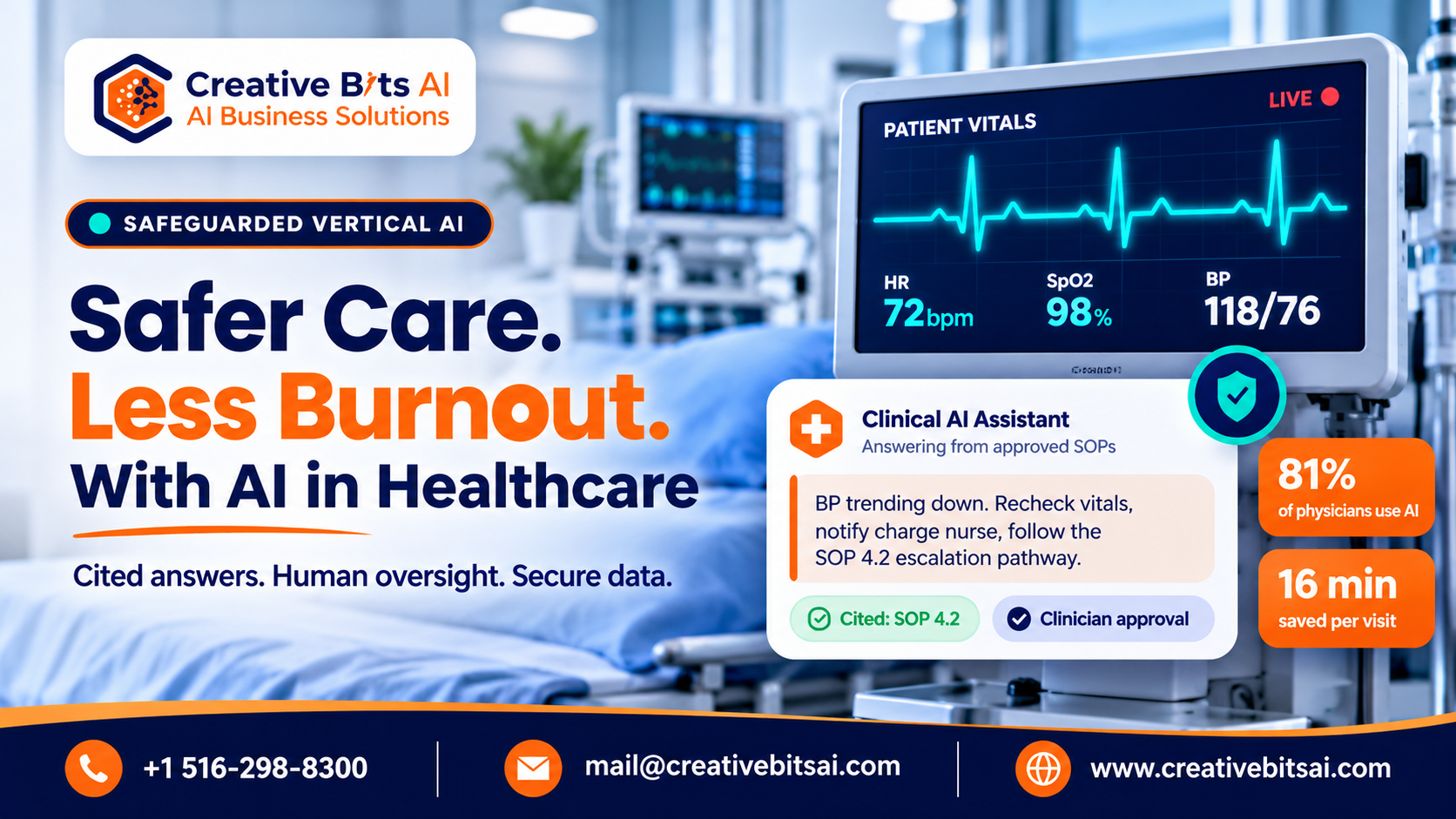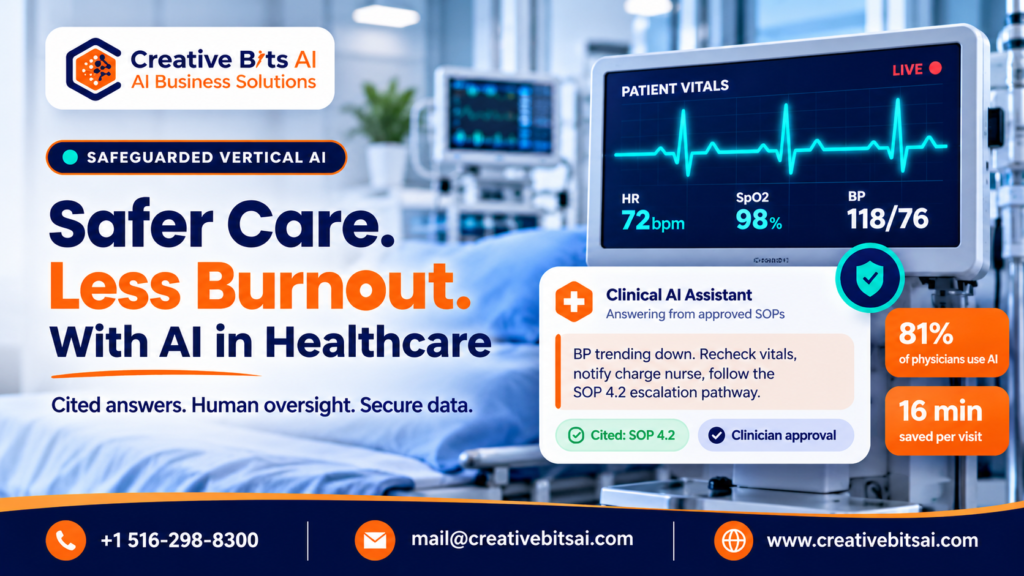
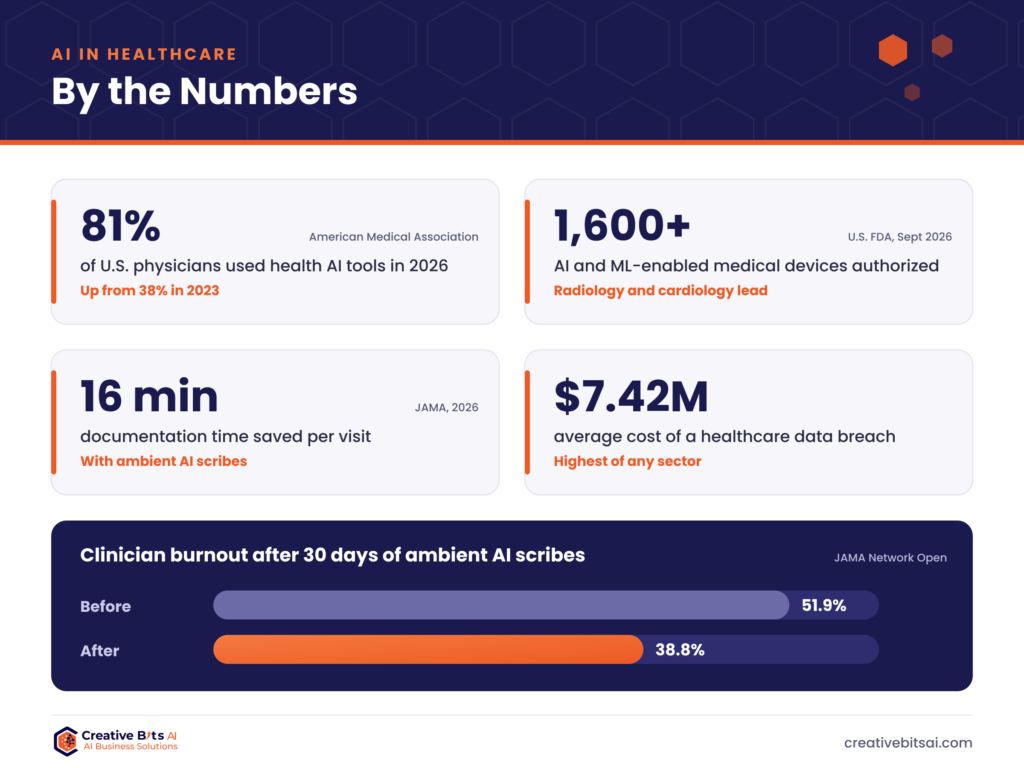
Artificial intelligence (AI) is rapidly moving from experimental pilot programs into everyday clinical practice and medical training. According to the American Medical Association, 81% of U.S. physicians used health AI tools in 2026, more than double the 38% adoption rate recorded in 2023. Yet as adoption accelerates, healthcare leaders face a critical reality: generic, off-the-shelf AI tools often fail in high-stakes clinical environments where accuracy, privacy, and compliance are non-negotiable.
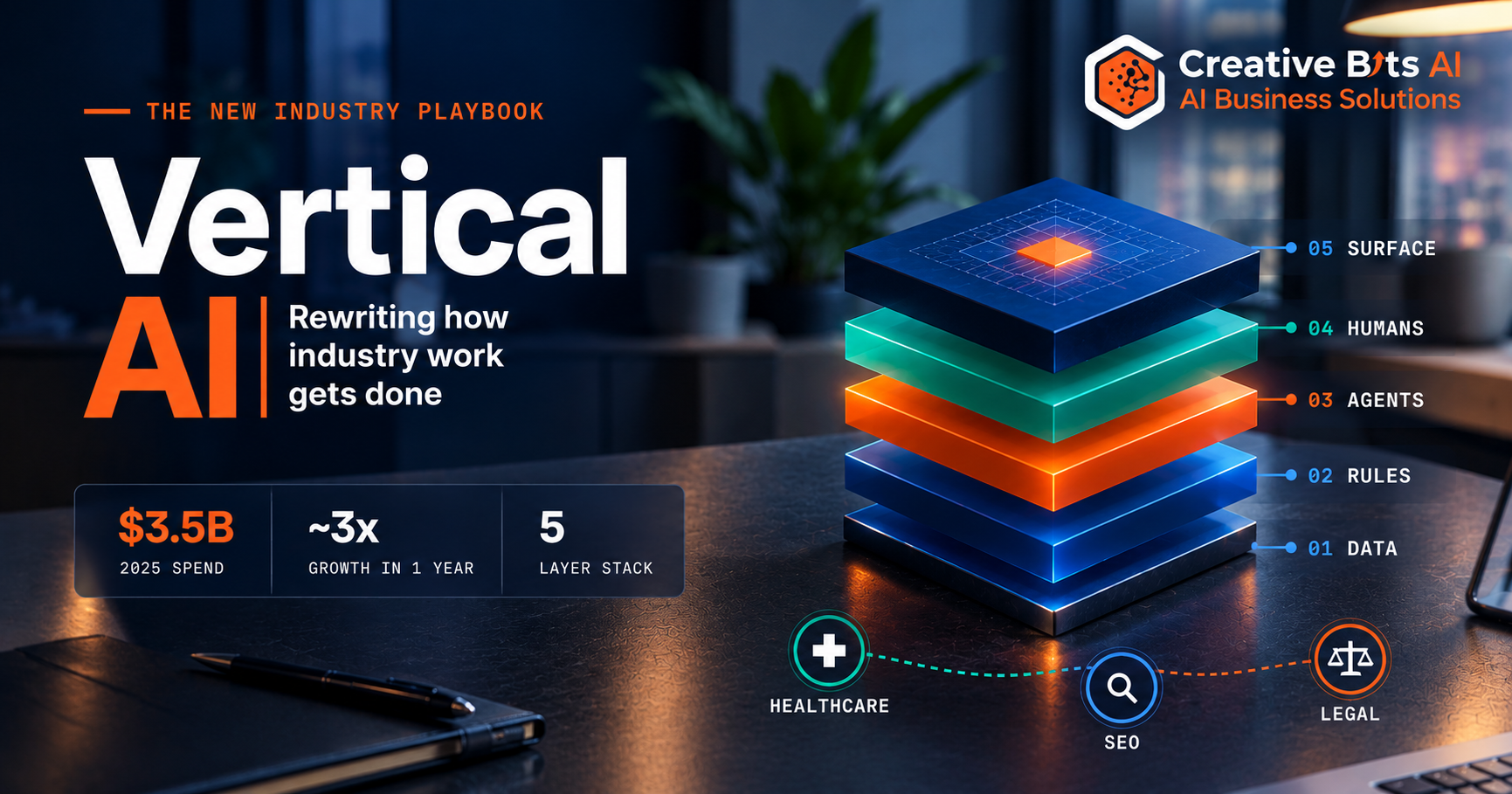
To bridge this gap, specialized AI consultancies like us at Creative Bits AI are helping healthcare providers, behavioral health organizations, and health insurers move beyond generic chatbots toward safeguarded Vertical AI: systems trained on approved medical data, integrated directly into clinical workflows, and built with human oversight at the core.
Transforming Medical Education and Clinical Knowledge
Traditional medical training relies heavily on textbook theory and limited clinical rotations, leaving students and frontline staff with uneven exposure to rare or high-risk scenarios. AI bridges this gap across both academic and active care settings:
- Risk-Free Clinical Simulations: Virtual patient platforms like DxR Clinician allow medical students to interview simulated patients, order diagnostic tests, and formulate treatment plans while receiving immediate, objective feedback on their clinical reasoning. Meanwhile, institutions like Harvard Medical School and Stanford University are integrating adaptive AI tutors that tailor curricula to individual knowledge gaps.
- Instant Frontline Knowledge Management: For active care teams, rapid access to approved protocols can be life-saving. Creative Bits AI’s healthcare knowledge management systems put vetted Standard Operating Procedures (SOPs), onboarding materials, and escalation pathways directly into the hands of nurses and caregivers. Instead of searching through static manuals during a 2:40 a.m. emergency, a caregiver can ask a plain-language question and receive verified escalation steps with exact SOP citations and one-tap supervisor routing.
Advancing Diagnostic Accuracy and Evidence-Based Care
In clinical settings, machine learning excels at detecting subtle patterns across massive datasets. By September 2026, the U.S. Food and Drug Administration (FDA) had authorized more than 1,600 AI- and machine-learning-enabled medical devices, with radiology and cardiology leading adoption.
- Earlier Disease Detection & Precision Care: AI imaging algorithms routinely screen mammograms, retinal scans, and CT images to flag early-stage cancers and stroke risks. Combining electronic health records (EHRs) with genomic data further enables clinicians to tailor oncology and chronic disease therapies to individual patients.
- Dynamic Clinical Guidelines: Medical research evolves faster than traditional guidelines can be updated. Creative Bits AI’s Evidence Intelligence Engine (EIE) continuously analyzes vast medical literature databases to help healthcare providers build dynamic, evidence-based clinical guidelines, incorporating rigorous validation and hallucination detection so clinical decisions remain grounded in verified science.
Reducing Burnout Through Workflow and Claims Automation
Administrative overload remains one of the primary drivers of healthcare worker shortages and operational bottlenecks. Targeted AI automation is allowing clinical and administrative teams to reclaim hours of lost time:
- Ambient Clinical Scribes: Tools that passively listen to doctor-patient visits and draft structured notes have proven highly effective. A 2026 multi-center study in JAMA found that ambient AI scribes cut clinician documentation time by an average of 16 minutes per visit, while research in JAMA Network Open showed clinician burnout dropped from 51.9% to 38.8% after 30 days of use.
- Streamlined Patient Support and Insurance Claims: Beyond the exam room, Creative Bits AI’s healthcare solutions automate patient ticket handling, appointment workflows, and patient education. In the insurance and audit space, Creative Bits AI’s health insurance platform automates short-term disability claims, verifies multi-party documentation across doctors and employers, and flags billing anomalies such as claim upcoding or duplicate billing, cutting manual intervention while strengthening compliance.
Is your team losing hours to documentation and claims? Creative Bits AI builds safeguarded healthcare automation that fits your workflows and compliance requirements. Book a free consultation with our team.
Navigating Ethical Risks and Practical Limitations
Deploying AI in healthcare carries high stakes. Without proper architecture and governance, unchecked AI introduces serious technical and ethical risks:
- Algorithmic Bias and Health Equity: Models trained predominantly on narrow demographic datasets often underperform for underrepresented populations, risking widened global health disparities.
- Clinician De-Skilling and Automation Bias: Over-reliance on automated suggestions can dull human clinical judgment. A 2025 study in The Lancet Gastroenterology & Hepatology found that endoscopists’ unassisted polyp detection rates dropped from 28.4% to 22.4% after growing accustomed to AI assistance. Similarly, evaluations in Nature Medicine show that generalist language models still struggle with emergency triage and require strict physician oversight.
- The “Black Box” Problem and Data Privacy: Healthcare suffers the highest data breach costs of any sector, averaging $7.42 million per breach. Furthermore, opaque “black box” models that cannot explain their reasoning undermine clinical trust and legal accountability.
How Safeguarded Architecture Solves the Trust Gap: This is precisely why Creative Bits AI emphasizes governance-first implementation. Rather than deploying unverified public models, Creative Bits AI builds closed-loop, auditable systems that answer strictly from approved institutional sources, cite every output, enforce strict data security, and keep human clinicians in final control of review and approval.
Looking Ahead
AI will not replace physicians, but healthcare organizations that pair clinical expertise with reliable, governed AI infrastructure will deliver faster, safer, and more equitable care. By combining rigorous clinical validation with tailored workflow automation from partners like us, medical systems can reduce administrative burnout while keeping human empathy and accountability firmly at the center of patient care.
Frequently Asked Questions About AI in Healthcare
What is Vertical AI in healthcare? Vertical AI is artificial intelligence built for one industry instead of general use. In healthcare, it is trained on approved medical data, connected directly to clinical workflows, and designed with human oversight, so it answers from verified institutional sources rather than the open internet.
How is safeguarded AI different from tools like general-purpose chatbots? Safeguarded AI answers only from approved sources, cites every output, enforces strict data security, and leaves final review and approval with clinicians. General-purpose models lack those controls, and a Nature Medicine evaluation found they still struggle with emergency triage.
How many doctors use AI today? According to the American Medical Association, 81% of U.S. physicians used health AI tools in 2026, more than double the 38% recorded in 2023.
Can AI reduce clinician burnout? Yes, especially by cutting documentation work. Ambient AI scribes reduced documentation time by an average of 16 minutes per visit in a 2026 JAMA study, and burnout dropped from 51.9% to 38.8% after 30 days of use in JAMA Network Open research.
Will AI replace doctors and nurses? No. AI handles pattern detection, documentation, and administrative tasks, while clinicians keep control of diagnosis, treatment decisions, and patient relationships. Over-reliance carries real risk: one study found endoscopists’ unassisted polyp detection fell from 28.4% to 22.4% after growing used to AI assistance, which is why human oversight stays central.
What are the biggest risks of using AI in healthcare? The main risks are algorithmic bias against underrepresented populations, clinician de-skilling, opaque “black box” models, and data breaches. Healthcare has the highest breach costs of any sector, averaging $7.42 million per incident.
Where can healthcare organizations start with AI? Start with a high-volume, well-defined workflow such as frontline SOP access, patient ticket handling, or claims review. Ground the AI in your approved documents, require citations, keep clinicians in the approval loop, and measure the time saved against your current baseline.
Are you Ready to Bring Safeguarded AI Into Your Care Workflows?
Whether you run a hospital, a behavioral health practice, or a health insurance operation, Creative Bits AI can help you deploy AI that answers from your approved sources, cites every output, and keeps your clinicians in control.
In a free consultation, we will:
- Map the workflows where AI can save your team the most time
- Review your data privacy and compliance requirements
- Outline a safeguarded pilot you can measure from day one
👉 Book your free consultation with Creative Bits AI
References
- American Medical Association: AI usage among doctors doubles as confidence in technology grows (press release, March 12, 2026)
- U.S. FDA: Artificial Intelligence-Enabled Medical Devices list (1,614 devices, list updated September 4, 2026)
- JAMA: Ambient AI scribes and clinician documentation time, multisite study (April 2026)
- JAMA Network Open: Use of Ambient AI Scribes to Reduce Administrative Burden and Professional Burnout (2025)
- The Lancet Gastroenterology & Hepatology: Endoscopist deskilling after exposure to artificial intelligence in colonoscopy (August 2025)
- NBC News: ChatGPT Health under-triaged half of medical emergencies, Nature Medicine study (March 2026)
- TechTarget: Healthcare remains costliest industry for breaches at $7.42M, IBM Cost of a Data Breach 2025
- HealthySimulation: DxR Clinician virtual patient platform