Voice search optimization has quietly become one of the highest-leverage moves in digital strategy, and most businesses are still optimizing as if everyone types. Voice search reached 27% of global search volume in 2026, driven by AI assistant adoption across smartphones, smart speakers, and in-car systems. That is more than a quarter of your search opportunity, and it follows completely different rules from the typed search most content is built for.

The shift is not just about voice. It is about convergence. Users are blending traditional voice search with conversational AI, asking Siri, Google Assistant, and ChatGPT questions without thinking of them as separate things. Optimizing for voice now means optimizing for the way people speak to every AI assistant they touch. This guide breaks down how to do it: conversational query patterns, question formats, and the featured snippet engineering that gets your content read aloud.
Why Voice Search Optimization Is a Different Discipline
When someone types, they strip language down. When someone speaks, they ask a full question. That single difference changes everything about how content needs to be structured. As one analysis of conversational AI search puts it: when typing, someone searches “pizza delivery Brooklyn,” but when speaking, they ask “Where can I get pizza delivered in Brooklyn right now?”
Those spoken queries are longer and more specific. Voice queries average four to seven words versus two to three for typed searches, conversational, and are almost always phrased as full questions. And critically, voice assistants do not read a list of links. They read one answer. The primary goal of voice SEO is to capture the featured snippet, because that is the answer voice assistants read aloud. If you are not in position zero, you are not “spoken” at all.
The Voice Search Optimization Framework
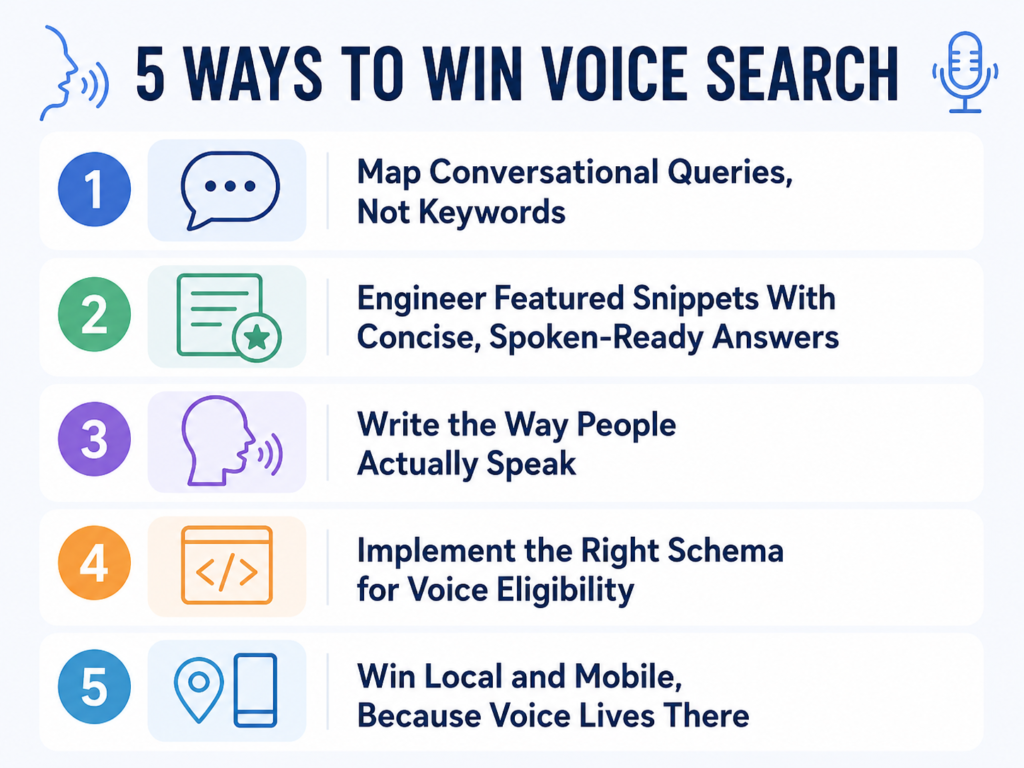
1. Map Conversational Queries, Not Keywords
Traditional keyword research returns short, high-volume fragments that reflect how people type. Voice optimization requires the opposite: capturing the full, natural-language questions your audience actually asks out loud.
Start by listing the real questions a customer would ask about your product or service. Use Google’s “People Also Ask” boxes and tools like AnswerThePublic to surface question variants. Then group them by intent. Voice queries reveal clear goals: informational, like “How do I reset a router?”, navigational like “Open settings menu,” and transactional like “Order a medium pizza near me.” Mapping intent to the right page type is the foundation of every voice strategy.
2. Engineer Featured Snippets With Concise, Spoken-Ready Answers
This is the technical heart of voice search optimization. Voice assistants pull their spoken answers almost exclusively from featured snippets. Around 41% of voice search results come directly from featured snippets, making it the single most direct path to getting your content read by assistants.
The format that wins is specific. Concise answers perform best, with 29 to 40-word responses matching the average voice answer length. The technique: pose the question as a header, then immediately follow it with a direct, self-contained answer of roughly 40 words before expanding into detail. The assistant lifts that block and reads it verbatim. If your answer is buried three paragraphs down, it will never be chosen.
3. Write the Way People Actually Speak
Voice-optimized content has to sound natural when read aloud, because it will be. Stiff, jargon-heavy, keyword-stuffed prose fails the moment an assistant tries to speak it. Write in a natural, conversational tone, avoid jargon, and answer the question directly near the top of your article.
A practical test: read your answer out loud. If it sounds like something a knowledgeable person would actually say in conversation, it is voice-ready. If it sounds like it was written for an algorithm, rewrite it. Natural language is no longer a style preference. It is a ranking signal.
4. Implement the Right Schema for Voice Eligibility
Schema markup is what makes your content extractable as a clean spoken answer. Without it, assistants have to guess at your content’s structure. With it, they can lift answers confidently. FAQPage, HowTo, LocalBusiness, and Speakable schemas improve voice eligibility.
The FAQ schema is especially powerful for voice because it pairs questions with concise answers in exactly the format assistants want. Add it to your key service and resource pages, wrapping each real customer question with a one to two-sentence spoken-ready answer.
5. Win Local and Mobile, Because Voice Lives There
A large share of voice search is local, and almost all of it is mobile. Voice searches are three times more likely to be local than text searches, often including “near me” or specific location modifiers. If you serve specific markets, include location context naturally in your headings and content, and keep your business profile and contact details consistent everywhere.
Speed matters too. Voice results load approximately 52% faster than the average web page, because page speed and mobile optimization are core voice ranking factors. A slow, clunky mobile page will lose the voice result even with perfect content.
The Hidden Bonus: Voice Optimization Improves AI Visibility
Here is what makes voice search optimization a strategic priority rather than a niche tactic. The same work that wins voice results also wins AI citations. Voice-optimized content is more likely to be selected for featured snippets, appear in AI Overviews, and be cited in AI-generated answers. Optimizing for voice also improves your chances of being chosen by AI.
That is because both voice assistants and generative engines reward the same things: clear questions, concise self-contained answers, natural language, and structured data. Optimize for how people speak, and you simultaneously optimize for how every AI system, spoken or written, finds and trusts your content.
What This Means for Your Business in 2026
Voice and conversational AI are converging into a single reality: people ask questions in natural language and expect one trusted answer. Voice assistants route most queries through featured snippets and AI Overview citations, making those positions the foundation of any voice search strategy.
The businesses that win this shift will not be the ones with the most keywords. They will be the ones whose content is structured to be the single answer, spoken aloud, when a customer asks.
The Takeaway
Typed search rewarded keywords. Voice search rewards answers.
The move is to stop writing for algorithms and start writing for the question a real person asks out loud, then engineer the snippet that answers it in 40 clear words. Do that consistently, and you earn visibility not just in Siri, Alexa, and Google Assistant, but across the AI assistants reshaping how people find everything.
The convergence is already here. The content built for it is still rare. That gap is your opportunity.
Are you ready to make your business the answer AI assistants speak?
At Creative Bits AI, we help mid-market enterprises optimize for voice and conversational AI, engineering the content structure, schema, and featured snippets that get you cited across voice assistants and generative engines alike. You may also want to read our companion guide, The AI-Ready Content Audit, which covers the technical foundation that makes voice optimization possible.