AI agents have moved from experimental to essential. But how are enterprises actually building and deploying them?
In partnership with research firm Material, Claude surveyed over 500 technical leaders across industries and company sizes to understand how organizations are deploying AI agents today, and where they see opportunity ahead.
The findings reveal a clear pattern: organizations are shifting from simple task automation to complex, multi-step workflows that span teams and business functions.
What the Data Shows About Enterprise AI Agent Adoption
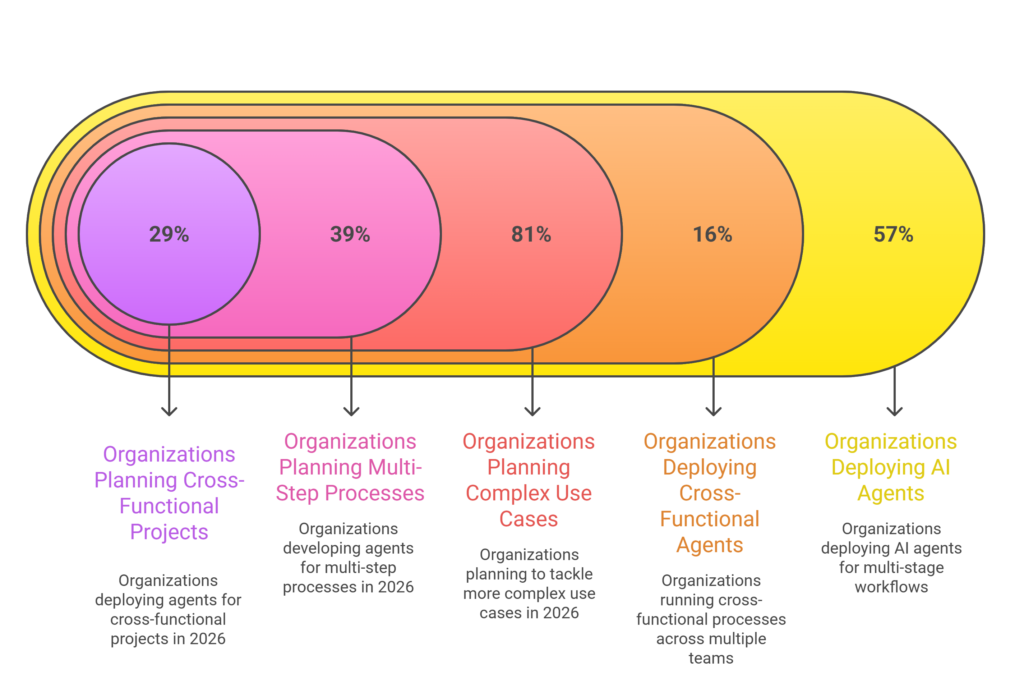
More than half of organizations (57%) now deploy AI agents for multi-stage workflows, with 16% running cross-functional processes across multiple teams. In 2026, 81% plan to tackle more complex use cases, including 39% developing agents for multi-step processes and 29% deploying them for cross-functional projects.
Coding leads adoption. Nearly 90% of organizations use AI to assist with development, and 86% deploy agents for production code. Organizations report time savings across the entire development lifecycle: planning and ideation (58%), code generation (59%), documentation (59%), and code review and testing (59%).
But the impact extends well beyond engineering. Data analysis and report generation (60%) and internal process automation (48%) rank among the highest-impact use cases. Looking ahead, 56% plan to implement agents for research and reporting over the next year.
Perhaps most notably, 80% of organizations report their AI agent investments are already delivering measurable economic returns.
What AI Agents Look Like in Practice
The organizations seeing results are treating agents as core infrastructure — not experiments.
Thomson Reuters uses Claude to power CoCounsel, their AI legal platform. Lawyers who once spent hours manually searching through documents can now access 150 years of case law and 3,000 domain experts in minutes.
Cybersecurity company eSentire compressed expert threat analysis from 5 hours to 7 minutes, with AI-driven analysis aligning with their senior security experts 95% of the time. In healthcare, Doctolib rolled out Claude Code across its entire engineering team, replacing legacy testing infrastructure in hours rather than weeks and shipping features 40% faster.
The retail sector is seeing similar gains. L’Oréal achieved 99.9% accuracy in conversational analytics, enabling 44,000 monthly users to query data directly rather than wait for custom dashboards.
The Path Forward for Enterprise AI Agents
The question for leaders in 2026 isn’t whether to adopt AI agents — it’s how to scale them strategically. The data points to three primary challenges: integration with existing systems (46%), data access and quality (42%), and change management needs (39%).
Nine in ten leaders report that agents are shifting how their teams work, with employees spending more time on strategic activities, relationship building, and skill development rather than routine execution.
This transition requires purpose-built infrastructure: models optimized for coding and enterprise workflows, frameworks like the Agent SDK, and tools like Claude Code that help teams move from prototype to production faster.
At Creative Bits AI, we’re seeing the same trajectory with our enterprise clients. While coding has been the proving ground for AI agents, it’s just the beginning. As agents expand into research, customer service, financial planning, and supply chain operations, the organizations that build expertise now will capture disproportionate value as the technology matures.
Are you ready to move from AI experimentation to enterprise-scale deployment? Contact Creative Bits AI to build your AI agent strategy.