Every CIO and CISO is living the same paradox. Your executive team wants the productivity that generative AI promises, and your risk team is terrified of what happens to proprietary data the moment it touches a public model. Deploy an unfiltered public large language model (LLM), and you risk leaking intellectual property. Lock your data silos down completely, and your teams are stuck with rigid software that cannot answer a real question in plain language.
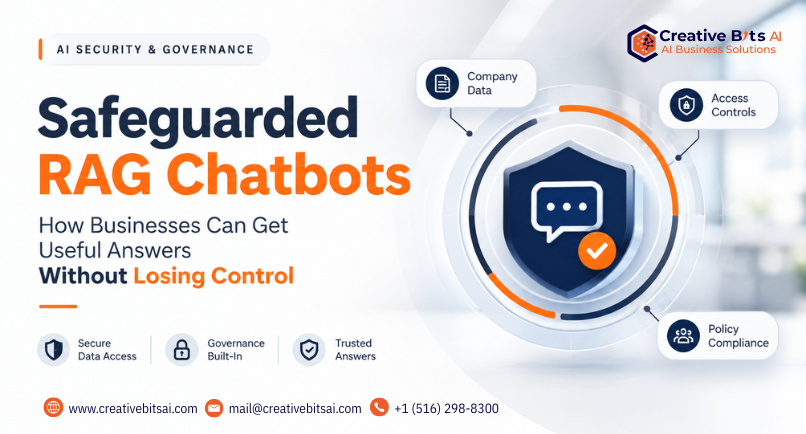
This is exactly the gap Safeguarded RAG Chatbots were built to close. Instead of training a model on your sensitive information, a retrieval-augmented generation design works like an intelligent librarian. It fetches only the exact passages a question needs from your private databases and hands them to the model to write a clear, grounded answer. Your knowledge stays yours, and the model never has to memorize a thing.
The catch is that a basic implementation is not safe enough for the enterprise. An unsecured assistant can quietly surface restricted payroll records to a junior employee, or a cleverly worded prompt can talk it into ignoring its own rules. Real security means building Safeguarded RAG Chatbots with a layered defense so your business gets genuinely useful answers without ever losing control of its data.
Why standard RAG systems quietly leak
To secure a conversational AI system, you have to look past ordinary transport encryption. The risk lives at the intersection of unstructured data, vector databases, and semantic search, and it shows up in two ways that traditional security tooling was never designed to catch.
The first is a data access control breakdown. Traditional permissions live on files and folders. When those documents are ingested into a vector database, they are broken into mathematical chunks called embeddings, and the original permissions often do not travel with them. As one permission-aware retrieval analysis puts it, the vector database behaves like a librarian obsessed with relevance and blind to clearance. If your pipeline does not map original document permissions onto the vector chunks, a well-phrased question can pull back and summarize files the user should never have known existed.
The second is prompt injection and semantic manipulation. Rogue input can override your system instructions and push the model to leak its own configuration or invent unsafe guidance. This is not a fringe concern. The OWASP Top 10 for LLM Applications ranks prompt injection as the number one risk (LLM01), and industry analysis has documented real-world attack success rates ranging from 50%-84%, depending on configuration. Worse, RAG introduces indirect injection, where a single poisoned document in your knowledge base can compromise every user whose query retrieves it.
A Zero Trust architecture for Safeguarded RAG Chatbots
The fix is to treat every chatbot interaction with the same rigor as a login attempt on your core network. A production-ready design for Safeguarded RAG Chatbots rests on three separate defensive perimeters, so a failure in any one layer is caught by the next.
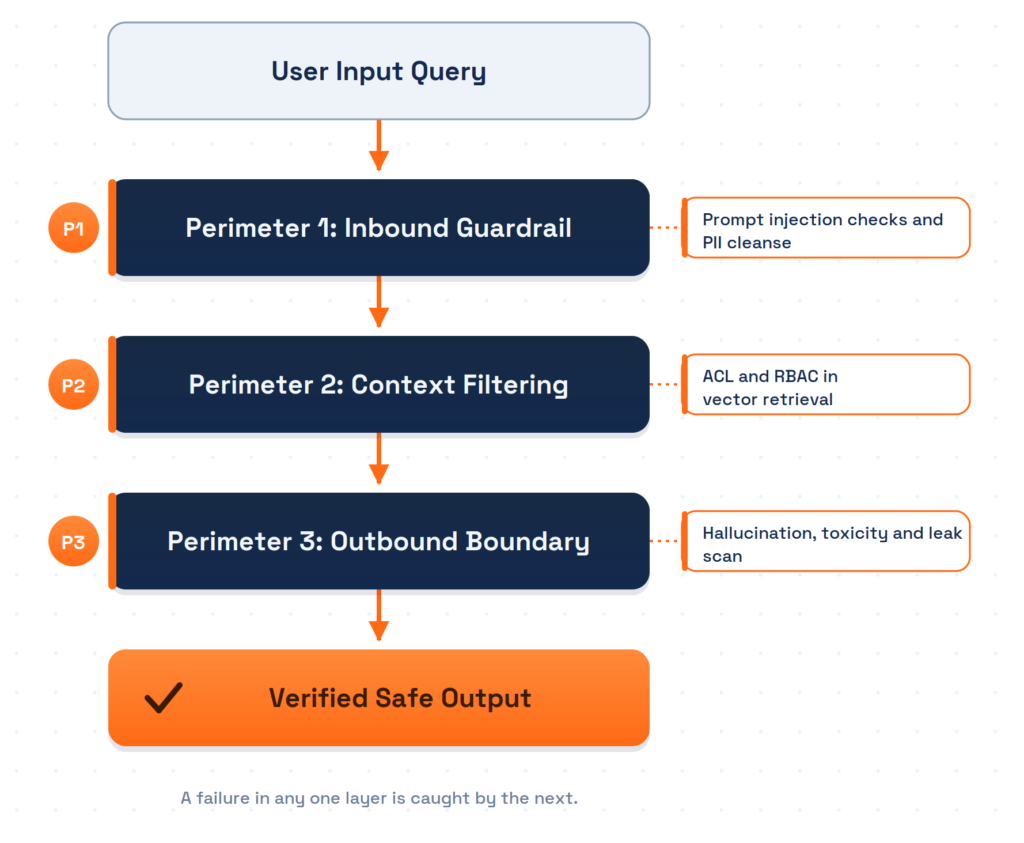
Perimeter 1: Inbound guardrail and ingestion safety
Security starts before a query ever reaches your model. During ingestion, run every internal file through an automated cleansing pipeline that scrubs inadvertently stored personal data, such as Social Security numbers or card numbers, before the text is converted into vectors.
At runtime, place a semantic firewall between the user and your backend. Tooling such as NVIDIA NeMo Guardrails inspects incoming prompts for adversarial patterns, so it flags and blocks instructions telling the bot to ignore its previous rules at the edge. Research on layered defenses for RAG chatbots found that combining input screening with later layers cut attack success from 71 percent to about 11 percent, while adding only around 61 milliseconds of latency.
Perimeter 2: Context filtering and role-based access
Never let your application search the entire corporate data pool. Your vector database must apply dynamic metadata filtering tied to role-based access control (RBAC). When a user submits a question, their validated directory credentials travel with the query, and the search touches only chunks the user is cleared to see. If someone lacks access to executive compensation folders, those vectors behave as if they do not exist.
The critical detail, and the one teams get wrong, is when the filter runs. Authorization has to happen before retrieval, not after. As a secure RAG data leakage study makes clear, filtering results after the search has already exposed unauthorized content to the retrieval layer is itself the leak. Restricted data should never enter the context window in the first place.
Below is an enterprise pattern using Python and LangChain that enforces metadata filtering at runtime, based on the user’s validated permission groups:
Perimeter 3: Outbound evaluation and verification
The last line of defense sits after the model drafts an answer but before anyone sees it. An outbound guardrail cross-checks the response against the source documents that were actually retrieved. If the model introduces facts or numbers that are not in those references, the answer is discarded and regenerated. The same layer acts as data loss prevention, blocking API keys, source code, or unreleased roadmaps from ever reaching the chat window.
Mapping Safeguarded RAG Chatbots to compliance
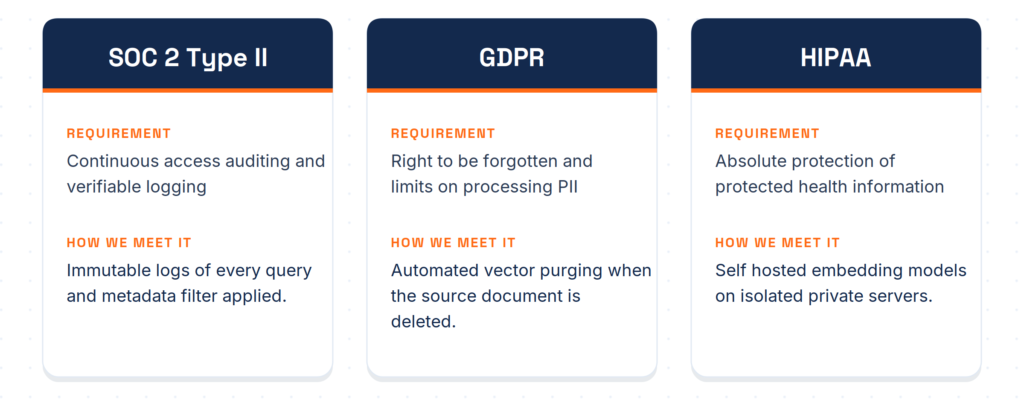
Deploying Safeguarded RAG Chatbots at enterprise scale means aligning the architecture with the frameworks your auditors already use. Mapping your pipeline directly to active regulations keeps your risk posture defensible.
The tradeoffs leadership should plan for
Every layer of protection adds latency and compute cost. Running secondary models to screen inputs and outputs adds milliseconds and increases token consumption, which shows up on your cloud bill. The practical answer is to use small, fine-tuned local models for the security checks rather than routing every classification through an expensive foundation model.
Infrastructure is the other decision. Cloud hosting gives you speed and easy scaling, while organizations under strict data sovereignty mandates often need an isolated private cloud so sensitive data never leaves their perimeter. Both can host Safeguarded RAG Chatbots well. The right choice depends on your regulatory reality, not on fashion.
How to roll it out safely
Securing corporate data while using AI is an ongoing practice, not a one-time launch. A sensible sequence looks like this:
- Start small. Deploy to a controlled internal group and test your data boundaries hard before any wide rollout.
- Log everything. Keep immutable records of which sources are queried, which prompts trip the inbound guardrail, and how often the outbound filter catches a hallucination.
- Audit continuously. Review vector database permissions regularly so access rules stay aligned with governance as roles and documents change.
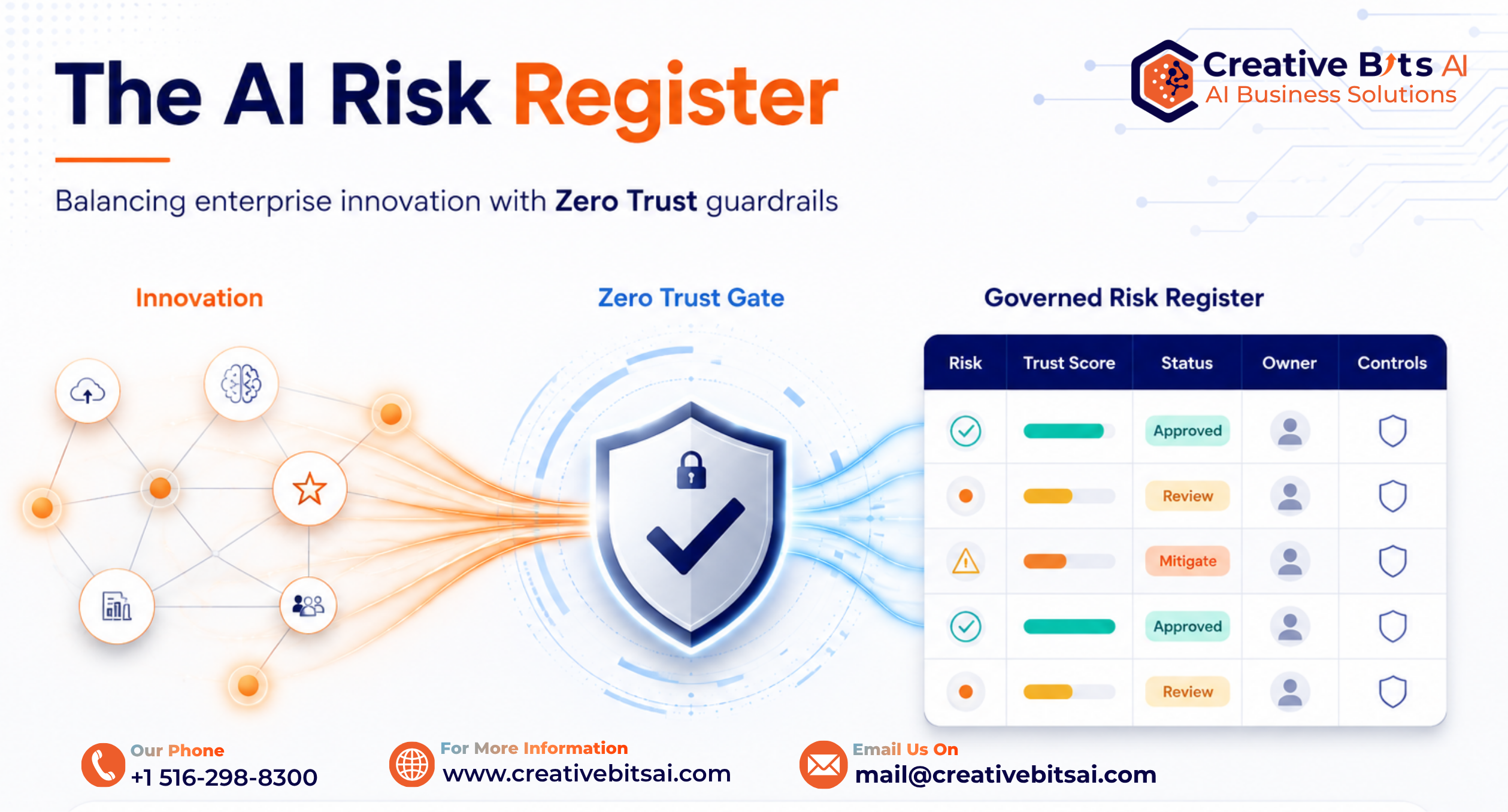
For a broader view of how this fits alongside model governance, our guide to AI security frameworks compares the standards worth mapping to, and our piece on AI governance for the enterprise covers the risk register side of the same problem.
The bottom line
The competitive edge belongs to the companies that deploy AI safely, not the ones that move fastest or lock everything down hardest. Pairing a zero-trust retrieval architecture with disciplined inbound and outbound guardrails lets your teams use powerful tools while you keep complete control of sensitive knowledge. That is the whole promise of Safeguarded RAG Chatbots: useful answers with the data control your board expects.
Ready to build a high-performing, safe conversational AI application tailored to your governance needs? Explore how our Custom AI Development and Consulting team can design a safeguarded framework for your enterprise, and book a free consultation to get started.