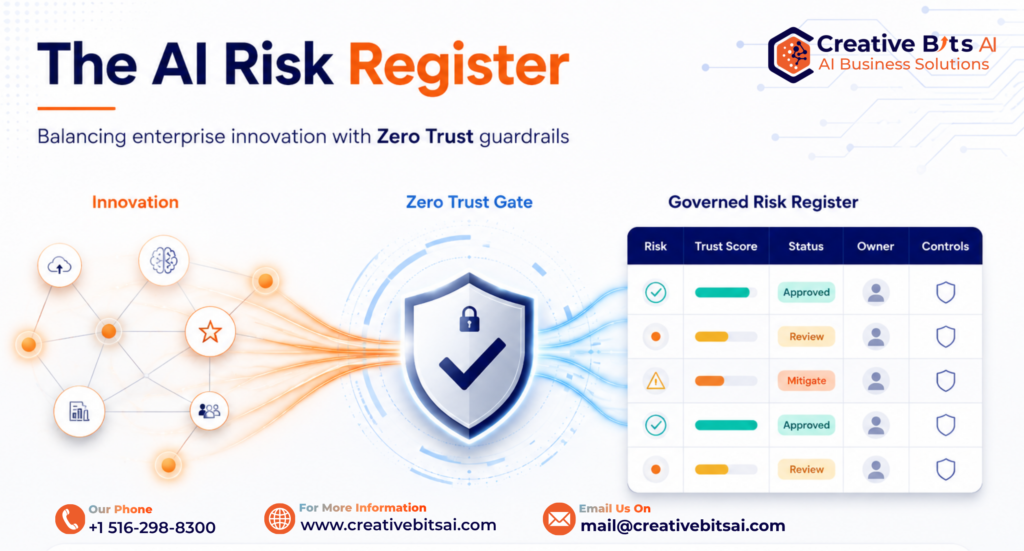
The AI risk register has quietly become the most important document most enterprises still lack. Your engineers are shipping AI features. Your marketing team is drafting copy in tools you have never approved. Somewhere in finance, a model is reconciling a spreadsheet nobody logged. And if you are the CIO or CISO, you have to answer the board when they ask a deceptively simple question: what could go wrong, and how do we know?
That question is the whole job now. AI adoption has outrun the mechanisms built to govern it. According to McKinsey’s State of AI research, 88% of organizations had integrated AI into operations by 2025, up from 78% a year earlier. Tools spread faster than the guardrails. So the modern challenge is not choosing between innovation and control. It is running both at the same time, on purpose, with a system that lets you say yes quickly and safely.
That system starts with an AI risk register and gets enforced through Zero Trust guardrails. Here is how the two fit together.
What an AI Risk Register Actually Is
Strip away the jargon and an AI risk register is a living inventory. It lists every AI system your organization touches, what each one does, what could go wrong, how likely that is, how bad it would be, and who owns the fix. Think of it as the single source of truth that turns vague anxiety about AI into decisions you can actually defend.
A traditional risk register tracks things like server outages or vendor dependencies. An AI risk register has to account for failure modes that did not exist five years ago: models that drift as the world changes around them, training data that can be poisoned, prompts that can be manipulated, and outputs that leak sensitive information in ways no firewall was designed to catch. The NIST AI Risk Management Framework organizes this thinking into four functions: Govern, Map, Measure, and Manage, and it has become the closest thing the industry has to a common language. If you want a deeper comparison of how it stacks up against ISO 42001, MITRE ATLAS, and the OWASP Top 10, we broke that down in our guide to choosing the right AI security framework.
The register is where governance stops being a slide deck and becomes an operating tool.
Why Innovation Keeps Beating Governance
Here is the uncomfortable truth every security leader already feels. Governance losses not because people are reckless. It is that the sanctioned path is slower than the unsanctioned one.
The data backs this up hard. IBM’s Cost of a Data Breach research found that 20% of breached organizations were compromised through shadow AI, the unsanctioned tools employees adopt without security sign-off, and those incidents added roughly $670,000 to the average breach cost. That is not the total. That is the premium on top of a breach that already runs into the millions. In financial services, 72% of employees use at least one unsanctioned AI tool. In healthcare, where breach costs average north of $7 million per incident, roughly one in ten professionals has used an unauthorized AI tool for direct patient care tasks.
The lesson from the companies that tried to ban their way out is clear. Samsung, Apple, and JPMorgan Chase all attempted early restrictions, and in each case the bans simply pushed usage into personal accounts and home networks where security could not see it at all. Prohibition does not reduce risk. It blinds you to it.
So the goal is not to slow innovation down. It is to make the safe path the fast path. That is exactly what pairing a risk register with Zero Trust is designed to do.
Where Zero Trust Comes In
If the risk register tells you what could go wrong, Zero Trust is how you contain it. And this is where things get technical, because the classic model needs reinterpretation the moment your actor is an AI agent instead of a human.
Zero Trust, codified in NIST SP 800-207, rests on three principles: verify explicitly, enforce least privilege, and assume breach. No user or system is trusted by default, regardless of network location. Access is granted per session, only after real-time evaluation of identity, device posture, and context.
Now apply that to an AI agent. The Cloud Security Alliance’s Agentic Trust Framework translates the principle directly: no AI agent should be trusted by default, regardless of its purpose or claimed capability. Trust has to be earned through demonstrated behavior and continuously verified. Three technical shifts matter most for CISOs:
1. Agents need their own identities. This is the big one. Research cited by Zentera found that only 22% of security practitioners treat agents as independent identities; the rest rely on shared API keys or inherited user sessions. Shared credentials make attribution impossible. When something goes wrong, you cannot tell which agent did it. Each agent, and ideally each instance, needs a unique, attestable identity that can be short-lived, certificate-based, and lifecycle-managed through your IAM system.
2. Guardrails and enclaves are not the same thing. A prompt-layer guardrail instructs an agent not to do something. An enclave enforces what the agent cannot reach, no matter what instructions it receives. As Zentera puts it, a guardrail can be overridden by a sufficiently crafted prompt, while an enclave cannot be reasoned around because it is enforced at the network layer, below the agent’s visibility. You need both. Guardrails govern what an agent should do; enclaves govern what it can touch.
3. The code-data boundary collapses. In conventional software, instructions and inputs live in separate domains. In an AI agent, a natural-language instruction and a natural-language data value are indistinguishable to the model. That is why prompt injection is so dangerous, and why monitoring agent actions is a detection layer, not a prevention layer. You cannot rely on the model to police itself.
This matters even more as businesses move toward autonomous systems. If you are designing agentic workflows, our piece on intelligent workflow design covers where autonomy belongs and where it does not.
Connecting the Register to the Guardrails
Here is the part most teams miss. A risk register and a Zero Trust architecture are not two separate projects. They are two ends of the same control loop.
The register defines your risk tolerance per system. A tiered model, mapped to the EU AI Act’s risk classifications, works well: prohibited and critical systems require executive sign-off, high-risk systems require documented controls and monitoring, and low-risk systems get lightweight oversight. That tiering then drives your Zero Trust policy. A high-risk agent with access to customer data gets a unique identity, a hard enclave around the systems it can reach, and continuous logging. A low-risk internal drafting tool gets far less friction.
That is the balance. You are not applying maximum control everywhere, which would strangle innovation. You apply proportionate control, informed by the register, and enforced by Zero Trust. Certifiable standards like ISO/IEC 42001 sit on top of this, giving you the audited proof that procurement teams and regulators increasingly demand before they sign.
And the enforcement gap is real. IBM found that only 34% of organizations with AI governance policies actually audit for unsanctioned AI use. An unaudited policy is not a control. It is a wish.
A Practical Starting Sequence
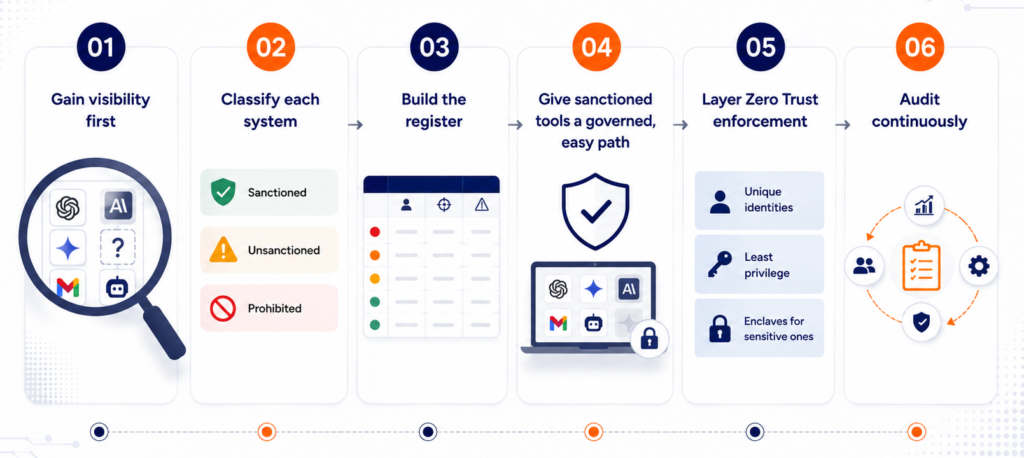
If you are building this from scratch, resist the urge to boil the ocean. The highest-impact, lowest-cost sequence looks like this:
- Gain visibility first. Map every AI system in use, including the shadow ones. You cannot govern what you cannot see.
- Classify each system as sanctioned, unsanctioned, or prohibited, and assign a risk tier.
- Build the register around those systems, capturing owner, purpose, failure modes, likelihood, impact, and mitigation.
- Give sanctioned tools a governed, easy path so employees stop reaching for consumer alternatives.
- Layer Zero Trust enforcement proportionate to each tier: unique identities, least privilege, enclaves for the sensitive ones.
- Audit continuously. Models drift, agents get new permissions, and new attack techniques appear monthly.
None of this requires a moonshot budget. Mapping usage and drafting a clear policy consistently are the two actions that deliver the most impact at the lowest cost.
The Bottom Line
The organizations winning at enterprise AI are not the ones that moved slowest, and they are not the ones that moved recklessly. They are the ones that built a system where speed and safety reinforce each other. The AI risk register gives you the map. Zero Trust gives you the enforcement. Together, they let you tell the board exactly what could go wrong and exactly how you have contained it, without becoming the department that always says no.
That shift, from gatekeeper to enabler, is the real strategic move. It is also why we think of AI less as a risk to be managed and more as a decision-making ally to be governed well.
At Creative Bits AI, we build enterprise AI solutions with governance and Zero Trust designed in from day one, not bolted on after an incident. Whether you are standing up your first AI risk register or extending Zero Trust to a fleet of autonomous agents, our team can help you map the right controls to your risk profile. Reach out for a free consultation and put a real strategy behind your AI ambitions.