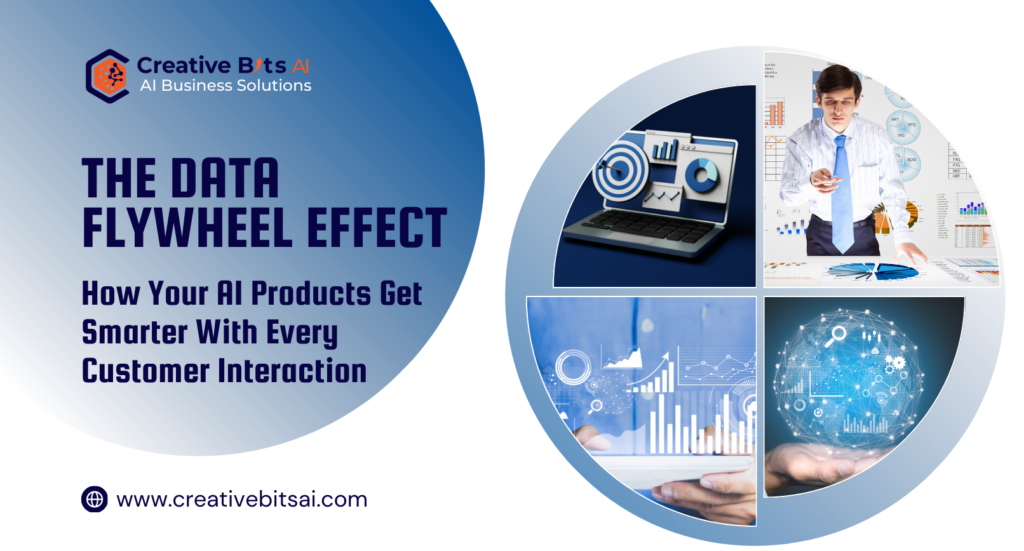
The data flywheel is the engine behind the world’s most successful AI products. Unlike traditional software that remains static after deployment, AI systems built with a data flywheel get better as they learn—both directly through users and indirectly through outcomes and feedback loops designed into the product. The largest language models and corporate copilots now operate on this principle: a reinforcing cycle in which usage creates data, data enhances models, better models increase adoption, and increased adoption generates even more data.
This data flywheel effect explains why early traction is such a crucial element in AI markets—and why companies that view AI as a fixed implementation cannot compete. The McKinsey State of AI report suggests that organizations incorporating continuous learning loops within AI systems have a much higher chance of reporting material business impact compared to those that deployed only one model. This is a pattern we see repeatedly at Creative Bits AI: AI products that gain ground in production perform better than the ones that reach their peak at launch.
1. Understanding the Data Flywheel in AI Systems
The data flywheel is not merely an architectural metaphor; it is an operational reality. Every significant interaction between a user and an AI system produces signals: prompts, responses, corrections, choices, rejections, time-to-completion, downstream task success, and escalations. When these signals are captured, labeled (explicitly or implicitly), and re-integrated into training or tuning pipelines, the system evolves.
This phenomenon has been widely reported in platform economics and AI product design. Andreessen Horowitz (a16z) defines the data flywheel as self-reinforcing loops in which improved products attract more users, generating better data that further enhances the product. The flywheel effect is amplified in artificial intelligence due to the ability to learn not only at the model level but also across prompts, routing logic, retrieval layers, and decision policies.
More importantly, data alone is insufficient. Without proper instrumentation, governance, and learning pipelines, interaction data becomes exhaust instead of fuel. The data flywheel only rotates when data is intentionally organized into feedback loops.
2. Feedback Loops: Turning User Behavior Into Learning Signals
Feedback loops—mechanisms that transform human interaction into machine improvement—form the core of the data flywheel. These loops may be explicit or implicit. Explicit feedback includes thumbs-up/down ratings, corrections, annotations, and human review. Implicit feedback encompasses abandonment rates, retries, follow-up prompts, task completion success, and latency tolerance.

The significance of feedback-driven improvement is explicitly emphasized in OpenAI’s documentation on training and model evaluation, noting that real-world usage cues are essential to improving reliability and model compliance over time. Similarly, Google highlights continuous assessment through live traffic signals as a best practice for deployed ML systems.
Effective feedback loops powering your data flywheel are not simply about training the model. They record learning as a by-product of regular usage. When users rephrase prompts, override suggestions, or escalate to a human, they create high-value signals of model failure modes. Signal capture and routing systems can systematically capture these inputs, enhancing improvement speed compared to systems that depend solely on offline retraining cycles.
3. RLHF and Beyond: Learning From Humans at Scale
Reinforcement Learning from Human Feedback (RLHF) has emerged as one of the most powerful methods for designing modern AI systems. RLHF enables models to optimize not only for likelihood or accuracy but also for human preference, safety, and usefulness. OpenAI’s original research on RLHF demonstrates how human rankings and evaluations can be converted to reward models and used to optimize policies.
However, in production AI products, RLHF represents only one component of the learning ecosystem that powers the data flywheel. According to Microsoft, enterprise AI systems increasingly integrate RLHF with continuous fine-tuning, retrieval-augmented learning, and post-deployment feedback loops to meet evolving user demands. This hybrid methodology enables systems to improve without causing behavioral breaks or regressions.
The critical engineering shift is treating human feedback as infrastructure, not annotation. Feedback pipelines must be versioned, auditable, bias-conscious, and aligned with business goals. At Creatuve Bits AI, we build RLHF-inspired loops where improvement is tied to operational KPIs—accuracy, resolution time, and cost per task—not abstract benchmarks.
4. Continuous Improvement Cycles: From Static Models to Living Systems
The most advanced AI products are living systems, not static models. Continuous improvement cycles unite monitoring, evaluation, learning, and redeployment in a closed loop that keeps the data flywheel spinning. Stanford’s AI Index report demonstrates that the most successful AI applications focus on post-deployment monitoring and iteration as core deployment practices, not optional features.

These cycles typically involve performance monitoring, error clustering, purposeful data collection, controlled updates, and rollback capabilities. Notably, not all improvements require retraining a foundation model. Prompt refinement, retrieval optimization, tool routing, and policy constraints often deliver faster, more cost-effective results.
Amazon Web Services (AWS) reinforces this principle by highlighting constant experimentation and iteration based on feedback as best practices for maintaining AI system performance at scale. Organizations lacking these cycles typically experience model drift, reduced user confidence, and escalating operational expenses.
Why the Data Flywheel Is a Strategic Advantage
The data flywheel effect explains why AI leaders continue to extend their lead. Learning systems that improve with each interaction compound their advantage, while non-adaptive deployments stagnate. This isn’t about gathering more data—it’s about engineering learning into the product itself.
At Creative Bits AI, we help organizations design AI systems where feedback is deliberate, learning is governed, and improvement is measurable. With RLHF-inspired pipelines, real-time evaluation, and controlled iteration, we approach AI products as evolving platforms, not static artifacts.
If your AI system looks the same as it did six months ago, then your data flywheel isn’t spinning. And in today’s AI landscape, standing still means falling behind.
Book a session with us at Creative Bits AI to build AI systems that get smarter with every interaction and turn usage into a sustainable competitive advantage.